Saccharine (2026) Review – Weight Loss Body-Horror Needs to Trim Down
Saccharine: Quick Verdict
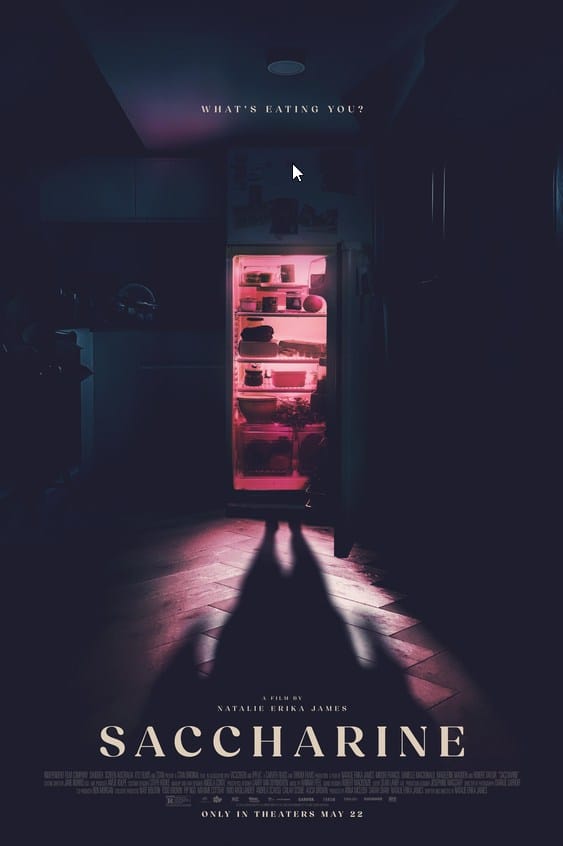
The TL;DR: Saccharine is a bit of a frustrating body-horror disappointment that squanders a phenomenal, highly relatable concept. Arriving right in the middle of a massive, female-led body-horror revival, director Natalie Erika James follows up her 2020 debut Relic by tackling weight gain, beauty standards, and binge-eating disorder. While it starts with an incredibly respectful, accurate portrayal of disordered eating and features a handful of effective early scares, the film completely falls apart in its second half. Clocking in at nearly two hours, the narrative drowns in heavy padding, clumsy dialogue, and tedious repetition. A jarring, forced final act that tries to mash up the emotional weight of Relic with campy, b-movie splatter comedy ultimately leaves the movie feeling rather unsatisfying.
Details: Director: Natalie Erika James | Cast: Midori Francis | Runtime: 113 Minutes | Release Date: 22nd May 2026 | Where to Watch: Shudder
Best For: Body-horror completionists who want to keep up with the genre’s current wave, and viewers who can overlook pacing issues and repetition for a unique, socially conscious premise.
Worth Noting: For those who suffer from misophonia, the first half of the film features highly intense, close-up eating sequences with amplified audio designed to highlight the raw, uncontrollable nature of the protagonist’s disorder.
Did You Know: For some reason, lead actress Midori Francis delivers her entire performance with a full American accent despite the film’s Australian roots. I have no clue why this wasn’t at least explained away somewhere.
Is It Scary: It features a few highly effective early supernatural encounters that carry a distinct Talk to Me flavor. Unfortunately, the central entity is used as a heavy-handed metaphor for addiction, and its scares lose all tension due to constant, repetitive reuse throughout the second half.
Rating: 2.5/5 Stars
(A promising, socially conscious body-horror concept that completely runs out of narrative steam, devolving into a repetitive, overlong, and structurally confused mess.)
Welcome to Knockout Horror and to our review of the Aussie body-horror movie Saccharine (2026). You can find this film on Shudder right now.
Table of Contents
Body Horror Is In Bloom
Body horror feels like it has been around forever. While the genre didn’t properly coalesce until the 1970s, specifically the beginning of David Cronenberg’s reign of terror, its origins could, perhaps, be traced all the way back to the surrealist, experimental movies of the late 1920s.
“If Shivers was one of the most important films in body-horror’s advent, then The Substance is equally important in the genre’s recent re-birth.”
I always look at the surgical procedures depicted in Luis Buñuel’s Un chien andalou as a pivotal moment in the movement’s birth. Filmmakers recognised that capturing the corruption of the human body in intimate detail could shock even the toughest of Avant-garde audiences.
If you want to go back to the first movie to define the genre’s rules, Cronenberg’s Shivers absolutely needs to be mentioned. Ever since then, body-horror has always been there. Sure, it’s had its ups and downs but there was always a fairly steady stream of new movies all aiming to shock viewers through gruesome depictions of bodily violation.
If Shivers was one of the most important films in body-horror’s advent, then The Substance is equally important in the genre’s recent re-birth. Again, it never went anywhere but it could be argued that, thanks to the aforementioned film, we are in the midst of a body-horror popularity wave the likes of which we haven’t ever seen.
A new perspective
The fantastic thing about this new wave of body-horror popularity is the fact that it is being led by female filmmakers. It’s incredibly exciting because this new perspective has shifted the genre from gross-out corruption of the flesh to matters of real significance.


Directors like Coralie Fargeat, Carlo Mirabella-Davis, Julia Ducournau, and Emilie Blichfeldt are turning the focus away from male anxiety and directly at matters of aging, societal expectation, beauty standards, and bodily ownership.
A name that sometimes doesn’t get included in that list of pioneering female body-horror directors is the person who is responsible for the movie we are looking at today – Natalie Erika James.
James brought us Relic back in 2020, a movie which intimately explored the impact of age related disease on both the body and the mind.
With Saccharine, she is exploring something that is equally as impactful to people, perhaps even more so – weight gain and the societal expectations that come along with being a woman.
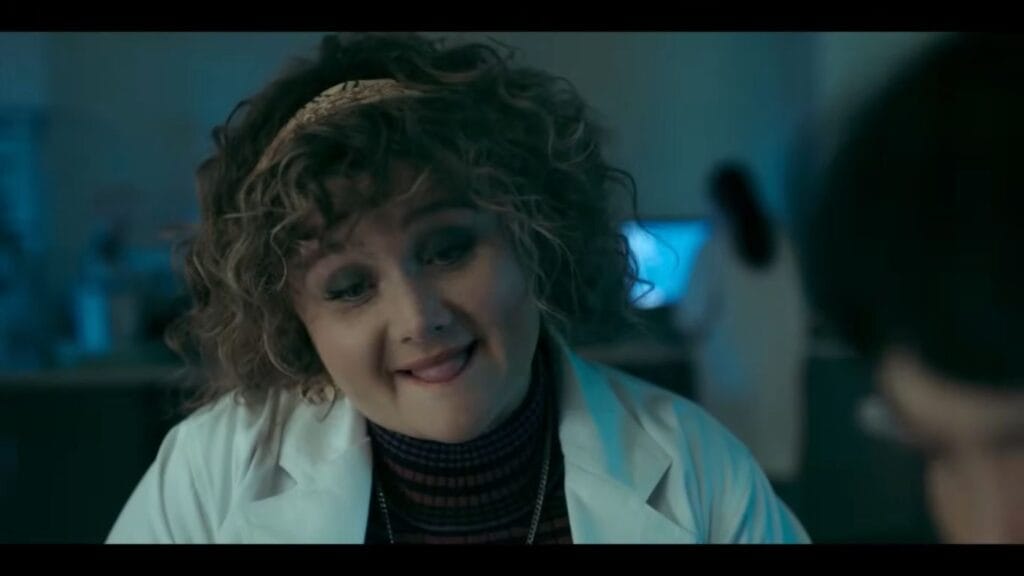
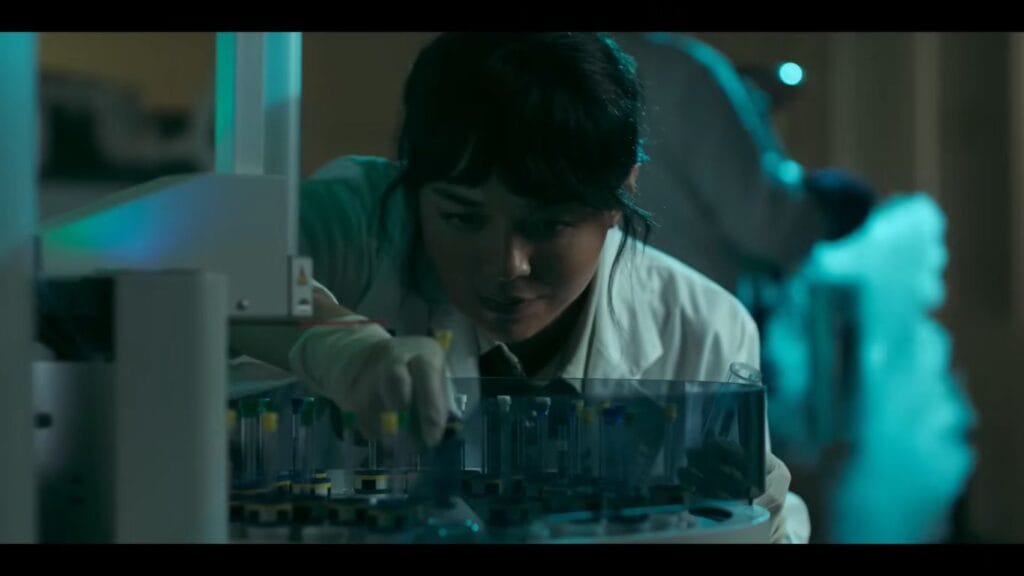
The story follows med student Hanna (Midori Francis) as she attempts to overcome a binge-eating disorder by taking part in a new diet fad – tablets filled with human ashes. Although everything seems great at first, she quickly begins to question her decision as a sinister presence begins to haunt her.
It’s a great concept
Unfortunately, all of the above seems like a grand introduction to a movie that is going to clearly establish its place alongside the recent greats of the body-horror genre like The Substance, The Ugly Stepsister, Raw, and Titane. The truth is, Saccharine is a bit of a disappointment. It’s a shame because the concept is great.
New ideas are hard to come by in horror but Saccharine’s focus on weight and diet fads feels pretty fresh. Weight gain is a problem a large percentage of the population experience and it is bound to be relatable for many. The very specific way James has chosen to portray Hanna’s condition also feels quite unique.
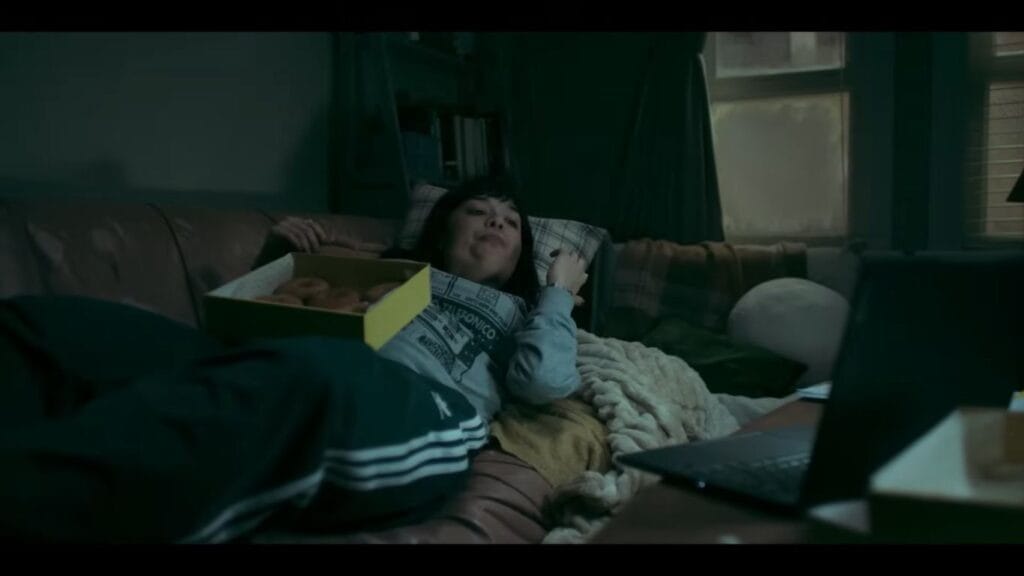
She’s not just a constant eater, she is suffering from binge-eating disorder. She wants to lose weight and she engages with eating plans and rigorous exercise. It all comes undone, however, when she is unable to fight off the enormous compulsion to eat vast quantities of food.
This is a very real thing for many people and the way Hanna is depicted as being so utterly dominated by these impulses feels respectful and accurate. When an easy out is offered to her in the form of a diet pill, she jumps on it, little realising the consequences.
It starts off promising
There’s lots of promise here. James’s direction is strong early on and she has a keen eye for an engaging shot. This is a gorgeous film and it feels higher budget than it likely is. The cracks only really show when it comes to some of the fat suits. One in particular looks terrible.
“Around the halfway mark, however, it all starts to go downhill. I can’t put my finger on when I stopped enjoying it but I can sure as hell put my finger on why.”
The body-horror is restrained but works well. Some of the eating scenes are going to be a nightmare for misophonia sufferers (myself included) but they serve to highlight the disparity between Hanna’s normal resolve and the avarice that comes when her disorder takes over.
She’s in pure heaven when she eats but utterly ashamed afterwards and James affords the viewer a great opportunity to share in that feeling. I really enjoyed Midori Francis in the movie Unseen and she does a fantastic job here for at least half of Saccharine’s runtime.
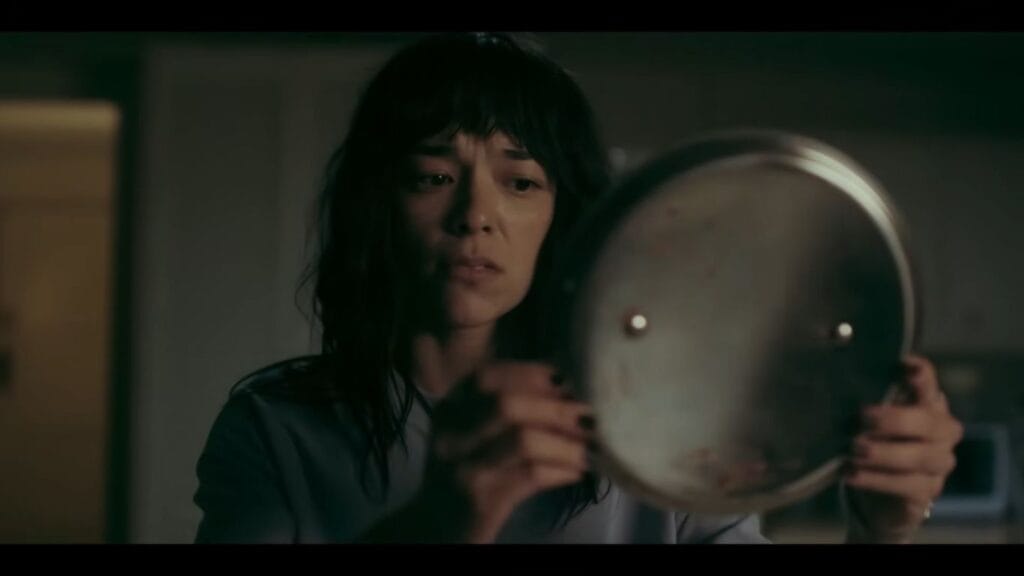
Hanna is an atypical horror protagonist and quite likeable; she feels quite refreshing in a lot of ways. James actually manages some decent scares, too. Some of Hanna’s first encounters with the entity that is haunting her are pretty effective, though I did feel they were very reminiscent of fellow Australian horror movie Talk to Me.
Around the halfway mark, however, it all starts to go downhill. I can’t put my finger on when I stopped enjoying it but I can sure as hell put my finger on why. Saccharine suddenly slips into a pattern of heavy repetition with diminished returns and that’s when the movie’s problems start to become more apparent.
Until it gets very repetitive
This is a very long movie clocking in at nearly two hours and, looking back on it, the entire first half needs to be cut down significantly. There’s far too much establishing of Hanna’s eating disorder and far too little story progression. By the time things actually start heating up, it becomes clear that James is struggling for ideas.
The entity here is used as a visual representation of the compulsion to binge but it feels extremely heavy handed; even more so than the heavy handedness of Relic’s metaphors. The film settles into a pattern of Hanna realising the entity is there with her and looking shocked as if it is the first time it has happened.
“Certain elements aren’t explained; the viewers is left to fill in blanks, and random plot points seem to evaporate into the ether.”
It repeats over and over; this repetition gets old and it gets old fast. In fact, this sequence is repeated throughout the second half of the film with no meaningful evolution beyond Hanna working out the reason why it is happening. It feels enormously padded and the horror sequences lose their weight quicker than Hanna does when she starts popping those pills.
Lots of issues that really add up
When you start to notice this repetition, the movie’s other little issues start to become a lot more apparent. The writing is, at times, shocking with some of the dialogue coming across as enormously clumsy. That clumsiness also occasionally extends to the plot and the handling of eating disorders.
Closeup shots of Hanna eating are massively overused to inspire a sense of disgust. There’s also a single shot focusing on Hanna’s eyes as the entity takes over that is whipped out with reckless abandon. Again, these are more examples of James dialing back her very obvious directorial talent to, instead, please a crowd expecting horror.
Midori Francis struggles a tiny bit as the movie goes on but it’s not really her fault. She speaks with a full blown American accent that’s never explained away which just seems lazy, to be honest. The repetitive nature of the script and narrative demands her to basically react the exact same way over and over again which undermines what is, otherwise, a fantastic performance.
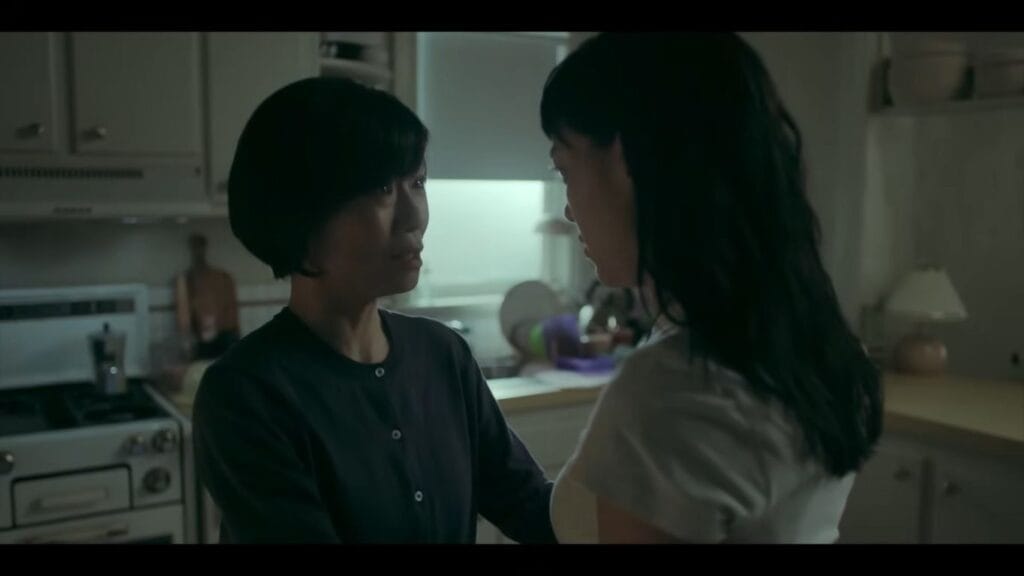
The narrative sinks into farce during the last third of the film. Certain elements aren’t explained; the viewers is left to fill in blanks, and random plot points seem to evaporate into the ether. The focus is switched squarely to making the viewer chuckle and subverting their expectation about what is to come in the final twenty minutes.
Those final minutes are a trip, too. It’s almost as if James is trying to blend some of that powerful storytelling from Relic’s finale with some utterly ludicrous, Ketamine-powered, Coralie Fargeat-esque, b-movie ridiculousness but it really doesn’t work. Saccharine’s bizarre, late in the day twist towards the camp and comedic feels forced and out of place. That ending is going to split viewers, too.
It’s a shame because, trimmed down immensely and tightened up, this could have been a fantastic film. As it stands, it just feels a bit messy and unsatisfying. There’s so much promise but, for me, it never really comes together.
The Good
- Fresh, Empathetic Premise: Explores diet culture and binge-eating disorder with a unique horror framing that treats the protagonist’s struggles with respect and accuracy.
- Strong Early Direction: Natalie Erika James exhibits her clear directorial talent early on, crafting engaging shots and a highly sympathetic horror protagonist.
- Effective Early Scares: Features a handful of genuinely creepy, atmospheric supernatural encounters during the first half of the film.
The Bad
- Severe, Bloated Repetition: Stretches a thin story across nearly two hours, trapping the second half in a tedious loop of identical supernatural occurrences with diminishing returns.
- Clumsy Writing & Dialogue: Features shocking drops in script quality, with awkward dialogue and an incredibly heavy-handed approach to its metaphors.
- Wasted Lead Performance: Midori Francis is fantastic but the poor script and repetitive narrative undermine her performance after awhile.
- Jarring Third-Act Pivot: Sinks into total farce during the finale by trying to force a campy, b-movie comedic tone that completely clashes with the serious subject matter.
The Ugly: The total collapse of its own identity. By trying to combine the very personal, tragic storytelling of Relic with the over-the-top, campy ridiculousness of The Substance, the film completely loses its footing and delivers a weirdly divided, messy ending.
Should You Watch Saccharine?
It is hard to recommend this one whole-heartedly. Saccharine is an incredibly promising addition to the modern female-led body-horror movement that sadly gets bogged down by structural laziness. While its focus on the psychological torment of weight gain and diet fads feels incredibly fresh, the film simply doesn’t have the narrative depth to sustain its near two-hour runtime. Had it been trimmed down into a tight, focused thriller, it could have been fantastic. As it stands, it is a bloated, repetitive, and tonally confused film that will likely leave you feeling detached and unsatisfied.
You might also like:
- Coraline (2009) Review – A Stunning and Sinister Stop-Motion Masterpiece
- Scrooged (1988) Review – A Darkly Comedic and Cynical Festive Favourite
- Somnium (2025) review – A Lynchian sci-fi with an identity crisis
- The Retreat (2021) Review – A Tense and Vital LGBTQ+ Slasher
- The Strangers (2008) review – A chilling masterclass in home invasion horror
Our Scoring Philosophy: A Fair Fight
Horror is a genre that thrives thanks to indie film makers and low budget creators. At Knockout Horror, we firmly believe that every movie that we review deserves a fair fight. That's why we grade on a curve. Our star ratings are all about context, judging a film on what it achieves with the resources it has.
A 4-star rating for a scrappy indie horror made for $10,000 is a testament to its ingenuity and raw power. A 4-star rating for a $100 million blockbuster means it delivered on its epic promises. We don't compare them side-by-side; we celebrate success in every weight class, from the back-alley brawler to the heavyweight champion. Please keep this in mind when considering star ratings.