Saint Maud (2019) Ending Explained – The Reality of Maud’s Vision
Movie Details: Director: Rose Glass | Runtime: 1h 24m | Release Date: 2019 | Star Rating: 4.5/5 Stars
Welcome to Knockout Horror. Today we will be explaining the ending to the bleak and depressing British psychological horror Saint Maud. Saint Maud has a somewhat confusing ending. To be honest the entire movie is a little perplexing. There is an air of ambiguity rolling throughout the entire narrative and the ending only serves to further bolster that. Let’s take a close look and explain it all. If you haven’t watched Saint Maud yet then why not have a look at our spoiler free review?
⚠️ Warning: Major spoilers follow below.
The Ending in Brief
The TL;DR: Maud is suffering from a severe psychotic break triggered by religious delusions and past medical trauma. She believes she is a divine servant tasked with saving Amanda’s soul. When her reality is challenged Maud murders Amanda while perceiving her as a demon. In the final scene Maud sets herself on fire on a beach believing she is ascending to heaven as an angel. The final split second shot reveals the horrific reality of her screaming in agony as she burns to death.
Was God real in the movie? No. The film portrays the world entirely through Maud’s fractured perspective. The “voice of God” she hears is actually her own voice recorded and slowed down. The supernatural events like the vortex in the clouds or Amanda turning into a demon are visual manifestations of Maud’s untreated mental illness.
Why did she kill Amanda? Maud believed her mission was to save Amanda. When Amanda admitted she had faked her religious experience Maud’s psyche could not handle the rejection. She dehumanised Amanda by seeing her as a demon which allowed Maud to justify the murder as a holy act.
The Resolution: The film ends with a brutal jump cut to reality. After a few seconds of beautiful golden light and Maud floating with wings the camera cuts to a grainy one second shot of her burning and screaming on the sand. She did not ascend; she committed suicide during a psychotic break.
Good to Know: The film’s director Rose Glass intended for the final frame to act as a “punctuation mark” that completely reframes the entire story as a psychological tragedy rather than a supernatural thriller.
Table of Contents
Saint Maud Ending Explained
No plot recap here, as always. Let’s jump straight into explaining this ending. Saint Maud follows Maud (Morfydd Clark) who was formerly known as Katy. She is an ex nurse who now works in personal palliative care for a world famous dancer called Amanda (Jennifer Ehle). Amanda is terminally ill and Maud becomes obsessed with the idea that she has been chosen by God to save Amanda’s soul.
Horror Context: The Fading Seaside Setting
The choice of Scarborough as the setting for Saint Maud is no accident. The town serves as a visual metaphor for Maud’s own state of mind. Like many British seaside resorts it carries the ghost of a grander and more vibrant past while currently appearing grey, dilapidated and somewhat abandoned.
Maud lives in a cramped and damp bedsit that overlooks the amusement arcades and the cold North Sea. The contrast between the neon lights of the seafront and the crushing loneliness of her room highlights her disconnect from the modern world. The town is stuck between its identity as a place of joy and its reality as a place of struggle, mirroring how Maud is stuck between her identity as “Katy” and her new persona as a saint.
The final scene on the beach brings this to a climax. The wide and indifferent horizon of the sea emphasises how small and unnoticed her tragedy really is. In a town full of people looking for a temporary escape Maud finds a permanent and horrific one, burning out in a place that has already seen its best days pass by.
The Root of the Delusion
Maud’s past is key to her delusions, here. Glimpses of flashbacks show a serious incident at her former hospital involving a failed CPR attempt. This trauma appears to have triggered a latent mental health condition.
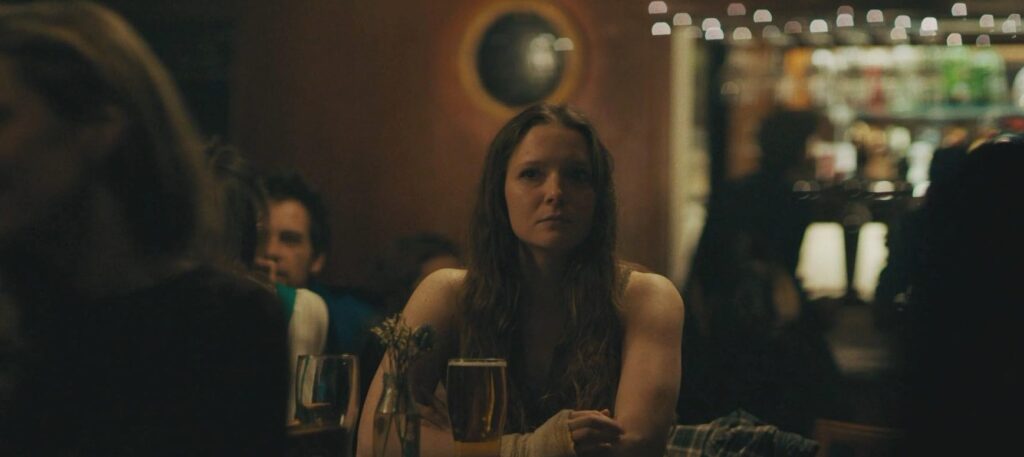
Maud retreated from her former life of “sin” (drinking and promiscuity) and sought refuge in a literal and extreme interpretation of Roman Catholicism. This is a common coping mechanism for those suffering from religious delusions as it provides a rigid structure for a collapsing mind. The problem here is that Maud takes everything just a little to literally, but for good reason. She is not a well person.
Thematic Spotlight: Religious Delusions in Psychosis
The use of religious themes in Saint Maud is grounded in a real clinical phenomenon known as religious preoccupation. For those suffering from schizophrenia or psychotic disorders, religious iconography often provides a framework for their delusions. Because religion deals with the struggle between good and evil, it offers a convenient narrative for a mind attempting to make sense of internal chaos.
Maud is a perfect example of this. She seeks out the extreme elements of Roman Catholicism because the rigid rules and the promise of divine purpose provide her with a sense of control. Her hallucinations are filtered through this lens. She does not just hear voices; she hears God. She does not just feel pain; she feels the ecstasy of a saint.
This makes the horror particularly tragic. Maud believes she is a hero in a grand cosmic battle while everyone around her simply sees a quiet and slightly strange girl. The film shows how religion can be used to mask a total psychological collapse until it is far too late to intervene.
The Divine Connection
Maud experiences what she believes are physical visitations from God. These are portrayed as almost orgasmic or ecstatic moments. In reality these are sensory hallucinations. She is suffering from a severe case of schizophrenia that is currently manifesting in the form of religious delusion.

She begins self harming as a form of self flagellation to remain “pure” for her mission but the delusions only get worse. When she encounters Amanda’s atheist lifestyle she views it as a battleground for a soul rather than a simple difference of opinion.
Maud’s interference in Amanda’s life – ruining her relationship with her carer, commenting on her relationship with the man she spends time with – eventually ends up in Amanda firing her from her role. Not before embarrassing her at a party, though.
Horror Context: Relapse and the Search for Contact
The scene where Maud drinks heavily and has sex with a man from a pub is a pivotal moment of psychological regression. After being fired by Amanda and losing her “divine mission” Maud’s identity as a pious saint collapses. In her despair she returns to the destructive patterns of her life as Katy which was defined by the very vices she spent the whole film trying to suppress.
This isn’t an act of pleasure but an act of desperation. Having been rejected by God and by her employer, she seeks out the most basic and degrading form of human connection she knows. It is a form of self punishment. By engaging in what she considers “sinful” behaviour she is leaning into her own self loathing and confirming her belief that she is unworthy without a holy purpose.
The trauma of the hospital incident haunts her throughout the encounter. The flashback to the failed CPR attempt during sex shows that her past is not just behind her but is actively intruding on her present. This “relapse” into her old life proves to her that she cannot exist as Katy anymore. It is this final failure that pushes her back toward her delusions with a lethal and final intensity.
The Murder of the “Demon”
After being fired and failing to find comfort in her old life Maud breaks into Amanda’s house. She desperately needs Amanda to validate her faith. When Amanda admits she faked the religious feelings the pair shared together, Maud’s reality shatters.

To protect her delusion Maud perceives Amanda as a literal demon with black eyes and monstrous features. She kills her believing she is vanquishing evil. This is a tragic portrayal of how paranoid schizophrenia can lead to violence when the sufferer believes they are acting on divine orders.
Thematic Spotlight: Ecstasy and Trauma
The film depicts Maud experiencing intense and almost orgasmic physical reactions to what she perceives as God’s touch. In clinical terms, these are known as somatic hallucinations. For Maud these sensations act as a powerful counterpoint to the deep shame and trauma she carries from her past as a nurse. Where the hospital incident left her feeling powerless and “dirty” these divine tremors provide her with a feeling of being chosen and purified.
There is a clear link between her suppressed sexuality and her religious fervour. Having abandoned her “promiscuous” lifestyle, Maud has redirected all of her physical needs into her worship. The pleasure she feels is not just spiritual, but a confused biological response to her extreme isolation and sensory deprivation.
By presenting these moments with such visceral intensity, the film forces the audience to experience Maud’s delusion from the inside. We see how addictive these sensations are for her. They provide the “proof” she needs to ignore logic and continue down a path that eventually leads to her destruction on the beach. Due to her schizophrenia, she never, for one second, realises that these experiences are anything other than real. That’s the strength of the hallucinations and delusions.
Does Maud Die at the End? The Final Ascension
Maud does die at the end of Saint Maud in a sad depiction of schizophrenic delusion.
The next day Maud walks to the beach. She believes she has completed her mission and that God is calling her home. She douses herself in acetone and strikes a match. As she burns she sees the onlookers kneeling in worship and feels wings sprouting from her back. She sees the sky opening up in golden light.

Then the film delivers its most famous, and horribly harrowing, shot. For a fraction of a second the “filter” of Maud’s perspective is stripped away. We see a low quality handheld style shot of a girl on fire screaming in absolute agony on the beach. There are no angels and no god; just a very sick young woman who has been failed by the system and her own mind.
Thematic Spotlight: The Silence of God
The film is a masterclass in subjective filmmaking. Because we spend so much time in Maud’s head we almost want to believe her. However the director provides subtle clues throughout that God is not there. The voice of God is Welsh because Maud is Welsh. I’m Welsh so I recognised it instantly but many viewers don’t. The “signs” are mundane things like a swirl in a cup of soup or a cloud formation.
The horror of Saint Maud is not supernatural. It is the horror of isolation. Maud is so lonely and so broken that her mind invents a relationship with the creator of the universe just to feel seen. The “Silence of God” is the ultimate tragedy of the film because Maud interprets that silence as a call to commit horrific acts.
Frequently Asked Questions
What was the incident in Maud’s past?
Maud was formerly known as Katy and worked as a nurse. She was involved in a medical accident where a patient died while she was performing CPR. This trauma appears to have triggered her latent mental illness and led to her rebranding herself as the pious Maud.
Why does God speak Welsh in Saint Maud?
Morfydd Clark is a Welsh speaker and the voice used for God is actually her own voice recorded and slowed down. Because the voice is an internal auditory hallucination it speaks her native tongue and is a manifestation of her own subconscious thoughts.
Is Amanda actually a demon at the end?
No. Amanda is a terminally ill woman who is bitter and afraid. To protect her own crumbling reality, Maud perceives Amanda as a literal demon with monstrous features. After the murder, the camera briefly shows Amanda’s normal human corpse lying on the bedroom floor.
What is the meaning of the nails in Maud’s shoes?
Maud puts nails in her shoes as a form of mortification of the flesh. This is a religious practice where a person inflicts pain on themselves to atone for sins or to feel closer to the suffering of Christ. It illustrates the severity of her mental decline and her desperate need for divine approval.
Final Thoughts
Saint Maud is a devastating look at how mental illness can be masked by religious zealotry. Rose Glass does a fantastic job of keeping the audience in a state of unease until that final second which hits like a physical punch to the gut. It is one of the best British horror films of recent years and a haunting exploration of the human mind’s capacity for self deception. I loved it but didn’t exactly enjoy it.
Thank you very much for reading. Why not stick around? Check out some more Ending Explained articles. I also review horror movies and I also write horror lists.
A Note on Ending Explanations
While we aim to provide comprehensive explanations based on the events on screen, film analysis is inherently subjective. The theories and conclusions presented in this "Ending Explained" feature are personal interpretations of the material and may differ from the director's original intent or your own understanding. That's the beauty of horror, right? Sometimes the scariest version is the one you build in your own head.
You might also like:
- Hold Your Breath (2012) Review – A Pointless And Bottom-Of-The-Barrel Asylum Mess
- Misery (1990) Review – A Masterclass in Psychological Dread and Obsession
- Snowbound Scares – 10 Chilling Winter Horror Movies
- The Hand That Rocks The Cradle (2025) review: A pointless, tension-free remake
- The Ugly Stepsister (2025) review – Cinderella meets Cronenberg
Support the Site Knockout Horror is a participant in the Amazon Services LLC Associates Program. Basically, if you click a link to rent or buy a movie, we may earn a tiny commission at no extra cost to you. As an Amazon Associate, I earn from qualifying purchases. This helps keep the lights on and the nightmares coming. Don't worry, we will never recommend a movie purely to generate clicks. If it's bad, we will tell you.
Disclaimer: Images, posters, and video stills used in this horror ending explained article are the property of their respective copyright holders. They are included here for the purposes of commentary, criticism, and review under fair use. Knockout Horror makes no claim of ownership and encourages readers to support the official release of all films discussed.