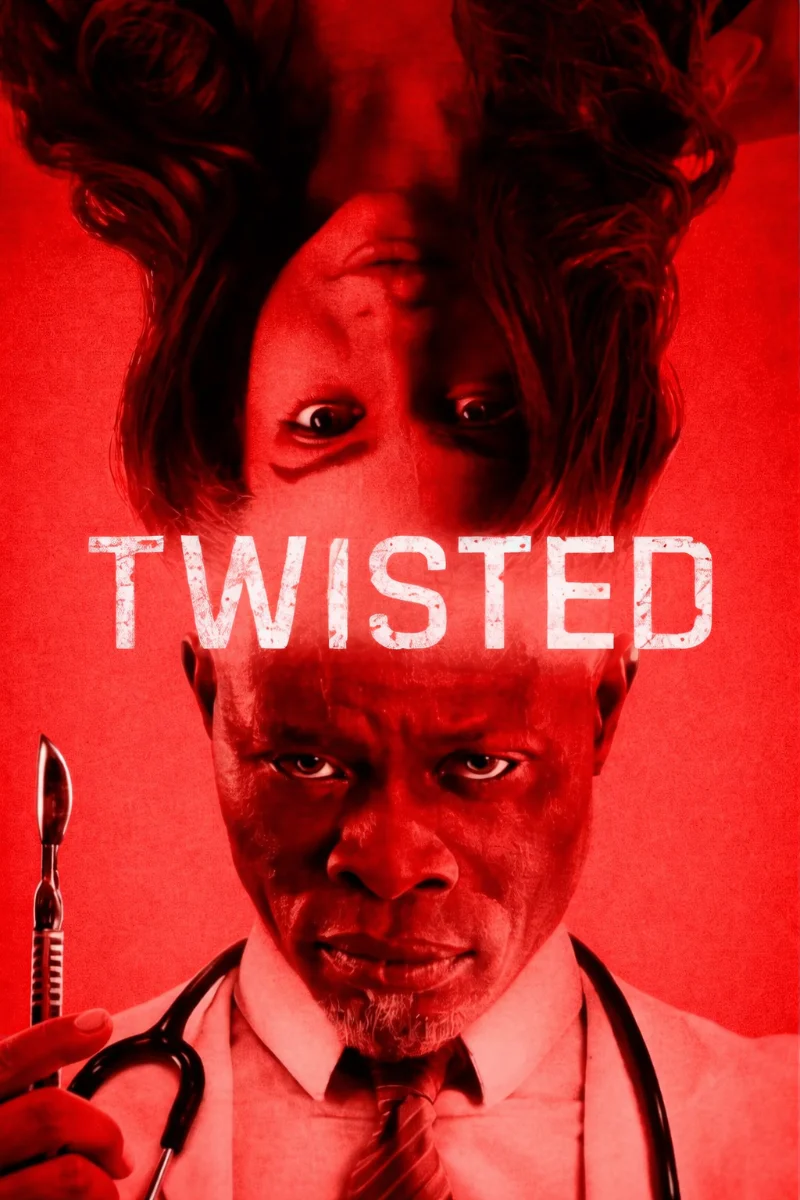
Twisted (2026) Ending Explained – Body Snatching & Brain Grafts
Movie Details: Director: Darren Lynn Bousman | Runtime: 1h 33m | Release Date: February 6th 2026 | Rating: 2/5 Stars
Welcome to Knockout Horror and to this Twisted (2026) Ending Explained article. I won’t beat around the bush, here – this movie was disappointing; you can check out our review of Twisted right here. Darren Lynn Bousman seems to be on a spiral (pun intended) of low quality films, as of late.
It’s also a bit confusing, too. That’s where Knockout Horror comes in. This is one of those films that tries to pull the rug out from under you. It starts off feeling like a high-stakes thriller movie but ends up as a bit of a Frankensteinian bloodbath. Let’s get into that miserable, mind-bending ending.
⚠️ Warning: Major spoilers follow below.
The Ending in Brief
The TL;DR: After discovering Paloma’s true identity, Dr. Robert Kezian uses her as an unwilling subject in his illegal “cranial anastomosis” trials. Driven by a god-complex and grief over his dying wife, Rebecca, Robert plans to perform a radical brain tissue transplant. Transplanting healthy tissue from Paloma’s brain into his wife’s to repair her brain-damage and give her new life. Smith is killed by Paloma in a case of mistaken identity during a botched rescue attempt. Robert uses her brain for a horrifying test run on another mark, Tad. In the final act, an attempted raid by the police goes wrong when it turns out Robert was actually keeping Paloma at a different property. Robert completes the surgery on Rebecca using Paloma’s brain tissue. While Rebecca physically survives, the final moments reveal that Paloma’s consciousness has completely taken over Rebecca’s body, leaving the real Rebecca effectively dead and Paloma trapped in a new life. Paloma kills Robert by cutting his throat.
Who Survived? Robert Kezian is killed in the final scene, only moments after fully believing his experiment was a triumph. Paloma’s mind survives, but her original body is gone. Smith, Dr. Bradshaw, the man from the bar, Tad, Lenny, and Rebecca’s original consciousness are all definitively dead.
Why Did Robert Snap? Profound grief mixed with unchecked arrogance. As a world-renowned neurosurgeon, Robert couldn’t accept that his brilliant wife’s mind was deteriorating from a disease he couldn’t cure. He viewed human lives, like the con artists and Tad, as expendable raw materials to “advance the world” and cure his wife.
What Was the Final Jewelry Scene? The final scene showing “Rebecca” looking at the jewelry inscribed with “S and J 4EVA” (Smith and Joia, which is Paloma’s surname, Forever) is the confirmation that Paloma is still alive. Coupled with her using Paloma’s voice to thank Robert, it confirms the transference wasn’t a cure for Rebecca, but a complete consciousness hijacking by Paloma.
Good to Know: The con artists in the film exclusively use famous literary characters as their aliases to secure properties. Keep an ear out for names like Emma Woodhouse from Jane Austen’s Emma, Daisy Buchanan from The Great Gatsby, Fleur Forsyte from The Forsyte Saga, and Molly Bloom from James Joyce’s Ulysses. The detectives actually use this exact pattern, narrowing their search to names found in Penguin Classics books, to track Paloma down
Table of Contents
Twisted (2026) Ending Explained
As always, no tedious plot recap here; if you watched the film, the last thing you want to do is read the entire plot all over again. I won’t put you through that misery. Let’s unpick this grim AF ending and answer some of the burning questions about what exactly went wrong in Dr. Kezian’s secret clinic.
The finale of Twisted attempts to subvert the traditional cat-and-mouse thriller trope. Usually, the con artists are the ones pulling the strings and always one step ahead of the mark. Here, the mark is actually the real antagonist – Dr. Kezian is a predator of a completely different calibre. Robert goes from being the tragic, grieving widower to an unhinged butcher, but the signs of his megalomania were actually there from the start. Did you spot them?
The Illusion of the Noble Doctor
Robert’s entire existence is built on the seriously fragile foundation of being a medical pioneer. Over the years, he has made a name for himself saving dozens of patients who were close to death. He now presents himself as a vulnerable, grieving widower who is far more concerned for his wife’s fate than that of his own fortune. This makes him look like the perfect target for a pair of morally dubious con artist twats.
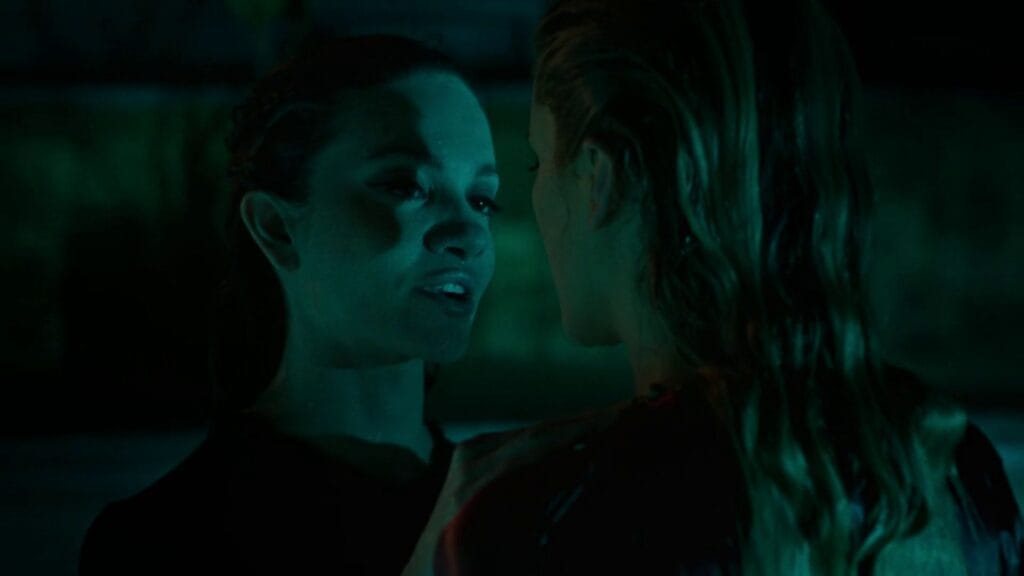
When his wife’s brain begins to degenerate, he uses his VacayNStay rental as a literal hunting ground. He uses the fact that Paloma and Tad are individuals of dubious reputation to justify his use of them in his experiments. They are bad people, therefore he doesn’t need to feel bad about playing around with their brain matter.
He is well aware that they are people society might not miss or, in Paloma’s case, criminals who can’t easily go to the police because what they are doing is wrong, too. He justifies his atrocities by claiming he is “advancing the world”, which is a classic horror movie rationalisation for a monster. Hell, it even dates back to Mary Shelley’s Frankenstein which this movie draws tons of inspiration from.
Unpicking The Logic: “You Can’t Con An Honest John”
In the grifter world, there is an old golden rule: you can’t cheat an honest person. A classic con almost always relies on the mark’s own greed, vanity, or willingness to bend the law. If the victim thinks they are getting away with something illicit, like buying stolen goods, getting an insider tip, or taking advantage of a loophole, they are too distracted by their own perceived cleverness to see the trap closing around them. The mark is so busy thinking they are the one doing the conning that they walk right into the slaughterhouse.


Twisted takes this old adage and weaponises it in horror form. Paloma and Smith think they are the apex predators, using literary aliases to rent out Dr. Kezian’s luxurious brownstone. They believe they are conning a naive, grieving widower out of a massive deposit. But Robert is the furthest thing from an “honest John”.
He actively allows himself to be “conned” because it brings fresh, untraceable, morally compromised subjects directly into his secret clinic. It’s a cycle of horror predators thinking they are outsmarting each other, completely blinding them to the reality of who is actually winding up on the operating table. Shame the movie isn’t better because the concept is great!
Why Does Tad Attack Paloma?
Tad attacks Paloma because he is a sex pest who misinterprets her pleasant manner for attraction.
Tad misinterprets Paloma’s niceness as attraction and propositions her. When she rejects him, he becomes aggressive which eventually leads to a fight breaking out. Naturally, this is a very clumsy plot point as it’s used to setup the entire next hour of the movie but it’s pretty on trend for the writing in this film.
How Did Smith Know Paloma Was in Trouble? Why “I Love You” Was a Red Flag
Smith knew that Paloma was in trouble because she received a text message from Paloma saying “I love you, too”. Paloma was apparently very aloof and would never tell Smith she loved her, she would just reply “same” when Smith told her.
Throughout the film, we see that while Smith is completely devoted to Paloma, she keeps her emotional walls built sky-high. Whenever Smith tells her “I love you”, Paloma always replies with a simple, non-committal “same”. Now, obviously, this is a sore spot for the couple, but it ends up being one of the most important details in the entire movie.
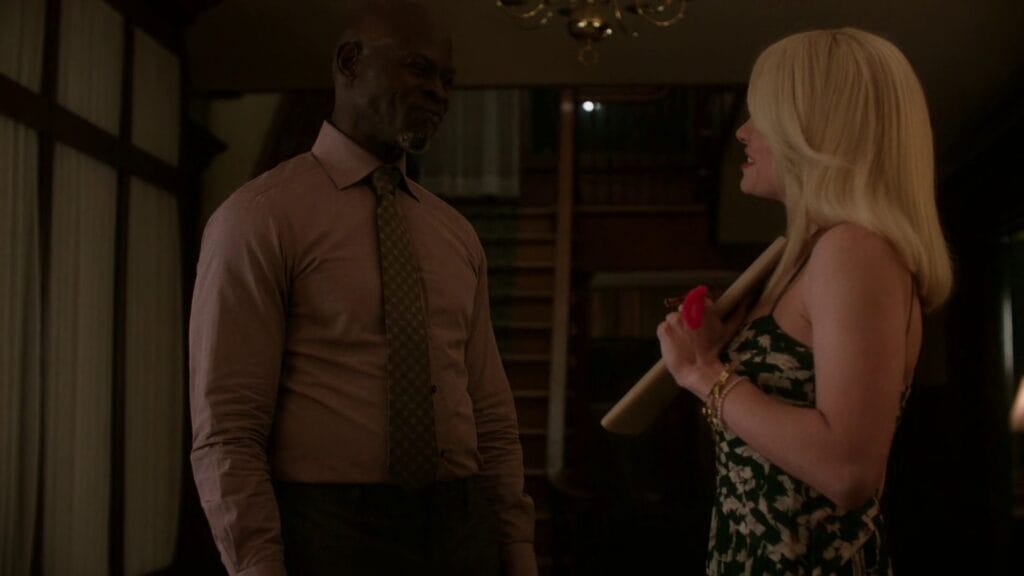
When Paloma goes dark after securing Dr. Kezian’s brownstone, Smith texts her that she loves her. Her phone immediately pings back: “I love you, too”. Naturally, to any normal person, that’s a sweet, reassuring message. To Smith, it is a neon red siren screaming something is seriously wrong because Paloma would never type those words.
Robert makes the oh so common horror movie mistake of not matching the manner of speech of the person he’s imitating which Smith clocks immediately and realises that something is wrong.
Thematic Spotlight: The Delusion of the “Greater Good”
One of the most interesting horror aspects of Twisted is how Dr. Robert Kezian weaponises medical ethics to justify his atrocities. He repeatedly hides his selfish, unprocessed grief behind the cold logic of utilitarianism, arguing that the ethical boundaries of biotech must be overcome “in order to serve the greater good”. To Robert, sacrificing a single life to potentially save millions from degenerative brain diseases isn’t murder; it’s a necessary medical breakthrough. By specifically targeting people he views as criminals, like Paloma, whom he writes off as “pure human trash” and a “con artist”, he convinces himself that no one will miss his victims anyway which, in his mind, justifies his actions.
However, the film quickly strips away this “noble” facade to reveal a standard horror garden variety god-complex. Robert is a narcissist who violently refuses to accept defeat. When his longtime colleague Dr. Bradshaw realises the horror of the human trials and calls him out for “playing God”. Robert’s response is classic, unadulterated megalomania: “Don’t be naive. I’m a surgeon! Every time I operate, God prays to me”. This shatters his “greater good” illusion because, let’s be honest, he isn’t trying to save the world. He is simply a man so terrified of losing his wife that he is willing to butcher anyone who stands in his way.
What Was Smith’s Plan?
Smith’s plan was to have the man she met at the bar enter Robert’s house and find Paloma. It was working until Robert attacked the man, killing him, so Smith was forced to change her plan and try to find Paloma herself.
Smith manipulated a man she met at the bar into entering Robert’s home under the guise of Robert being a wife beater. She told the man her friend Molly was being held against her will in there. The man agreed and burst into Robert’s home asking to see Molly.
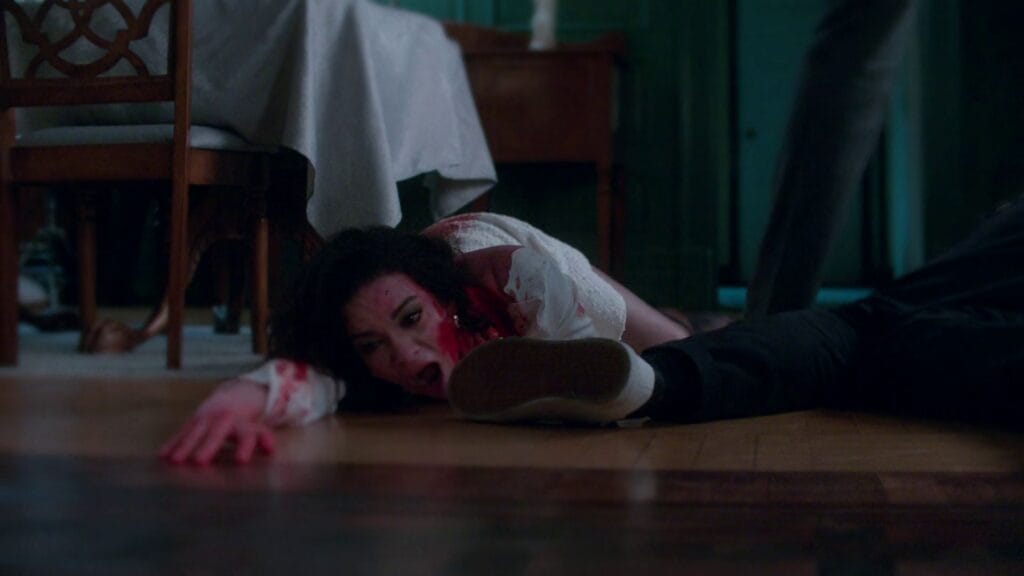
The man accused Robert of being a wife beater and smashed pictures of Robert’s actual wife, Rebecca. In retaliation, Robert sliced the man’s throat with a vinyl record. Smith was then forced to find a way into the property herself using the home’s floorplan as a guide.
What Happened to Smith?
Smith managed to find her way into the house, though the dog alerted Robert and Lenny to her presence. Paloma then repeatedly stabbed Smith in a case of mistaken identity.
Paloma was obviously waiting for Robert or Lenny to appear so that she could stab them and escape. She was never expecting Smith to be in the house so just wildly stabbed whoever appeared on the other side of the curtain which just so happened to be Smith. Apparently she can’t tell the difference between a small woman’s silhouette and that of two large men. Ah well!
🧠 Did You Know: The Ghost of Rebecca Kezian
In Twisted, the scenes where Dr. Robert Kezian speaks to his wife, Rebecca, following Smith’s death are actually hallucinations. While she appears to be pretty damn healthy, the film later reveals the real Rebecca is in a persistent vegetative state. Robert’s “conversations” with her are a manifestation of his unprocessed grief, serving as a psychological mechanism to justify the horrific crimes he commits in the name of saving her.
What Does Robert Do To Smith and Tad?
Robert conducts a personality transplant “test run” using Smith and Tad. Paloma asks Robert to save Smith after she stabs her but I doubt she could have imagined something as horrendous as how Robert “saves” her.
Tad, the aggressive mark who initially attacked Paloma, didn’t actually die. He is already a lobotomised shell of his former self by the time Paloma finds him. He is effectively dead behind the eyes, kept alive solely to be a petri dish for Robert’s cranial anastomosis.
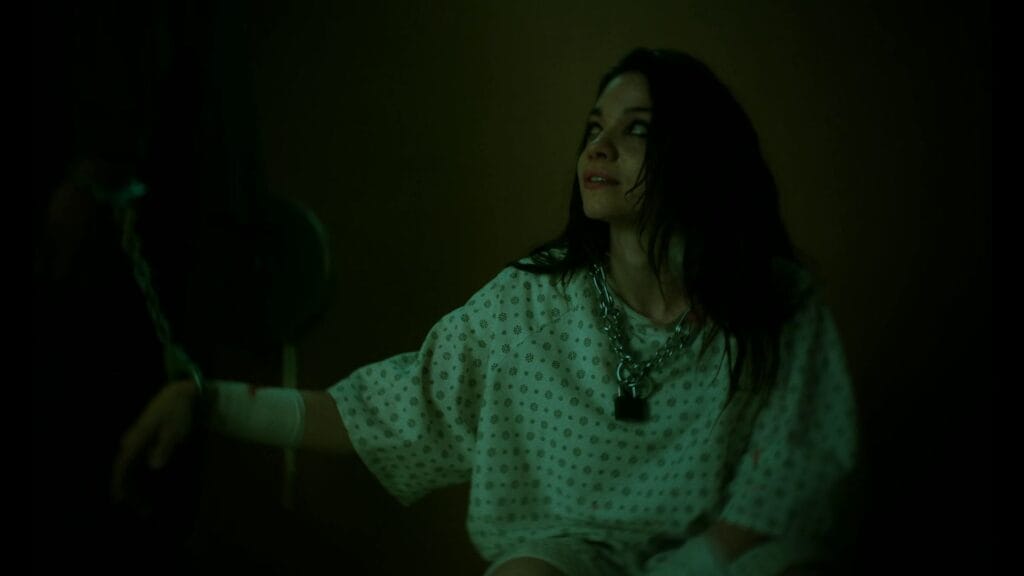
In an attempt to save her, Robert grafts Smith’s brain tissue into Tad. The resulting scene, where Tad briefly speaks with Smith’s memories, relating the whole “”Baltimore can suck my dick” line the pair used earlier in the film, is a confirmation that the procedure actually worked. Robert really was capable of transferring one person’s personality into another person’s body.
The one thing that Robert couldn’t predict is that the transfer wasn’t 100% effective. Tad was still in there and almost immediately reappeared, referring to all women as bitches before becoming violent and being dragged away by Robert. As Paloma vows revenge, Tad domes himself which, considering the whole exposed brain thing, finishes him off once and for all. This is a bit of foreshadowing for the ending, as well.
The Big Twist – The Second Home
Twisted’s big ‘twist’ is that detectives Warricker and Crace think they have the whole thing sussed out but they actually raided the incorrect address.
They raid the home that Paloma originally used as part of her scam after reports of gunshots in the area (the gunshots came from Robert killing his colleague Dr. Bradshaw). They were entirely expecting to find an elaborate scam involving hustlers (Paloma and Smith) because they have been tracking them for months. They also believed Robert to, somehow, be involved.
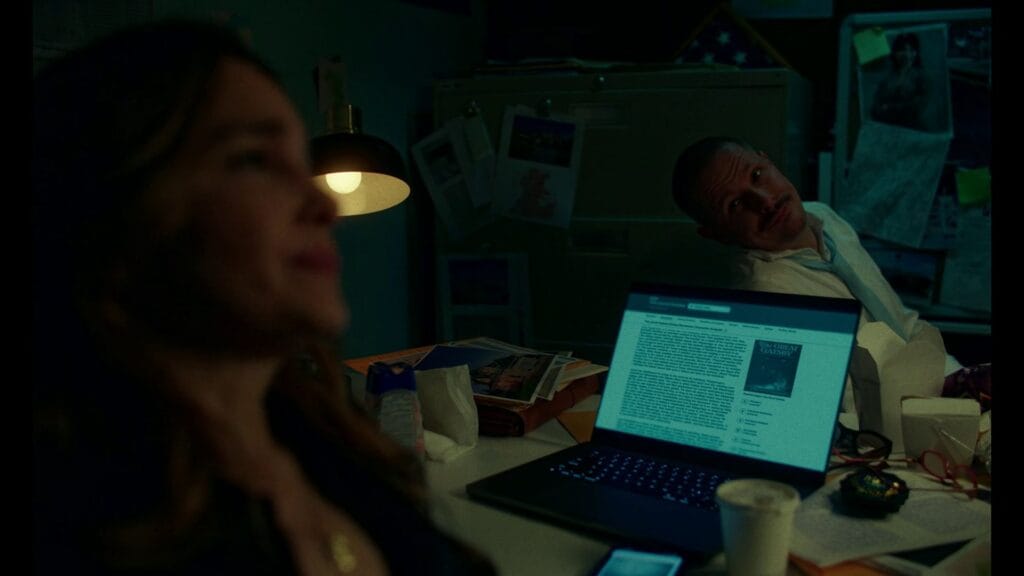
Instead, they find an abandoned house with no trace of Paloma. Robert’s laboratory was actually in his other property on the same street. He had been doctoring camera footage to show the house as empty while he was actually there which threw the detectives off his trail. Paloma was never trapped there, she was in a completely different location that police had no idea about.
Robert was able to continue the operation with no hindrance at all. The police never found him and Paloma was completely unable to fight back.
Horror Context: The Loss of Identity
If you look past the surgical setups, the core horror of Twisted is actually rooted in the fear of losing one’s identity. Degenerative brain diseases are terrifying because they slowly erase who a person is. Robert is terrified of this erasure happening to Rebecca.
However, in his hubris, he becomes the very thing he was trying to cure. By forcefully transplanting Paloma’s brain tissue, he violently and instantly erases whatever was left of his wife. I guess the message is that, sometimes, the desperate pursuit of a cure can destroy the very thing you are trying to save.
Paloma’s fate is equally grim, despite the way the ending frames it. She survives, but she is trapped in the body of a stranger, and the the love of her life is dead. It’s a beautifully bleak, monkey’s-paw ending where everyone loses, even the man who thinks he won.
What Happens at the End of Twisted? Did the Operation Succeed?
Robert’s surgery succeeds but not in the way he planned it to. He inadvertently transplanted Paloma’s entire personality into Rebecca, essentially replacing his wife entirely. Rebecca (who is now actually Paloma) cuts Robert’s throat, killing him.
He completes the surgery on Rebecca using Paloma’s tissue. At first glance, the weeks-later time jump makes it seem like Robert has won. Rebecca looks healed and rejuvenated, she just needs to work on the ol’ coordination because she has been a popsicle for the past few months. But the subtle shift in her mannerisms tells a different story.
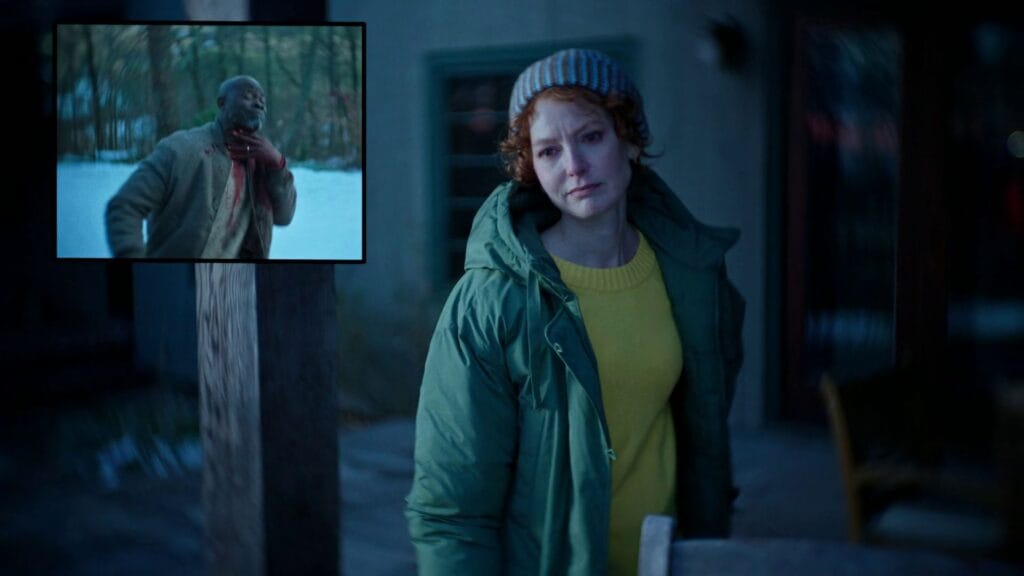
The “hugger” trait is the dead giveaway, quite literally. Rebecca puts her arms around Robert and claims that he knows she is a “hugger”. Startled, he realises exactly what is about to happen. He botched the transplant and Paloma is now in Rebecca’s body. She cuts his throat, killing him instantly.
Paloma, a masterful con artist, has been pulling the ultimate con: pretending to be Robert’s wife to survive and regain her strength. The final look at the “S and J 4EVA” ring confirms that Paloma is fully conscious inside Rebecca’s body. Robert has effectively traded his wife’s life, and his own life, to give a criminal mastermind a brand-new, probably quite wealthy existence.
Unpicking The Logic: Cranial Anastomosis Explained
Dr. Robert Kezian specialises in a highly experimental (and highly illegal) procedure he calls “cranial anastomosis” or “partial neurotransplantation”. The theoretical goal is to cure degenerative brain diseases by grafting matching, healthy brain tissue directly into the patient’s deteriorating brain. According to Robert, this healthy tissue possesses an amazing ability to literally “rewrite faulty genetic code” and reverse the damage.
However, because the brain contains the “essence of who we are”, the tissue cannot be harvested from a deceased organ donor; it must be taken from a living, breathing subject. This requires a perfect biological match, which he finds in Paloma, as she shares his wife’s O-positive blood type and lacks any genetic markers for disease.
During the surgery, Robert exposes the frontal and temporal lobes and uses a “light-activated bioadhesive” to fuse the stolen tissue with the recipient’s brain. The greatest risk of the operation is what he calls “transference”, the danger that the living donor’s consciousness will overpower the recipient’s mind. To prevent this, Robert attempts to prepare the donor’s limbic lobe by stimulating their visual cortex with sights and sounds familiar to the recipient, such as playing the classical Chopin piano music that his wife adored.
As the ending obviously reveals, this psychological safeguard completely fails, allowing Paloma’s consciousness to execute the ultimate survival con by taking over Rebecca’s body entirely.
Frequently Asked Questions
Is the character Lenny a reference to Of Mice and Men?
Yes, the character is a deliberate homage to Lennie Small from John Steinbeck’s classic novella Of Mice and Men. There are a surprising number of literary references in this film. Much like Steinbeck’s Lennie, he is physically imposing but lacks cognitive awareness – a state made infinitely worse by Robert’s horrific medical tampering. He essentially has no cognitive function outside of mindlessly obeying Robert who essentially saved his life but in the worst way possible, leaving him a walking husk.
What happened to Lenny?
Lenny took his own life so he didn’t have to live as one of Robert’s failed experiments. Paloma wanted him to escape with her but, instead, he chose to end his own suffering.
Did Paloma survive the ending?
Yes and no. Paloma’s physical body is dead, having been harvested by Robert. However, her consciousness survived the “transference” and completely took over Rebecca’s body. She is now living as Rebecca.
What does the “S and J 4EVA” jewelry mean?
The inscription stands for “Smith and Joia Forever.” Joia is Paloma’s real last name. The fact that “Rebecca” is looking fondly at this piece of jewelry is the final confirmation that it is Paloma’s mind occupying the body, mourning her murdered partner.
Why did Robert choose Paloma for the procedure?
Paloma wasn’t just a random victim; she was a perfect genetic match for Rebecca, even down to blood-type (O Positive). After obtaining her DNA during her time at the rental, Robert realised she was the biological key to successfully grafting healthy tissue into his wife’s deteriorating brain.
Is Rebecca really dead?
Yes. While her body is alive and functioning beautifully, her original consciousness has been entirely overwritten by Paloma’s stronger, healthier brain tissue. The woman Robert loved is gone.
Why did Robert kill Dr. Bradshaw?
Dr. Bradshaw realised the horrifying extent of Robert’s illegal trials and attempted to stop him during the move to the secondary location. Consumed by his god-complex, Robert viewed Bradshaw as an obstacle to his “greater good” and murdered him to protect the experiment.
Final Thoughts: A Bit of a Disappointment
Twisted is a little bit of a disappointment, really. The switch up from con based thriller into legitimate body-horror should work pretty well but it just feels too messy and convoluted. The movie is massively over stylised, as well, and it feels like Darren Lynn Bousman hasn’t changed at all since the early 2000s. Ah well.
Thanks for reading! Why not stick around? Check out some more Ending Explained articles. I also review horror movies and curate horror lists.
A Note on Ending Explanations
While we aim to provide comprehensive explanations based on the events on screen, film analysis is inherently subjective. The theories and conclusions presented in this "Ending Explained" feature are personal interpretations of the material and may differ from the director's original intent or your own understanding. That's the beauty of horror, right? Sometimes the scariest version is the one you build in your own head.
You might also like:
- Presence (2024) review – Soderbergh’s voyeuristic ghost story
- Final Destination: Bloodlines (2025) review – Death is back and better than ever
- Shut In (2022) Review – A Tense but Preachy Redemption Thriller
- Hellraiser (1987) Review – A Visceral and Transgressive Masterpiece of Flesh
- Pet Sematary (2019) Review – A Modern and Gory Twist on King’s Classic
Disclaimer: Images, posters, and video stills used in this horror ending explained article are the property of their respective copyright holders. They are included here for the purposes of commentary, criticism, and review under fair use. Knockout Horror makes no claim of ownership and encourages readers to support the official release of all films discussed.