Hive (2026) Ending Explained – The Hive Mind and the Missing Babysitters
Welcome to Knockout Horror. Today we are digging deep into the underground playground networks of Felipe Vargas’s Tubi Original horror feature, Hive (2026). We are going to break down exactly what the creature beneath Coral Grove is, explain how the neighborhood’s affluent families are connected to this parasitic operation, and unpack that sugar-fueled climax. As always, we will kick things off with our ND-friendly Ending in Brief for anyone looking for immediate answers before we head underground for the full subterranean breakdown.
If you want to check out my full, spoiler-free thoughts on the movie’s execution, be sure to head over to our official review of Hive (2026).
⚠️ Warning: Major spoilers follow below.
The Ending in Brief
The TL;DR: The, frankly, quite shitty situation plaguing Coral Grove is actually orchestrated by a subterranean parasitic entity that functions as something of a predatory hive mind. The entity uses local children as infected little sleeper agents to lure unsuspecting, hardworking babysitters into the neighborhood’s playgrounds and gardens where they can be dragged underground and consumed (or eaten, as Frances describes it). The affluent parents are entirely, yet unwittingly, complicit, acting as slightly larger sleeper agents themselves, feeding the entity other unsuspecting workers. It’s not just babysitters, though. Maids, gardeners, labourers, housekeepers, and basically anyone who is from the working class are ripe for the picking. Sasha, herself, is briefly taken in by the entity but is saved by Marco after he realises that sugar breaks the entity’s control over its subjects. In the climax, after her brother Marco’s leg is broken, Sasha utilises a high-sugar, syrup-based weed killer from the back of a pick-up truck. Climbing to the top of the playground structure, she dumps the entire vat down the slide tunnel, effectively melting the hive mind from the inside out and freeing its trapped victims. Hive acts as a metaphorical horror story about the exploitation of the working classes by the wealthy but we get into that more later on.
Who Survived? Thanks to Sasha’s quick thinking, most of the main group actually makes it out alive. Sasha, her injured brother Marco, and the veteran babysitter Frances all survive. They also rescue Mabel Grace, the original babysitter who was acting as the central host body for the entity. Unfortunately, Marco’s friend Darius is brutally impaled early on, and the elitist mother, Camille, is swallowed up by the hive mind during the final playground confrontation… I’m not sure anyone will really mourn her loss, though.
Why does sugar destroy the entity? There are two reasons here, one of which is a Knockout Horror metaphorical theory. For the literal explanation, the entity’s biological composition reacts aggressively to concentrated doses of pure sugar and syrup. While a simple bag of sweets (or candy for my Stateside readers) is enough to temporarily weaken its grip and free a trapped victim, dumping an entire commercial vat of high-fructose, syrup-based weed killer straight into the central nexus causes the hive mind’s physical structure to completely disintegrate. The next explanation revolves around the note left in the bag of sweets by Sasha’s dad “A bit of sugar to ground you”. The note suggests that occasional treats like sugar keep hard working people grounded, or in other words humble. Reality is tough, a little sweetness helps calm you and remind you what you are working for… It is a treat. The sugar acts as poison to the rich elite (the hive mind) because they are so synthetic and fake that they have lost all morality and are not humble. They are as far away from grounded as possible and sugar has become poison to them. This is a story about the rich taking advantage of the working class. Sugar has often been seen as a symbol of luxury and excess flaunted by the rich. The killing of the hive mind using sugar represents the wealthy elite literally rotting from the core due to their own indulgence and decadence. Or, at least, that’s my view on the subject.
Who was the old woman in the tunnels? The older woman in the tunnels, serving as the central host body for the hive mind, is Mabel Grace, a missing babysitter whose mysterious disappearance years prior was the catalyst for the entire neighborhood infestation. By forcing Mabel to remember her actual identity outside of the entity’s control, Sasha cracks the hive mind’s psychological hold just long enough to orchestrate a physical counter-attack.
Table of Contents
Hive (2026) Ending Explained
I’m sure you know the deal by now on Knockout Horror but, if you don’t, allow me to explain. We never waste your time with boring, linear plot recaps here. You just sat through the movie, who the hell wants to sit through that all over again in text form? We cut right to the chase. So let’s cut the crap and unpack the literal and metaphorical layers of Hive.
The Parasitic Underworld of Coral Grove
Hive initially presents itself as a standard creepy-kid horror movie before rapidly morphing into an explicit, biological nightmare. The pristine lawns and Pastel-painted houses of Coral Grove hide a literal, shifting underground labyrinth controlled by a sentient hive mind entity.
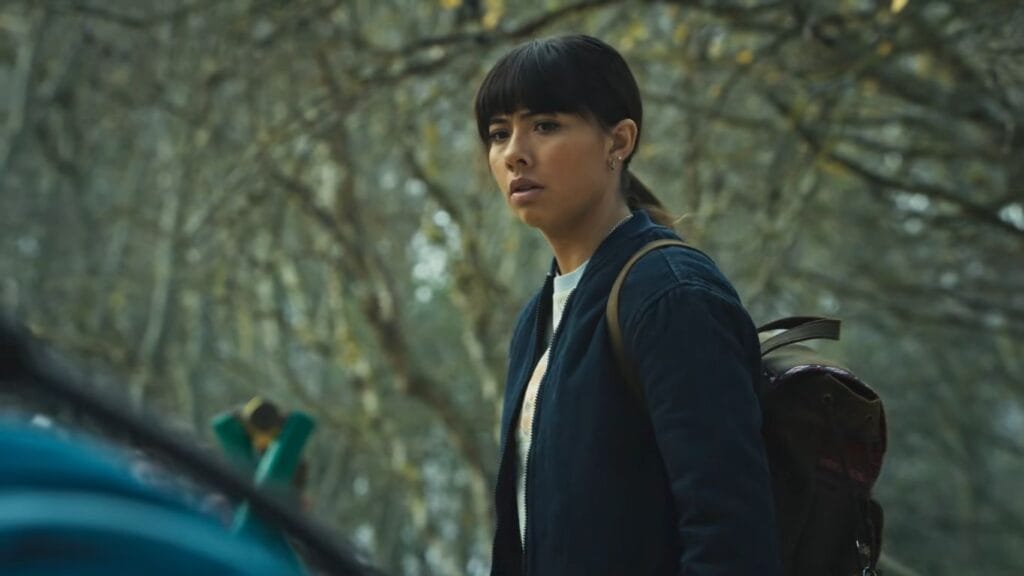
The entity is pretty damn insidious, too: it targets children, infecting them without the kids even realising. These kids don’t lose their lives or anything; instead, they function as hollowed-out sleeper agents doing the bidding of a central entity.
Most of the time, they are normal children that absolutely need someone keeping an eye on them at all times because their rich parents are too busy to care for them themselves. This lures in hardworking, financially vulnerable babysitters who are hired to care for the children.
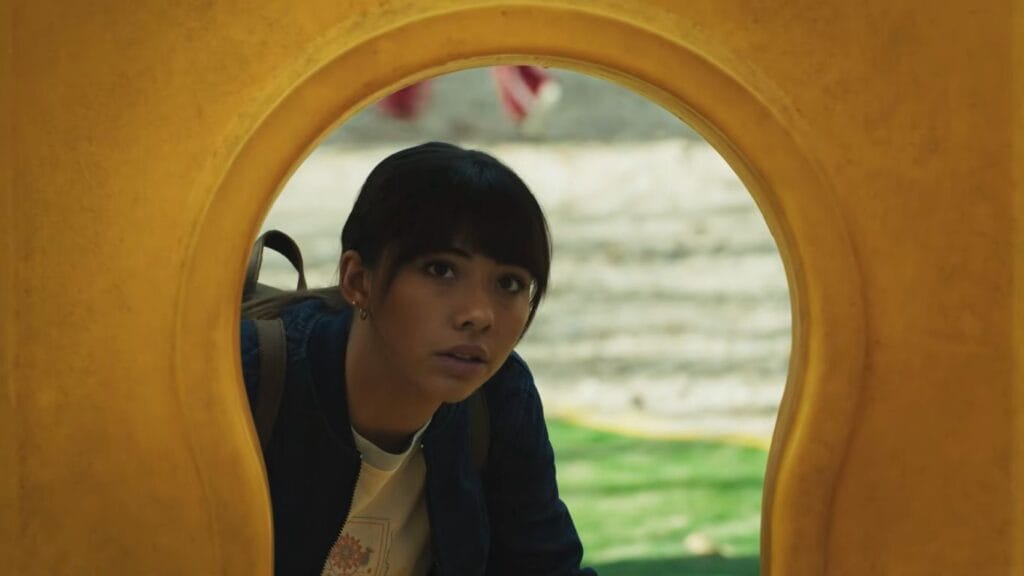
Once a babysitter enters the designated trapping zones (playgrounds, gardens, sand pits), the kids are suddenly overtaken by the hive mind which forces them to collectively attack the victim. The victim is then dragged underground into a green-lit tunnel network to be absorbed into the collective system. The kids snap back to reality not remembering a single thing that had happened.
It’s not just babysitters who are at risk, though. Basically, anyone of a lower position in life who can be consumed without causing suspicion is at risk. Gardeners, housekeepers, maids, labourers. When one trap goes away, another pops up in a completely different location to replace it.
What Does the Entity do to Its Victims?
The entity forces its victims into a life of servitude in its underground lair performing mindless, repetitive tasks.
This can be seen when Sasha is possessed in the underground lair. She is seen adjusting dolls limbs over and over, other adults are seen sorting endless coloured balls.


It’s not so much that these tasks would serve any purpose other than powering the creature so that it can grow. They are just a visual representation of how the victims are transformed into mindless husks forced to work endlessly just to survive.
Were the Parents Involved? The Complicity of Privilege
Yes, the parents were involved the entire time but as sleeper agents being controlled by the entity as part of the hive mind. It’s presented, in the movie, as if the parents were turned during the latter parts of the film, but this is an allegorical tale of the rich taking advantage of the poor. Best believe the adults were sleeper agents the entire time.
Camille and the other wealthy residents of Coral Grove are already infected. The hive mind functions as a seedy transactional agreement: the elite unwittingly feed the entity a steady supply of disposable, working-class people (babysitters, housekeepers, maids, gardeners), and in exchange, the entity preserves the neighborhood’s pristine perfection, status, and economic wealth.
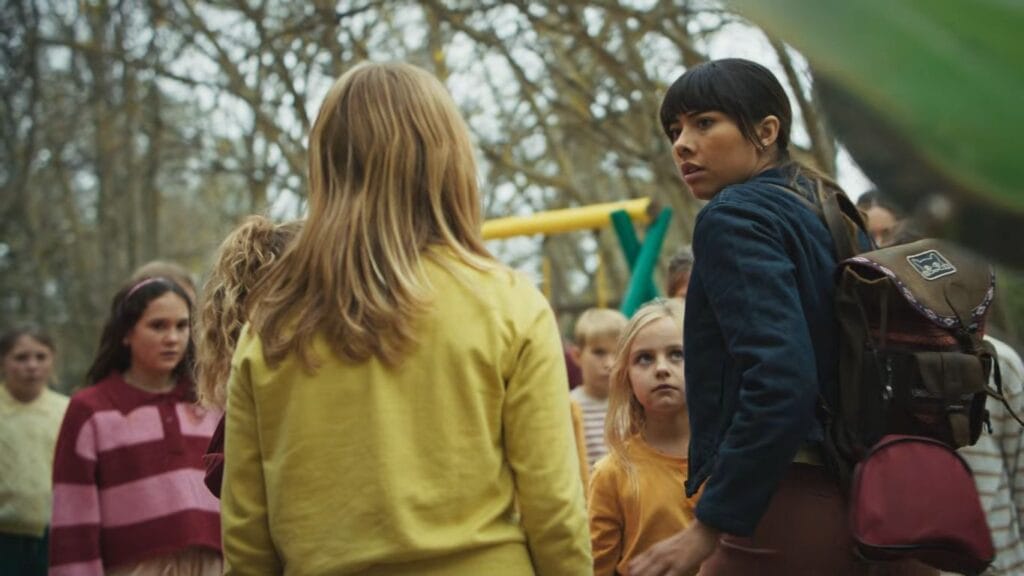
When Camille discovers Sasha defending herself against Zaley, she doesn’t try to protect the teenager. Instead, she reveals herself to also be part of the hive mind. She is quickly joined by other mind-controlled adult agents to eliminate Sasha and protect the status quo.
The movie reveals, later on, that they have no memory of actually being part of the hive mind but that’s the way it works. It uses their bodies as husks to essentially do its bidding.
Thematic Spotlight: Class Warfare on the Playground
While Felipe Vargas’s execution relies heavily on campy B-movie tropes, the subtext of Hive is actually focused on some very real world social issues. The horror element in the movie functions as a literal manifestation of class exploitation and underclass systemic consumption. In short, the narrative depicts the exploitation of the lower class by the upper class.
Sasha is a student who desperately wants a pre-med education at Winscott, but is forced to defer her dreams due to financial strain. She absolutely needs this job to stay afloat. Camille uses the promise of academic validation and financial aid references as the proverbial carrot to keep Sasha compliant. Sasha, due to needing Camille’s reference, stays completely blind to the fact that Camille is viewing her as literal meat for a grinder.
The entity beneath the playground is a physical metaphor for how the upper crust thrives by systematically draining the energy, labor, and lives of the working class, leaving them hollowed out so that the manicured gardens above stay green. It’s a tale as old as time, just mondernised for a horror audience.
Why Does Sugar Destroys the Hive Mind?
Sugar destroys the hive mind because the hive mind has a chemical vulnerability to it but there is also a metaphorical explanation, too and it revolves around luxury and excess.
The turning point in the battle against the entity comes due to the hive mind having a highly specific, total biological intolerance to concentrated sugar and syrup concoctions.
We see the first proof of this concept when Marco dives into the green-lit tunnels to find his sister. Forgetting that he had a bag of candy given to him by their father, one falls out of the bag and lands on the walls currently trapping Sasha. Marco notices that it fizzes so he pours more of the contents of the bag onto the wall to see what the deal is.
The pure sugar hits the organism like acid, causing it to sizzle and melt. Realising that there is something to the reaction, Marco gives some of the sweets to Sasha who is then immediately transformed back to normal. Therefore, sugar damages the hive mind.
During the final moments, Sasha realises that she needs a lot of sugar to destroy the hive mind. She does this by feeding a type of industrial weed killer that’s made from a combination of high fructose corn syrup and sugar right into the centre of the hive mind, literally rotting it from its core.
The Metaphorical Reason Why Sugar Damages the Hive Mind
Sure, the whole sugar rotting the hive mind from its core is a bit on the nose but there is more to it than meets the eye from a metaphorical standpoint. Hive is a horror movie with a social bent.
This is a story about rich people taking advantage of the poor and working class. The rich are eating (consuming) the poor, essentially. Luring them in with promises of financial gain before the hive mind consumes them. Hard working people disappear and nobody bats an eyelid. Even police won’t investigate because that would risk the status quo.
When Marco is in the underground lair and realises the sweets damage the hive mind, he opens the bag and sees a note from their father that states “A bit of sugar to ground you”. What this means is that sugar is a treat to working class people. You eat a little to relax you and remind you of what you are working for. Hard labour equals a reward but that reward should never be taken in excess.
To the wealthy elite, sugar has always been a symbol of luxury. In the case of Hive, sugar is no longer a treat for these people, it is literal poison.
They have been drowning in excess, indulgence, and decadence their entire lives and have forgotten what hard work and respect is. The sugar (wealth and luxury) is essentially killing them. They have lost their souls by taking advantage of the people around them.
Excess, luxury, and decadence is rotting the elites from their core and turning them into heartless, uncaring monsters who will do anything to get ahead. The “sugar” is destroying them from the inside and Sasha weaponises that against them in the most literal sense.
Horror Context: Sugar as the Rot of Excess
While pouring syrup down a playground slide feels like a proper piece of campy B-movie silliness, the biological weakness driving the finale of Hive is actually rooted in a seriously unsettling historical reality. Let’s be honest, we take sugar for granted because it is everywhere. For centuries, however, refined sugar wasn’t an ordinary pantry staple. It was the ultimate status symbol of decadent wealth, extreme privilege, and colonial exploitation. In the courts of Europe, the ultra-wealthy would flaunt their status with towering, intricate sugar sculptures, entirely blind to the brutal, agonising labor of the enslaved workforces dying in the fields to produce it.
The film actually weaponises this historical subtext to fuel its class-warfare allegory. The entity nesting beneath Coral Grove is literally and metaphorically fueled by the neighborhood’s toxic, synthetic sweetness. It’s a bubble of privilege that thrives off the labor of the exploited underclass. By making the monster biologically dependent on, yet completely destroyed by, an overdose of sugar, the narrative actually relates a pretty sharp socio-economic punch: the elite are quite literally rotting from their own self-indulgence.
When Sasha uses a humble, blue-collar workspace tool (syrup-based weed killer from a laborer’s truck) to deliver the final blow, she is turning their own symbol of status into a weapon. It flips the script on their wealth and decadence, proving that the only way to smash a system built on sweet, artificial delusions is to drown it in its own rotten excess.
Who Was The Old Woman In the Underground Lair?
The old woman in the underground Lair was Mabel Grace. She was the very first victim of the hive mind.
Mabel Grace was a friend of Frances and worked as a nanny for a family in the area. She was, by all accounts, a wonderful person who was very giving and worked incredibly hard.
Mabel was the first person taken by the hive mind after mysteriously disappearing years before. The hive mind was, essentially, possessing her body and using her as the psychic central control network that the entire system ran through. She was not a willing participant in this, she was possessed.
The Climax: Saving Mabel Grace
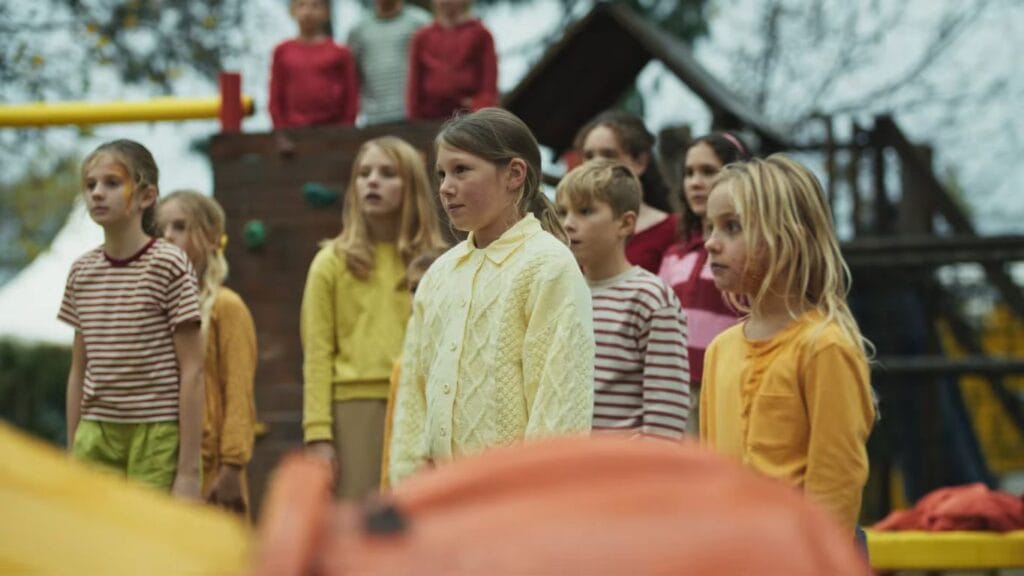
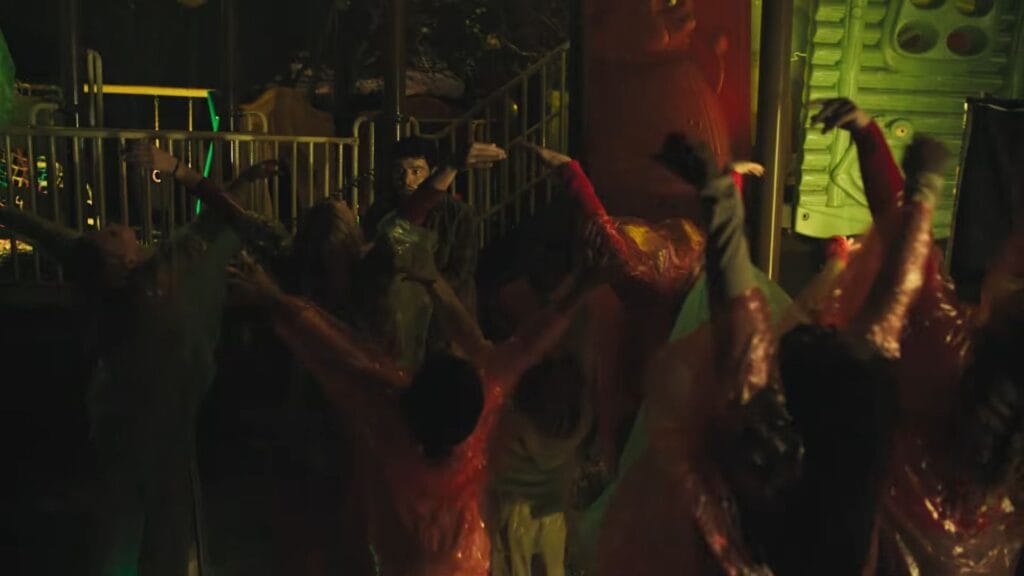
The finale sees the entire playground layout sink into an absolute warzone as the entity unleashes its full army of mind-controlled corporate parents and empty-eyed children. Again, it’s more on the nose allegory but the message is clear.
With Marco’s leg horribly broken by the surrounding sleeper agents, Sasha realises that fighting the individual limbs of the hive mind is simply not going to work; she needs to strike the host body.
She identifies the central nexus of the entity as Mabel Grace, the original missing babysitter whose disappearance set this entire thing in motion years ago. Instead of executing her, Sasha appeals to Mabel’s suppressed humanity, forcing her to remember her authentic name and identity, which completely fractures the entity’s inner psychic network.
To seal the deal physically, Sasha sprints to the bed of Darius’s abandoned truck and grabs a commercial-grade container of weed killer, a solution heavily composed of dense syrup and raw sugar. She scales to the top of the playground structure and dumps the entire vat straight down the central tube slide.
The concentrated rush of sugary chemicals causes the entire subterranean hive mind to completely disintegrate from the inside out, triggering a mass release of all its surviving victims.
Social Commentary: The Racial Divide of Coral Grove
We can’t really fully dissect the class warfare in Hive without talking about how explicitly it maps onto racial lines. The structural divide in Coral Grove is obviously very visually stark: the affluent, order-giving elite are depicted as almost entirely white, while the hardworking, exploited underclass, represented by Sasha, her brother Marco, and their friend Darius, are of Latin-American heritage. It is a highly deliberate piece of casting from a Colombian director that mirrors real-world systemic dynamics, where minority communities are disproportionately funneled into demanding domestic labor roles with little structural protection and limited upward mobility.
The horror of the film stems from the sheer entitlement of this racial and economic privilege. Camille and her wealthy neighbors view the babysitters, maids, nannies, and labourers as entirely disposable capital. Camille uses the carrot of academic advancement to keep Sasha submissive while leading her toward a literal meat grinder. Thus highlighting the additional lengths impoverished people are forced to go to to better their lot in life. The subterranean hive mind acts as an extension of this dynamic, surviving by systematically swallowing the marginalised youth who keep the neighborhood running.
It’s worth noting that while the film handles this metaphor with a complete lack of subtlety, leaning hard into rigid clichés to ensure the audience catches the message, the core visual punch is definitely there. When Sasha and Marco fight back using working-class tools and a simple bag of candy, entirely supposed to be a small treat, they are effectively staging a fierce, localised, rebellion against a system designed to chew them up and spit them out.
What Does the Final Scene Mean?
The final scenes reflect that Sasha no longer wants help from rich people and is content to work hard and enjoy her occasional treats rather than chase a lifestyle of money and wealth.
The closing moments of Hive provide a bit of a bittersweet, slightly campy conclusion to an otherwise grim economic metaphor.
Sasha successfully loads the freed Mabel Grace into the back of the truck, allowing her and Frances to have an emotional, long-awaited reunion. As Sasha drives Marco, Frances, and Mabel away from the ruined suburbs of Coral Grove toward the hospital, she reaches into her pocket, pulls out the bag of candy and pours an absolutely huge mouthful… I definitely don’t think she meant to pour that many, she looks like she is about to choke.
This final gesture carries a bit of a dual meaning: on a literal level, it ensures she keeps any latent parasitic infection out of her own bloodstream. On a symbolic level, it represents a complete rejection of the corrupt, high-society “gifts” offered by Camille. Sasha doesn’t need a letter of recommendation from the elite to save lives; her own working-class wits, familial solidarity, and resourcefulness are what ultimately cured the neighborhood. She has earned that occasional treat.
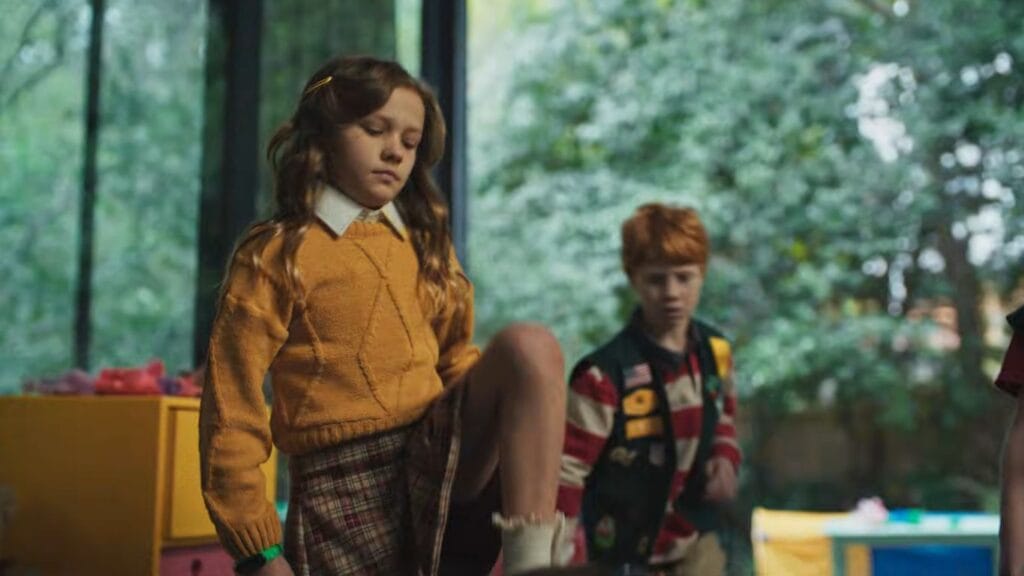
There’s another small snippet here that is easy to miss. Zayla asks her mum to look after her occasionally. This hints at the very real world fractured relationships between rich parents and their children. The pursuit of money comes first so often that these children are left to essentially be raised by housekeepers and nannies. All they really want is to be cared for by their actual parents but money comes ahead of that. There are people suffering at all levels of maintaining that lifestyle.
Final Thoughts: A Pretty Standard Streamer
Look, let’s be honest… Hive is far from an unwatchable disaster, but it certainly isn’t going to redefine the evil-children subgenre anytime soon. Director Felipe Vargas and cinematographer Carmen Cabana have crafted a decent-looking picture that nails that uncanny, pastel suburban valley aesthetic early on. It’s just a shame the script trades its sharp social commentary for a repetitive cycle of kids standing around looking menacing down the stretch.
It is perfectly acceptable, harmless background noise for a quiet weekend streaming session on Tubi, but hardcore horror purists will likely find themselves wishing the script had a hell of a lot more bite. Thanks for reading! If you love digging through ending explanations without getting bogged down in fluff, stick around and check out some of our other Ending Explained breakdowns, browse our horror reviews, or dive into our curated horror movie lists.
Frequently Asked Questions
What exactly was the monster beneath the playground?
The monster was a parasitic, biological hive mind organism that nested beneath Coral Grove. It utilized local children and adults as mind-controlled sleeper agents to lure in outside babysitters, gardeners, and labourers, dragging them down through the playground slides to absorb their lifeforce and fuel its growth.
Why were the parents helping the creature?
The wealthy parents of Coral Grove were entirely complicit in the operation. The hive mind maintained the neighborhood’s artificial perfection, status, and financial success in exchange for a steady supply of lower-class, disposable babysitters and workers, making the monster a literal metaphor for upper-class exploitation of the working-class.
How did Sasha figure out the creature’s weakness?
The realisation happened sequentially. First, her brother Marco discovered that pouring a bag of standard candy onto the hive walls weakened its structure and freed Sasha when she ate some. Recognising the creature’s extreme biological intolerance to sugar, Sasha scaled the playground during the climax and dumped an entire commercial vat of high-fructose, syrup-based weed killer down the main slide to liquefy the organism’s core network.
What happened to Mabel Grace at the end of the film?
Mabel Grace, the original missing babysitter who was being used as the central psychic host body for the entity, was successfully rescued by Sasha. After Sasha broke the hive mind’s psychological hold by forcing her to remember her name, Mabel was pulled from the melting tunnels and reunited with Frances as they drove away from the neighborhood.
A Note on Ending Explanations
While we aim to provide comprehensive explanations based on the events on screen, film analysis is inherently subjective. The theories and conclusions presented in this "Ending Explained" feature are personal interpretations of the material and may differ from the director's original intent or your own understanding. That's the beauty of horror, right? Sometimes the scariest version is the one you build in your own head.
You might also like:
- Ghost Webcam (2023) Review – A Low-Budget Screenlife Fumble
- Ghostwatch (1992) review – The Groundbreaking BBC Hoax That Terrified A Nation
- No Me Sigas (2025) Review – International Blumhouse Horror Fails to Impress
- Hallow Road (2025) review – A road trip into trauma and boredom
- Until Dawn (2025) review – A splatter fest that ignores the game
Disclaimer: Images, posters, and video stills used in this horror ending explained article are the property of their respective copyright holders. They are included here for the purposes of commentary, criticism, and review under fair use. Knockout Horror makes no claim of ownership and encourages readers to support the official release of all films discussed.