28 Days Later (2002) 4K Blu-Ray Steelbook Review – Does 4K Help to Clear Things Up?
Release: 28 Days Later (2002)
Distributor: Sony Pictures Home Entertainment UK
Format: 4K UHD (Single Disc BD-100)
Packaging: Limited Edition Steelbook
Certificate / Region: BBFC 15 / Region Free
Video Codec: 2160p HEVC (SD Digital Source Upscale / Native 4K 35mm Epilogue)
HDR Formats: Dolby Vision / HDR10
Aspect Ratio: 1.85:1
Audio Tracks: Dolby Atmos (7.1.4), DTS-HD Master Audio 5.1
Runtime: 113 Minutes
Welcome to Knockout Horror. Today we are taking a look at the highly anticipated 4K Blu-Ray Steelbook of the groundbreaking 2002 outbreak movie 28 Days Later by Danny Boyle. I believe the feature set on this one is standard across releases so the information here should be applicable to different regions. Let’s take a look.
Table of Contents
A Highly Anticipated Release
It goes without saying that, in the world of 4K horror Blu-rays, 28 Days Later was a hotly anticipated release. So much so, in fact, that it began to sell out on pre-orders and people are already scalping it on eBay for double the original asking price.
We actually had our pre-order at Amazon, only for them to suddenly say that it was randomly delayed. This has happened to us before and it always seems to result in us missing out. With this in mind, we immediately went to HMV and ordered an in stock copy to make sure that didn’t happen.
After last year’s release of 28 Years Later, a hell of a lot of people headed to online marketplaces to try and pick up the original film. They quickly learned that this was a fairly expensive task. Physical releases were few and far between and often fetched prices north of £50 a unit. Not only that, but it had all but disappeared from digital streaming platforms worldwide.
The rights for the movie had actually been left in limbo after the Fox and Disney merger meaning production stopped and streaming was impossible. It wasn’t until they reverted back to producer Andrew Macdonald that a new deal could be struck with Sony Pictures. This allowed them to distribute the upcoming trilogy and takeover the back catalogue, too.
For a long time, collectors were very unsure as to whether we would ever even see a 4K release of 28 Days Later. Needless to say, when one was announced, anticipation was high.


A Ground-Breaking Horror
I probably don’t need to remind horror fans but 28 Days Later is one of the most important zombie genre films ever released.
Outbreak horror was all but buried and rotting by the late 90s. People were sick of the Romero-style siege format and there was a general consensus that the shambling undead just weren’t all that scary anymore.
“28 Days Later changed the game and its influence can still be seen today in the way outbreak movies are formatted”
Danny Boyle, coming off the success of Shallow Grave, Trainspotting, and The Beach, along with writer Alex Garland, was about to change all that.
The story follows courier Jim (Cillian Murphy) who wakes up in a seemingly abandoned hospital in London after being in a month long coma. Exploring the area, he finds the entire city abandoned as the result of a viral outbreak that turns humans into rage filled infected. Teaming up with fellow survivors, he begins a journey to find new hope and an answer to the disease.
I’ll save my rambling about the significance of this title for my upcoming review. Suffice to say, 28 Days Later changed the game and its influence can still be seen today in the way outbreak movies are formatted and structured. The survivor road-trip theme that’s so common today comes as a direct result of the first half of this film.
It’s about as important a horror movie as you will ever find. With that being said…
My Controversial Take
Want my controversial take? While I can appreciate its significance, 28 Days Later is not up there with my favourite movies. Hell, it’s not even in my top 5 favourite outbreak films.
I’m not a big zombie-horror fan, in general, but I did have high hopes for this. I missed its initial release but eventually watched it in 2009 as my fiancee was a big fan and owned the DVD. Honestly, I didn’t really get the hype.
The first half of the movie is very solid and felt fresh even a few years later. The second half is one of the least inspiring in modern zombie horror history.
When the story sees the group doing their best to survive and smile through the trauma, it is very compelling. As a tale of empathy and kindness against overwhelming odds, it’s compelling, entertaining, and even quite touching.
When the halfway mark hits and it devolves into a generic cat-and-mouse thriller, it is eminently forgettable.
A further 17 years later and my opinion has only strengthened. I’ll leave the rest of that discourse for my review. There’s a 4K Blu-Ray Steelbook to discuss, after all. I’m sure you are all wondering how that awful early 2000s DV presentation held up so let’s get to it.
Packaging & Physical Presentation
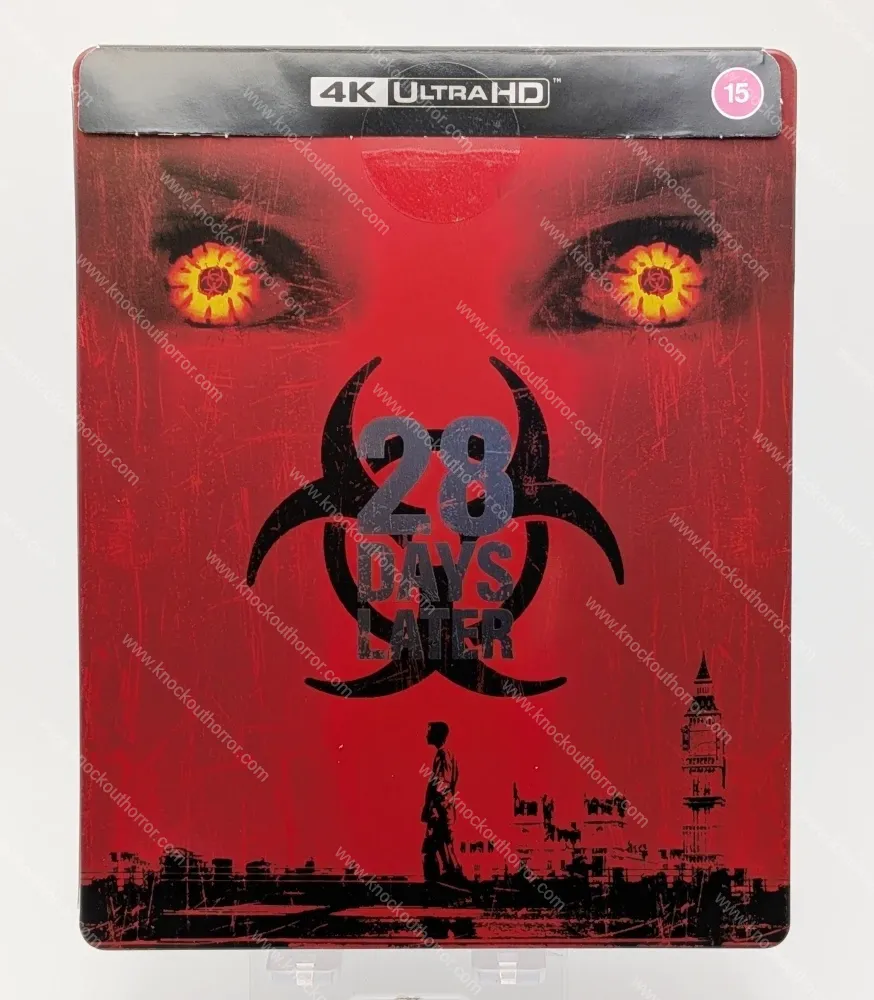
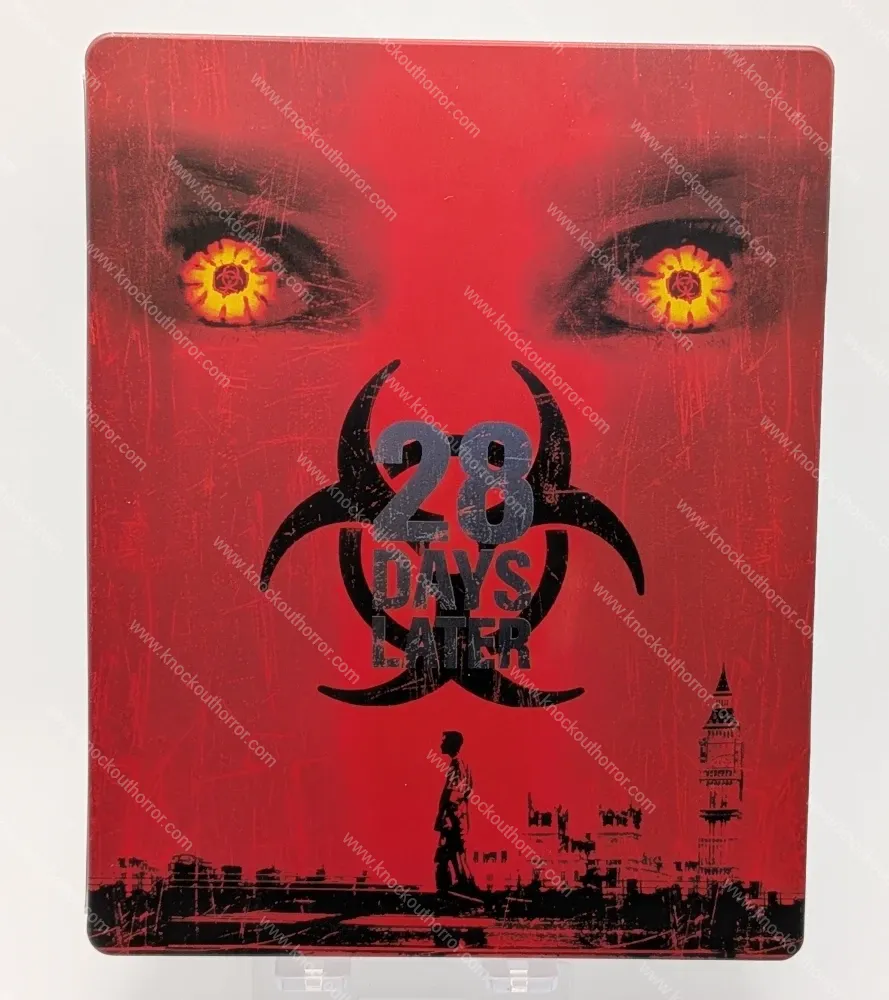
First of all, I absolutely love the Steelbook. I mean, the cover was always going to be pretty obvious, right? The red and black theme was absolutely essential so it would be a bit naive to expect some sort of bespoke design. It’s the original cover placed over a set of menacing eyes.
“It’s a well presented steelbook with some fantastic artwork and some seriously iconic moments captured in print.”
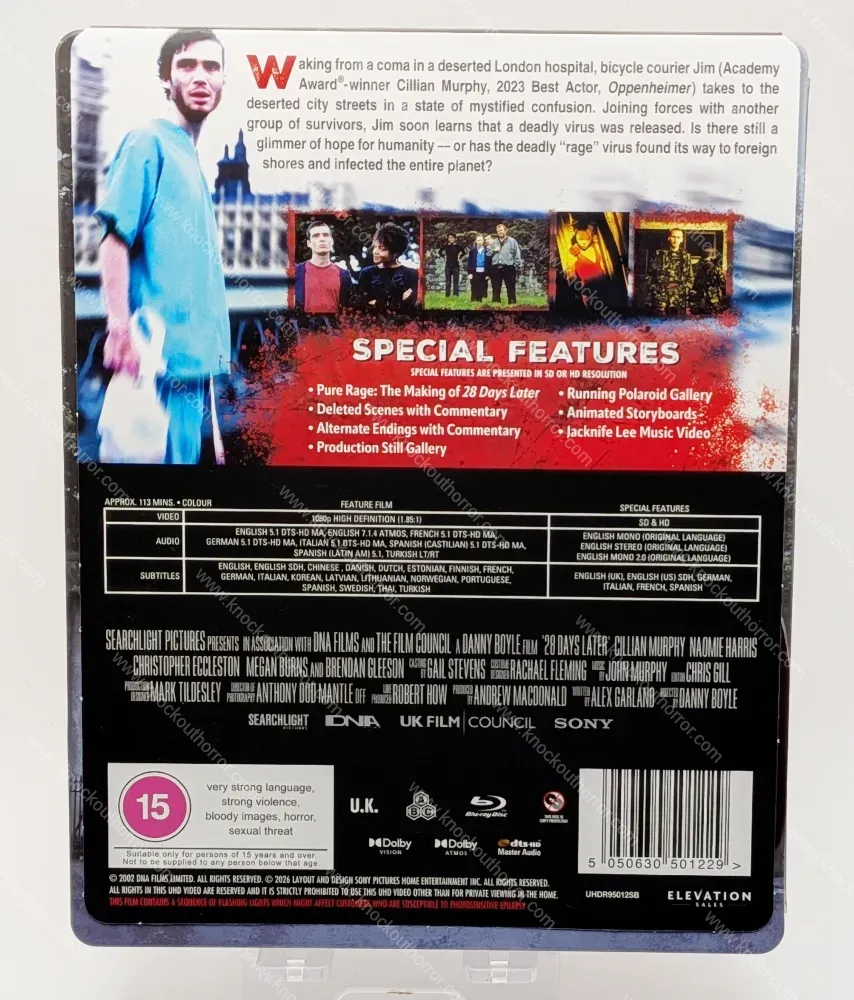
The cover is matte while the 28 Days Later logo is metallic silver. Incidentally, the J-Card here is not actually card, at all. It’s a flimsy, glossy paper material that is probably going to need to be put away or placed in a protective casing to stop it from ripping when sliding in and out of your collection.
Naturally, due to it being paper it features a sticker to keep it attached… Please keep sticky stuff away from my steelbooks. Luckily it’s not enormously tacky and comes off without leaving residue. It’s a bit of a disappointment to be honest. Compounding that is one of those all too common 4K Blu-ray traits – mislabelling.
The technical details for the video section appear to be those of a standard 1080p Blu-ray. Everything else is accurate. Fear not, this is just a misprint and the film has been upscaled to 4K. We will talk about that more in just a sec.
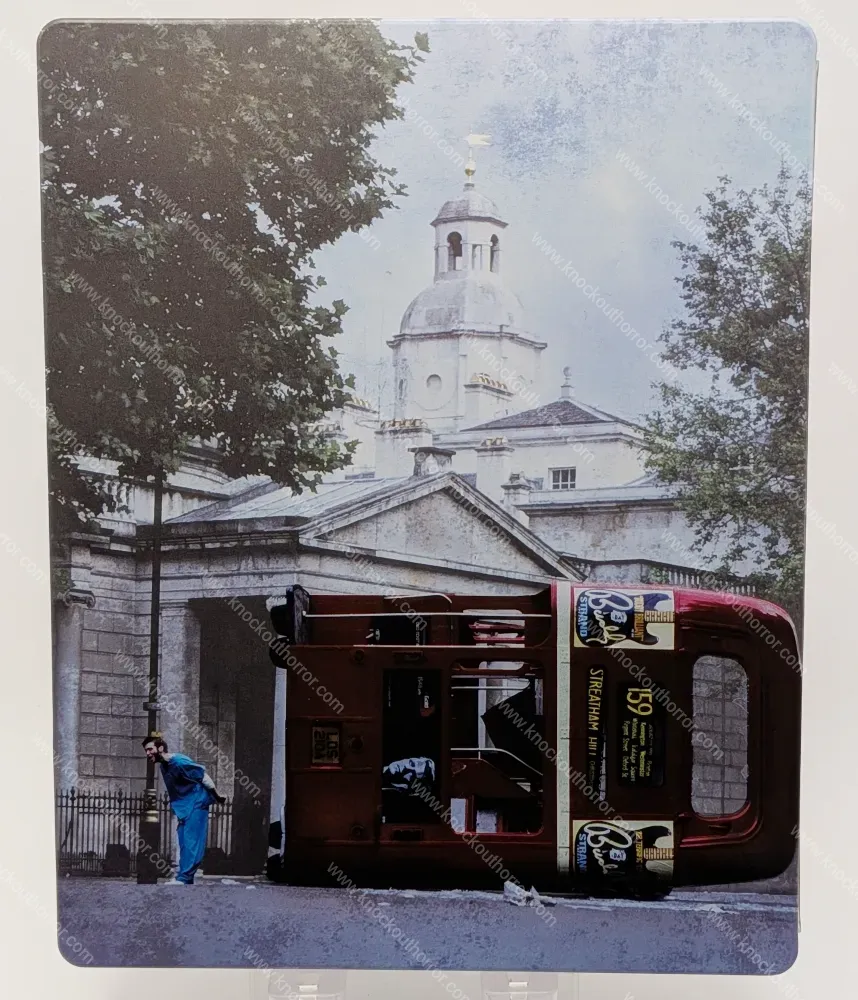
The rear of the steelbook is much cooler. It’s an image of Jim standing besides a toppled London bus. Again, the print is matte but the Bus is a sort of metallic effect. I really like this image and, to be honest, wouldn’t have hated it being the front cover.
I imagine people are going to want to store that flimsy J-Card away somewhere to keep this fantastic image in easy view.
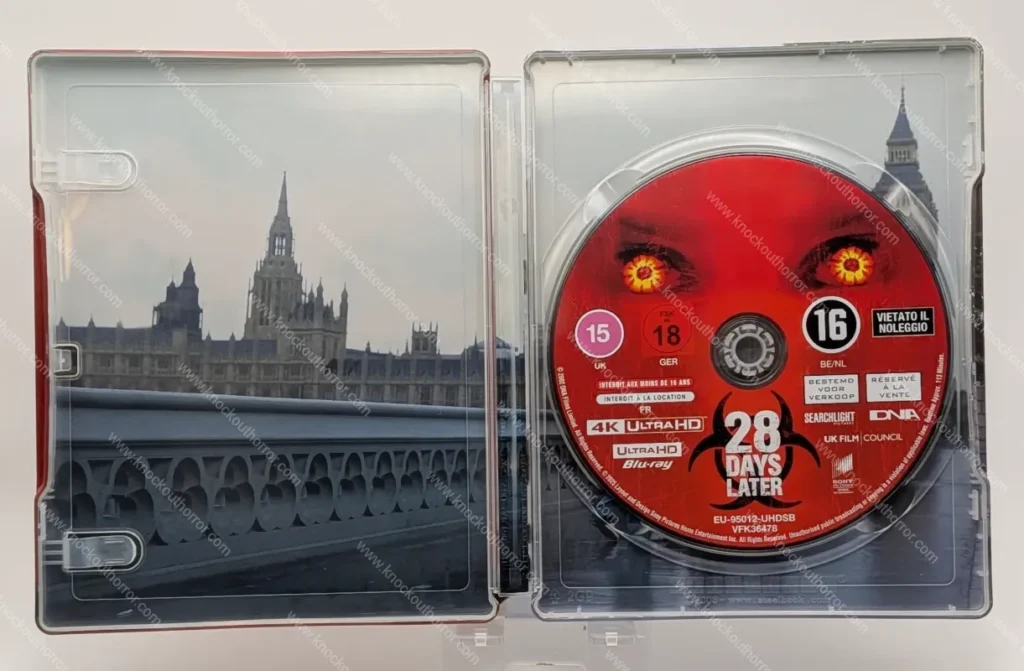
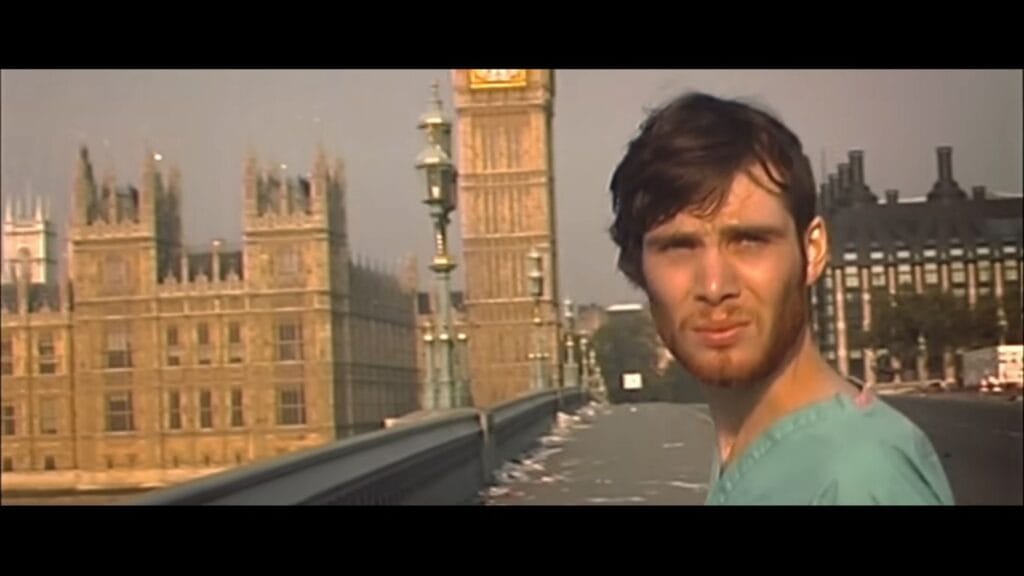
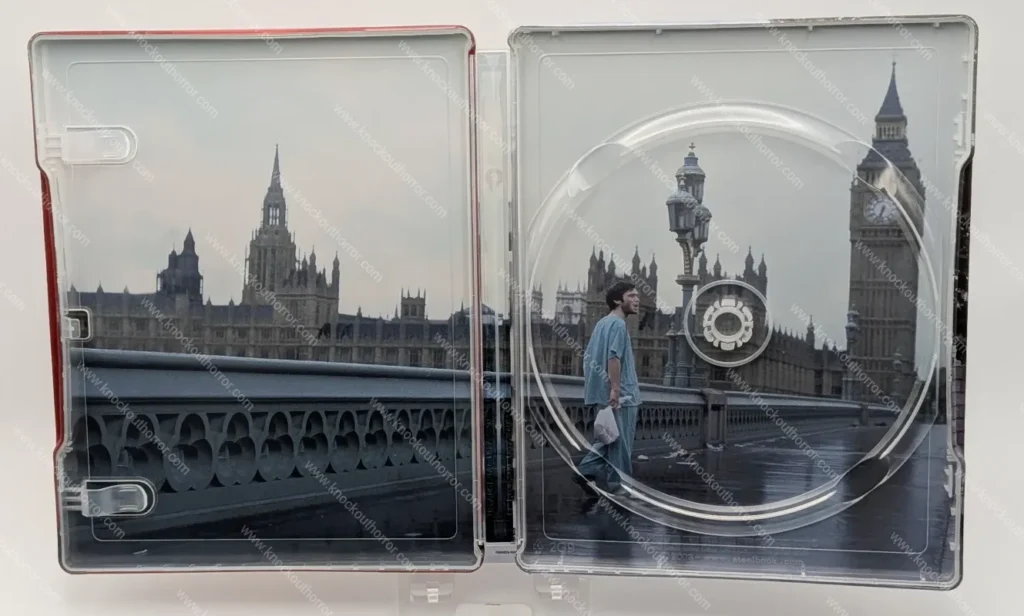
The disc, once again, features the black and red theme, the rage filled eyes, and the 28 Days Later logo. The inside cover is a landscape shot of Jim standing on the abandoned Westminster bridge. I mean, it had to be, right?
All in all, it’s a well presented steelbook with some fantastic artwork and some seriously iconic moments captured in print. It actually arrived in perfect condition despite being shoved into our wall mounted letter box, too.
So About That Video Quality
Okay, this is where things get very muddy… and artifacty, and bloomy, and grainy.
For those of you who don’t know, Danny Boyle chose to film this movie on Canon XL1 Digital Cameras. There were a couple of reasons for this.
Cinematographer Anthony Dod Mantle had spent a ton of time immersed in the Danish Dogme 95 movement and felt he could leverage the harsh, cheap texture of digital video to create a seriously immersive and raw style.
Secondly, Boyle needed to employ an almost Guerilla filmmaking approach for capturing those iconic shots of London’s empty streets due to strict time limits enforced by the Metropolitan Police. There was no time to rig up massive 35mm cameras and film a bunch of takes. The crew basically had a few minutes to set up the shots, fire up their handheld cameras, and leave.
The problem is, the Canon XL1 was classed as a “prosumer” camera. While it was a top of the line option for your average wedding photographer, it was hardly the 1080P, enormous HDW-F900 digital cameras that George Lucas used to film Attack of the Clones around the same time.
It was handheld, had a tiny 1/3-inch CCD sensor that had no tolerance for high light exposure or dark shadows, featured 4:2:0 colour sampling, a pathetic 25 Mbps bit rate, and recorded in 576i at roughly 720×576 (that’s about 0.4 megapixels so compare that to what your phone does now).
This movie is hideously ugly, almost to a degree that makes it fairly difficult to watch.
As a point of comparison, I have a Nokia N95 from 2007 in a drawer somewhere. If I was to fire that up and transfer the videos from it to my 4K television and whack on the upscaling, they would probably be better quality than this film. Naturally, the optics would be very different due to the lenses used, but the technical side was already exceeded by mid 2000s phones.
Cinematography is stunning, almost throughout, but the picture is full of artifacts and tonal variation is almost negligible. Shadows merge together into blobs of black, highlights are absent, light blooms horrendously, and colours bleed together enormously.
4K Video Presentation
The 28 Days Later 4K Blu-ray transfer sits in a weird space somewhere between a hell of a lot worse and, somehow, quite a lot better.
“If you are looking for the film presented in as pure a format as possible, you will be delighted.”
They have obviously worked on the tonal issues a little. Some of the shadows are a bit more defined, some of the bloom is a bit less messy, and there’s a bit of sharpening here and there.
You can actually read the writing on the church wall now, for example. Characters outlines are more defined and it is very noticeable that colours don’t bleed nearly as much. Jim walking around London in his green hospital scrubs looks a lot better because the distant shots don’t look like a random green blob floating around grainy streets.
Incidentally, HDR10 and Dolby Vision are very subtle. Again, it plays into the more defined contrast in shadows that adds a little extra detail that original releases lacked. The colour palette is a little more vibrant and rich while tonal variation is a tiny bit more natural.
With the above benefits noted, the upscaling has, obviously, made a lot of the issues more apparent.
Artifacts and macroblocking are far more noticeable, particularly in dark scenes. Dimly lit indoor scenes look like they have been filmed on a 2000s phone camera. Zoomed in camera shifts feel a lot more juddery and far less smooth. The shaky cinematography that seemed to make the infected so much scarier in 2002 suddenly feels nauseating and amateurish.
There’s almost a constant overlay of grain and nastiness that’s obviously the result of pushing a tiny image way beyond its capacity for scale. It’s a genuinely difficult watch and the “smothered in Vaseline” style of the 1080p release afforded the image a degree of smoothness that the 4K version simply does not.
HDR10 and Dolby Vision also does a bit of a number on some of the brighter scenes, too. That chalky white sky is even chalkier and whiter as HDR simply enhances it with limited regard to nuance.
On The Plus Side
On the plus side, there is no obvious AI interference here. They have obviously gone right back to the source and offered it up with as few adjustments as possible.
This is the film presented warts and all, for better or for worse. The horrible edge enhancement stuff from the original blu-ray release is gone, there is no terrible AI enhanced HDR implementation, and no over aggressive noise-reduction.
If you are buying this 4K Blu-Ray expecting an improved picture, you are going to be very disappointed. It’s slightly better but this is a difficult movie to watch.
28 Days Later was, essentially, an experiment in early digital filmmaking and it shows. If you are looking for the film presented in as pure a format as possible, you will be delighted.
Audio Tracks
Full disclosure, we watched this movie in Dolby Atmos with a compatible surround sound system.
There was a bit of a problem when it came to audio recording on 28 Days Later. As you will notice when watching, Dod Mantle was using 6 to 8 cameras at any one time when filming to grab as many shots as possible. That’s what gives the movie it’s frenetic, kinetic style.
The problem with that, however, is that boom operators would have to stand well out of the way. You didn’t want them in shot, after all. This means that audio is recorded from a distance and this has a huge impact on vocal clarity in the mix. Couple that with unsophisticated editing software from the day inadvertently stripping out vocal tone while trying to remove ambient noise and you have a bit of a lacklustre track.
Voices can feel a bit tinny and hollow. They can be a little undefined, as well. Cillian Murphy’s accent tends to drawl together a bit making certain pieces of dialogue tough to understand. That’s really about as far as the problems stretch, though.
Sound production, courtesy of veteran sound mixer John Rodda, is generally fantastic during action heavy scenes.
Spacial sound is used really well to give you the feeling that you are right there being pursued by hordes of infected. John Murphy’s score is an absolute highlight, as well. It’s an inspired mix of frantic tracks and reserved choir music that adds immensely to every scene.
While the second half of the movie is a serious narrative downgrade, the thunder effects rumble through the floor and really heighten the intensity of the action. Guns sound particularly impactful, too. All in all, sound production is a big cut above the visuals and a real highlight of the 4K Blu-ray.
Bonus Features & Value
There’s a lot of features, here. While the overall value gets a bit of a downgrade for the lack of a 1080p Blu-ray disc, the extras are fantastic.
We have an audio commentary by Danny Boyle and Alex Garland that I am really looking forward to watching. The alternate endings, with or without commentary. A bunch of deleted scenes, animated storyboards, production still gallery, and a Polaroid gallery.
We also have Pure Rage – the making of 28 Days Later documentary, and the Jacknife Lee music video which, I suppose, is something. There’s a good few hours of extra stuff to dig your teeth into, here.
It’s a great value package for fans and, considering the 4K video presentation is the most faithful to the source, this is the ultimate way to experience the film.
The Good
- Purist, Unfiltered Source Presentation: Avoids horrible AI smoothing, aggressive DNR, or fake edge sharpening, presenting Anthony Dod Mantle’s raw MiniDV cinematography warts-and-all.
- Hard-Hitting Dolby Atmos Audio: Spatial immersion shines during chaotic infected chases, backed by deep, floor-shaking low-end bass and John Murphy’s iconic score.
- Superb Steelbook Artwork: Sharp matte finish with striking metallic accents across the rear London bus shot and iconic front typography.
- Packed Supplemental Archive: Retains the essential Boyle/Garland commentary, deleted scenes, alternate endings, and retrospective featurettes.
The Bad
- Cruelly Exposes Standard-Def Flaws: Blown up to 4K, the tiny 576i sensor source brings intense macroblocking, juddery camera pans, clipped highlights, and muddy shadow detail right to the surface.
- Thin, Inconsistent Dialogue: Far-flung boom mics during chaotic shooting leave vocal tracks sounding distinctly hollow and tinny in the mix.
- Flimsy Paper J-Card & Misprint: Ships with a delicate paper backer held by sticky adhesive and carries an erroneous 1080p resolution spec print.
- No Companion 1080p Disc: A single-disc BD-100 release that drops the standard Blu-ray format entirely.
The Ugly: The standard-definition digital video reality check. For casual buyers expecting a razor-sharp 4K demo disc, blowing up sub-megapixel 2002 camcorder tape to modern high-resolution displays looks like a low-bitrate relic smothered in digital noise.
Should You Buy the 28 Days Later (2002) 4K Steelbook?
If you pick this up expecting reference-grade 4K eye candy, you will be sorely disappointed: 28 Days Later is fundamentally an ugly, gritty early digital experiment, and high-resolution upscaling only magnifies every compression flaw, clipped sky, and sensor limitation. However, by strictly respecting the source rather than wrecking it with synthetic AI processing, Sony has delivered the most authentic, untouched archival home presentation possible. Paired with a thumping Atmos mix and a handsome steelbook, it is a mandatory purchase for physical media purists after years of out-of-print limbo.
You might also like:
- A24 Backrooms’ Bollocks, Bonus Scary Movie, Resident Evil Hype, and More – Cutting the Crap Horror Roundup
- Hellraiser (1987) Review – A Visceral and Transgressive Masterpiece of Flesh
- Slapface (2022) Review – A Messy and Muddled Metaphor for Abuse
- The Wicker Man (1973) Review – The Definitive Folk-Horror Masterpiece
- The Dirties (2013) Review – A Chilling And Hilarious Found Footage Masterpiece