Pontypool (2008) Review – A Chilling and Intellectual Lo-Fi Horror
Pontypool: Quick Verdict
The Verdict: A masterfully restrained and intellectually stimulating “chamber piece” that successfully reinvents the stagnant zombie sub-genre. Pontypool thrives on its unique premise, using language as a vector for infection and relying on the power of suggestion rather than visceral gore. Stephen McHattie delivers a career-best performance, grounding the high-concept script with his gravelly, charismatic presence. While the film’s experimental final act may feel slightly contrived to some, the overall sense of claustrophobia and verbal dread is undeniably effective. It is a 3.8 star standout that functions as a chilling tribute to the radio dramas of old while offering a sharp social commentary on communication. For those tired of the traditional “shambling corpse” tropes, this is a sophisticated and unsettling alternative that lingers long after the broadcast ends.
Details: Director: Bruce McDonald | Cast: Stephen McHattie, Lisa Houle, Georgina Reilly | Runtime: 1h 36m | Release Date: 6 March 2009 (Canada)
Best for: Fans of high-concept psychological horror, viewers who enjoy single-location “bottle” movies, and those who appreciate the power of sound design.
Worth noting: The film is based on the novel Pontypool Changes Everything by Tony Burgess, who also wrote the screenplay. It was filmed almost entirely in sequence over just 15 days.
Where to Watch: Available to stream on Shudder and AMC+
Rating: 3.8/5 Stars
(Superb lead performance, innovative premise, but slightly disjointed final act.)
Welcome to Knockout Horror. Today we are following up Resolution with another lo-fi horror movie – Pontypool from 2008. If you are looking for some answers regarding this film, check out our Pontypool ending explained article. Keep in mind however, unlike this review, the explanation contains spoilers.
Table of Contents
A compelling horror chamber piece
Based on the novel by Tony Burgess. Pontypool follows the story of “shock jock” radio host Grant Mazzy heading into work at his new radio station. On his way, he encounters a woman babbling randomly and repeating a single word. Strange, but things are about to get much stranger. While on the air, the station’s eye-in-the-sky helicopter news reporter spots a riot taking place outside of a doctor’s office.
“The vast majority of the horror here takes place through voices talking to each other. Pontypool puts a whole new spin on the tried and tested zombie horror formula of old.”
Reports come in of crazed people speaking nonsensically and attacking others. There is carnage and mayhem throughout the town and the radio station’s crew are trapped inside with no idea what is happening all around them.

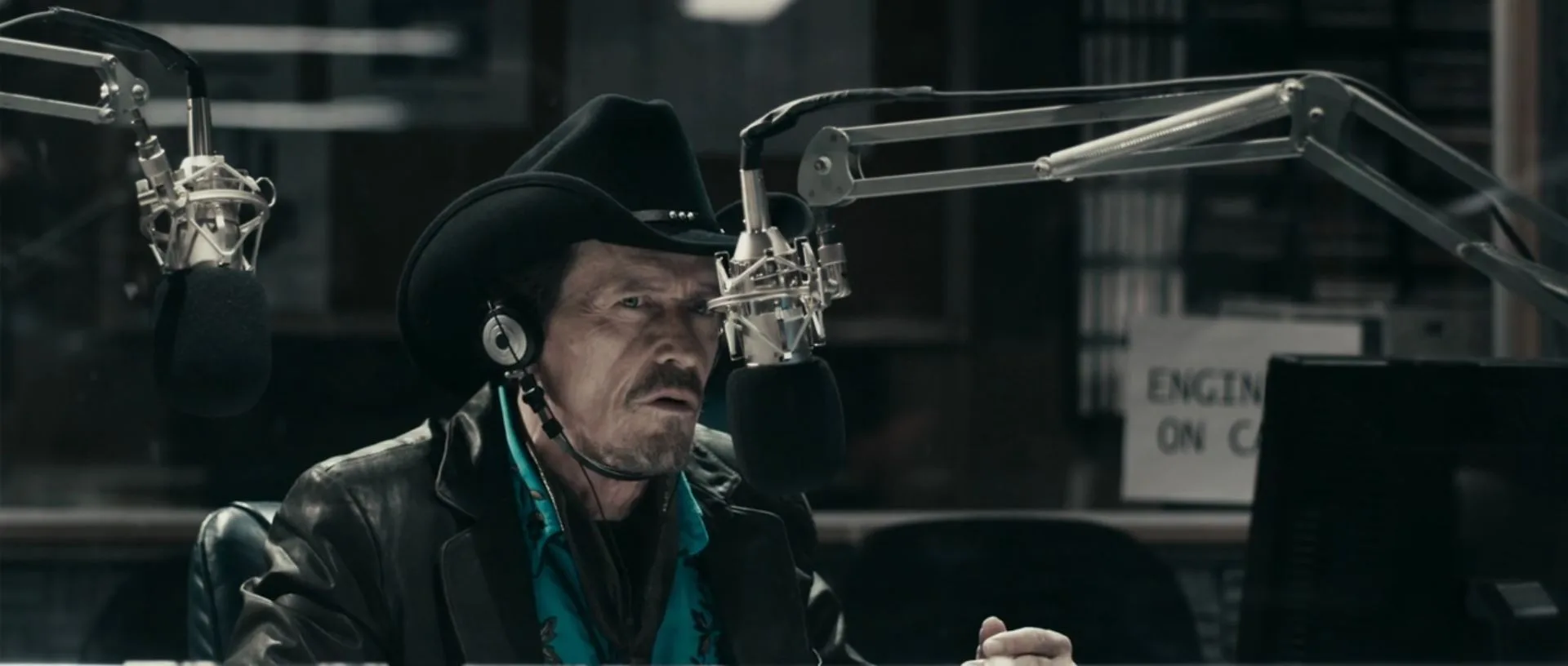
Pontypool starts off incredibly slowly. We are introduced to our charismatic radio host Grant Mazzy (Stephen McHattie), his producer Sydney (Lisa Houle) and his assistant Laurel-Ann (Georgina Reilly). We see Mazzy presenting the morning radio show, we see him argue with Sydney and we see him drink Glenfiddich criminally mixed in with his coffee. Nothing much of note happens but that is very deliberate.
The slow build is extremely purposeful and is about to give way to a horrific story that is executed in a style almost reminiscent of Orson Welles’ radio broadcasts. The vast majority of the horror here takes place through voices talking to each other with limited visual depictions. Pontypool puts a whole new spin on the tried and tested zombie horror formula of old.
Legitimately unsettling in parts
Pontypool sole purpose is discomforting the viewer. There is no overt violence or people being ripped apart in front of your eyes, there are no special effects or gallons of gore. This is a horror movie that goes about things in a very different way. Many of the most frightening scenes in Pontypool are the ones being described to one character by another.
There is something innately terrifying about hearing a person relate the horrifying things they are witnessing in front of their very eyes. It is affecting in a whole different kind of way than what we can physically see in front of us.

This is what makes Pontypool really stand out. There really isn’t much like it and you have to go back to the days of radio horror shows to find something similar. It is almost like reading the words in a novel and creating an image in your mind to go along with the story. And when your imagination is allowed to run wild, it tends to do a better job of creating some truly horrifying images than any special effects artist can.
“There is something innately terrifying about hearing a person relate the horrifying things they are witnessing. It is affecting in a whole different kind of way.”
It’s hard not to think of the original Orson Welles radio broadcast of War of the Worlds when watching Pontypool. Whereas much of this is down to budget constraints, I imagine that director Bruce McDonald was, at least a little, inspired by those radio broadcasts of old. It’s unique and fantastic. There really is very little like Pontypool nowadays.
A social commentary
There are a number of scenes that do resort to more traditional horror techniques. One being particularly noteworthy for just how much more effective and shocking it manages to be for its simplicity. The interesting thing, however, is that while this scene is taking place, Mazzy relates the horror of what he is seeing to his audience in somewhat muted detail to avoid causing upset.
This, in turn, is him describing it to the viewer, as well. Further reinforcing that extremely interesting narrative style and allowing the viewer to expand on the events taking place beyond what they see on screen. It’s fascinating stuff and extremely immersive.

Again, I will avoid going into details to avoid spoilers. But the central theme of Pontypool and the cause of the unrest acts as something of a social commentary. It points the fingers at people’s careless repeating of dangerous rhetoric while also highlighting how easy it is for these thoughts and ideologies to spread.
A few negatives
It has to be pointed out that Pontypool is not going to be for everyone. This is lo-fi horror and extremely slow for much of its length. Even when it gets going it isn’t particularly action filled and isn’t going to satisfy anyone looking for traditional zombie horror thrills and spills.
The movie does lose some of its impact as it goes on. Towards the final 30 minutes the concept has reached its peak and never really manages to bounce back. There is only so far you can go, given the theme, and Pontypool milks most of the scares pretty early on.
It’s hard not to point out the final 10 minutes of the film, as well. This is one of those movies that sort of writes itself into a corner. I am not sure how it could have ended satisfactorily but I really am not a fan of how things wrap up. It feels unnecessary and forced, as if the writer needed a conclusion but couldn’t quite think of how to make one fit. In its efforts to continue subverting expectation, Pontypool produces an ending that feels contrived and a bit silly.
Decent acting and direction
Naturally the star of the show is Stephen McHattie as Grant Mazzy. McHattie has a perfect radio voice and has absolutely nailed the cadence and flow of this type of presenter. He is solid almost throughout and provides a few laughs on a number of occasions. He has a tendency to overact a little bit. A scene where he is about head outside while his co-workers try to stop him being a perfect example. He is definitely the highlight of the movie, though.

Lisa Houle provides a perfect foil for Mazzy as his producer Sydney. She has some effective scenes towards the end of the movie and brings a nice sense of realism to her character. Georgina Reilly is brilliant as Laurel-Ann. She does a fantastic job during the middle of the movie and provides a performance that is legitimately affecting. Special shout-out to Rick Roberts as helicopter reporter Ken Loney, as well. He has a number of voice-only scenes that are brilliant and add tons to the story.
“Stephen McHattie has a perfect radio voice and has absolutely nailed the cadence of this type of presenter. He is definitely the highlight of the movie.”
Direction is, generally, fine. There are some decent shots and Bruce McDonald’s use of the sound proof booth to create both scares and laughs is fantastic. There are a few dodgy transitions here and there but that seems to be editing problems more than anything. McDonald manages to balance the drama, horror and the comedy perfectly as well which definitely deserves mention.
The Good, The Bad & The Ugly
The Good
- Stephen McHattie: His performance as Grant Mazzy is sensational. His voice and presence carry the entire film, making the radio booth feel like the centre of the world.
- Sound Design: The film uses audio to brilliant effect, building terror through phone calls and reports that allow the audience’s imagination to do the heavy lifting.
- Originality: The concept of a “linguistic virus” is incredibly fresh and allows for a type of psychological horror that feels truly unique.
The Bad
- Experimental Finale: The ending takes a turn into the abstract that may feel a bit silly or unsatisfying for those wanting a more grounded resolution.
- Pacing: The transition from the slow-burn buildup to the chaotic finale can feel a bit abrupt, with some of the early tension dissipating too quickly.
- Limited Scope: As a “chamber piece,” the film stays rooted in one location. While effective, some may find the lack of visual scale frustrating.
The Ugly: The “Laurel-Ann” transformation. A masterclass in physical acting that shows how a simple repetitive sound can become a terrifying symptom of a complete psychological breakdown.
Should You Watch Pontypool?
Yes, especially if you want a horror movie that actually makes you think. It is a 3.8 star gem that proves you don’t need a massive budget to create a lasting sense of dread. It is atmospheric, well-acted, and bold in its storytelling. While the ending is divisive, the journey there is one of the most interesting experiences in modern Canadian horror.
You might also like:
- Underrated & Surprising – 10 Hidden Horror Gems of 2024
- End of the World – 10 Essential Post Apocalyptic Horror Movies
- Halloween II (1981) review: The sequel that started the splatter rot
- The Decedent (2025) review: A found footage hidden gem on Tubi
- Suburban Nightmares – 10 Essential Small Town Horror Movies
Our Scoring Philosophy: A Fair Fight
Horror is a genre that thrives thanks to indie film makers and low budget creators. At Knockout Horror, we firmly believe that every movie that we review deserves a fair fight. That's why we grade on a curve. Our star ratings are all about context, judging a film on what it achieves with the resources it has.
A 4-star rating for a scrappy indie horror made for $10,000 is a testament to its ingenuity and raw power. A 4-star rating for a $100 million blockbuster means it delivered on its epic promises. We don't compare them side-by-side; we celebrate success in every weight class, from the back-alley brawler to the heavyweight champion. Please keep this in mind when considering star ratings.
Support the Site Knockout Horror is a participant in the Amazon Services LLC Associates Program. Basically, if you click a link to rent or buy a movie, we may earn a tiny commission at no extra cost to you. As an Amazon Associate, I earn from qualifying purchases. This helps keep the lights on and the nightmares coming. Don't worry, we will never recommend a movie purely to generate clicks. If it's bad, we will tell you.
Disclaimer: Images, posters, and video stills used in this review are the property of their respective copyright holders. They are included here for the purposes of commentary, criticism, and review under fair use. Knockout Horror makes no claim of ownership and encourages readers to support the official release of all films discussed.