Ginger Snaps (2000) review: The ultimate coming-of-age werewolf movie
Ginger Snaps: Quick Verdict
The Verdict: Ginger Snaps is a stone-cold classic for a reason. It is the perfect blend of biting wit, genuine horror, and a surprisingly deep metaphor for female puberty. Katharine Isabelle and Emily Perkins deliver iconic performances that elevate this far above your standard teen slasher. The final act wobbles a bit with some goofy practical effects, but the journey there is essential viewing.
Details: Director: John Fawcett | Cast: Katharine Isabelle, Emily Perkins, Mimi Rogers | Runtime: 1h 48m | Release Date: May 11, 2001 (US)
Best for: Fans of smart teen horror, werewolf enthusiasts, and anyone who wants a horror movie that perfectly captures the “autumnal” Halloween vibe.
Worth noting: This is a coming-of-age story first and a monster movie second. The werewolf effects in the finale are a bit dated, but don’t let that put you off.
Where to Watch: VOD (Amazon / Apple TV) / Shudder.
⭐ Knockout Rating: 4.0 / 5
(Classic status, smart script)
Welcome to Knockout Horror. If you are looking for a perfect Halloween movie that expertly captures those quintessential Autumnal vibes, look no further than the film we are reviewing today: the cult classic Ginger Snaps (2000).
Table of Contents
An Autumnal Classic
The story follows the socially outcast sisters Ginger (Katharine Isabelle) and Brigitte (Emily Perkins). After heading out late one night to prank one of their fellow classmates. Ginger is attacked by, what appears to be, a werewolf. Though she survives, she begins going through a series of changes that threaten not only their close relationship but the lives of the people around them.
“Ginger Snaps is, at its heart, a true coming-of-age movie. That’s where its strength really lies. It’s a story about a girl’s transition into womanhood and all the genuinely scary things that come along with that.”
Ginger Snaps is one of the most apt movies when it comes to cosy autumnal vibes. There are fallen leaves everywhere and it feels distinctly chilly. With that being said, this is a much deeper film than a lot of people might think. It’s the perfect way to round out our 31 Days of Halloween feature.
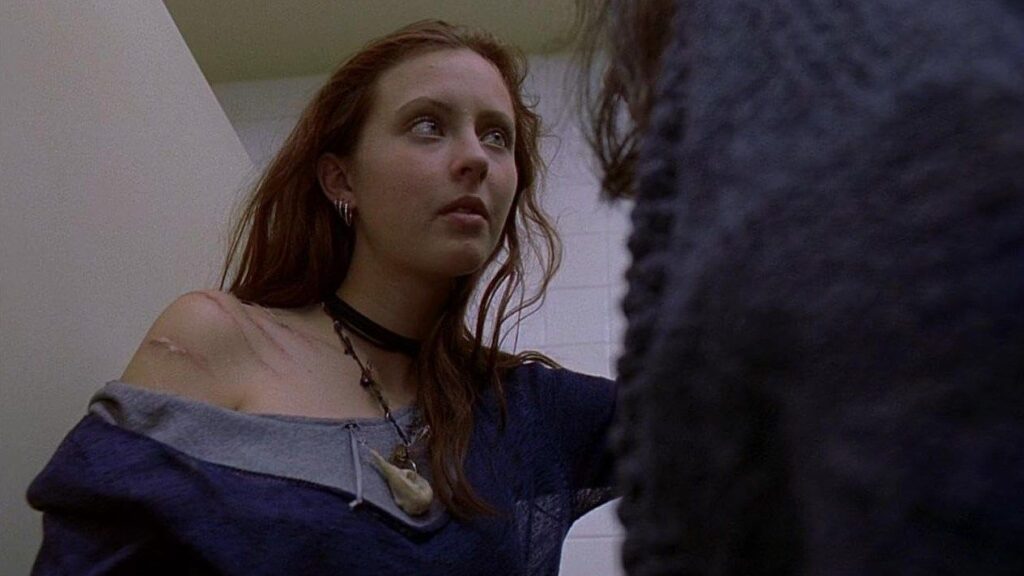
Despite its teen horror leanings, director John Fawcett and writer Karen Walton came up with the idea for Ginger Snaps out of a desire to create a horror movie that was distinctly female and subversive. They wanted to craft something that would speak to women and address the topic of female puberty head-on.
This desire actually ended up becoming a bit of an albatross around the neck when it came to getting this movie produced. It sat in development hell for years because studios just weren’t comfortable with the themes of two death obsessed teen girls coming of age. It was considered too dark and, unfortunately, too feminist leaning.
Ginger Snaps almost never made it to production
Things were looking very bleak indeed. Eventually, Canada’s main federal film financing agency, Telefilm Canada, along with other provincial and government backed sources, jumped on board and the movie was finally green-lit. That’s when it ran into more problems. This time in an altogether more tragic form.
The Columbine Massacre occurred right as pre-production was taking place. All of a sudden, teen-centric violent horror movies suddenly had the spotlight aimed at them. A Canadian national paper ran a story about government money being used to fund a teen slasher and it caused a media storm.
Ginger Snaps had a foot in the starting blocks but looked like it might never get a chance to actually join the race. Luckily, the team managed to move past these issues to begin work on their dream project and the rest is history.
Through Struggle Comes Strength
Ginger Snaps follows two sisters with an extremely close yet worryingly co-dependent relationship. This means Fawcett needed to catch lighting in a bottle when it came to casting. Luckily, Emily Perkins (Of the It minseries fame) and Katharine Isabelle hit it off tremendously in auditions and had an almost instantaneous chemistry, together.
Isabelle, just 18 at the time, had already been acting for a decade and the 22 year old Perkins started around a similar time. Despite Perkins’ turn as Beverly in 1990’s It and Isabelle’s supporting role in 1998’s Disturbing Behaviour, neither were picked for their name value. Their casting was purely down to that aforementioned instant chemistry between the two.
To say that decision paid dividends would be an understatement. As the backbone of the film, these two are absolutely fantastic. Brigitte and Ginger are entirely believable as a pair of morose teen sisters. You really get the sense that they actually share a history together and know what each other is thinking.

It’s these parts of the movie that shine in a way that few other teen horrors could ever hope to. The sisters have a compelling dynamic thanks to Ginger’s somewhat domineering personality and Brigitte’s somber and restrained affect. Their status as outcasts is frequently cemented by Ginger’s willful antagonising of the people around her.
Their home life is equally enjoyable. They divide their time between staging elaborate death scenes for photographs and clashing with their overly invasive mum, played brilliantly by Mimi Rogers. It isn’t until Ginger is bitten by a werewolf that the horror starts to turn up a notch.
A Metaphorical Kind of Monster
Ginger falling victim to the Lycanthrope just so happens to fall in line with the onset of her first period. This creates a parallel narrative between the sexual maturation of Ginger herself and the onset of her transformation into a werewolf. Obviously, one is used as an analogy for the other and it works extremely well.
As Ginger starts to change physically, first growing hair from the wound the werewolf left her with, she changes in mentality. Suddenly, hanging out with her sister is way down the bottom of her list of priorities. She’s now dressing more provocatively, hanging with the cool kids, and having no difficulty attracting boys.
“Isabelle and Perkins are fantastic; they both deliver, quite easily, two of the best performances in teen horror history.”
Ginger also has a new found propensity towards violence and the neighbour’s dogs begin mysteriously dying. She relates how at first she thought it was a desire for sex but the realised that the only thing that felt good was ripping living things apart. Brigitte, obviously alarmed, enlists the help of the local school drug dealer to help her find a cure.
A Coming of Age For The Outsiders
Ginger Snaps is, at its heart, a true coming-of-age movie. That’s where its strength really lies. It’s a story about a girl’s transition into womanhood and all the genuinely scary things that come along with that. Some of them feel good, some are rather worrying, others transform you into a person you simply don’t recognise. It’s extremely well crafted, in that respect.
Presenting it from a horror lens makes it more palatable to a younger audience, in a lot of ways. Stories like this are typically told as if the person watching has already gone through these things. This movie talks directly to the people going through them right now. That lends the narrative a sense of connection with the audience that a lot of movie’s lack.

Fawcett really manages to corner another audience, as well, by expertly tapping into the girl’s outsider tendencies. These are two people who absolutely hate the vast majority of society. They don’t connect with them, they find people to be false, and they have no desire to pursue what regular people pursue.
In a post-columbine world, this character presentation was immensely brave. The depiction of teenage characters as sombre and melancholy outsiders had been somewhat villainised thanks to the media portrayal of the killer’s at the centre of that crime. This movie represented a quick pivot back towards accepting that not everyone is going to fit neatly into society’s box.
A Compelling Relationship Dynamic
Ginger Snaps has an extremely bleak vibe for much of its length, reflecting the inner turmoil our protagonists feel. This is going to connect instantly with anyone who has ever felt different or like they don’t fit in.
That bleakness is maintained almost throughout. I still think Ginger and Brigitte’s bedroom is one of the most depressing locations in horror. Having been cleverly designed to almost look like a prison. It only really lifts as Ginger begins to embrace her transition from teenager girl into animalistic killer.
The sister’s relationship, and its gradual erosion, makes for the perfect vehicle to carry the story. It’s executed in an entirely believable fashion, going through peaks and troughs before eventually coming apart at the seams.
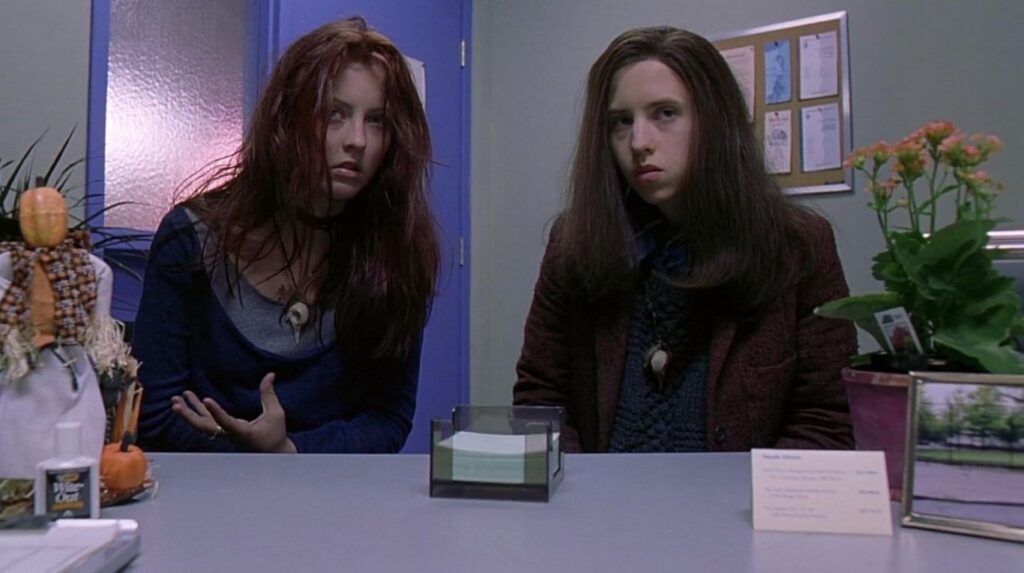
In Ginger’s maturation, the girls go from being devoted to each other to suddenly feeling like strangers. That camaraderie suddenly twists into conflict and rivalry, with neither sister completely understanding what the other wants or desires. Suspicion suddenly reigns where love and devotion once sat.
I can’t think of too many horror films aimed at a young audience that so accurately reflect the turbulent nature, and delicate balance, of female relationships. It’s impossible not to invest and Brigitte acts as the perfect avatar for the viewer, reflecting their concern at Ginger’s transformation.
A Brilliant Script and Even Better Performances
I might be going out on a limb saying this but I think Karen Walton’s script is one of the best ever in a modern teen horror. It manages to be legitimately funny while never leaning into full blown comedy. All while perfectly relating the very personal struggles of female puberty to an audience that is, perhaps, mostly male.
“The movie really falls foul of a derivative werewolf design and some extremely lousy practical effects. Ginger’s complete transformation looks terrible and moves even worse.”
She never condescends to the viewer and everything is presented in a distinctly matter-of-fact manner. Walton also manages a deft balance between authentic dialogue and brilliantly dry humour that keeps it quite light even when the movie starts to get very dark.
I find Ginger Snaps to be endlessly quotable, as well. Ginger’s “supernova” speech is one of my all time favourites. Of course, the script wouldn’t work without some stellar performances. There isn’t a weak link in this entire cast. Everyone from Kris Lemche to John Bourgeois and all the cast members in between are on top form.
Isabelle and Perkins are fantastic; they both deliver, quite easily, two of the best performances in teen horror history. Isabelle, in particular, is utterly incredible as Ginger. She never misses and I will always struggle to understand why she didn’t have the same ascension into Hollywood that people like Anya Taylor Joy did.
Dropping The Ball Big Time
Ginger’s practical effects based transformation looks, for the most part, excellent. It’s not your standard, one minute they are a human the next they are a wolf, style of metamorphosis. It’s quite gradual. First she grows a tail, then her teeth change, etc etc, all taking place over an extended period.
The way this is reflected in Ginger becoming more physically attractive alongside those more beastly changes works extremely well with the puberty metaphor. While much of the analogous stuff is a little on the nose, it’s no less effective for it. After all, teen horror isn’t exactly the perfect home for subtlety.

Where I think Ginger Snaps really drops the ball is in the moments where it turns full blown horror. For the first hour plus, it is, for the most part, pretty formulaic stuff, though elevated by some great scripting and a wonderful performance by Isabelle. It’s never really a big problem, despite that. The subtle changes Ginger experiences are enough to keep the horror element consistently interesting. The ending, however, is a big let down.
The last twenty minutes, or so, devolve into completely formulaic werewolf horror territory. It’s dull, predictable, and entirely unremarkable. The movie really falls foul of a derivative werewolf design and some extremely lousy practical effects. Ginger’s complete transformation looks terrible and moves even worse. It’s a big step down from even older movies like An American Werewolf in London.
The suspenseful cat and mouse stuff plays out as a very disappointing end to an otherwise brilliant movie. It’s overly long, lacking in tension, and completely fails when attempting to balance scares with emotional impact. It’s hard not to feel like the movie’s runtime is needlessly extended to fit this otherwise lacklustre sequence in.
The Good, The Bad & The Ugly
The Good
- The Metaphor: Using lycanthropy as a metaphor for female puberty is genius, and it’s executed perfectly here.
- The Cast: Katharine Isabelle and Emily Perkins are legendary. Their chemistry drives the entire film.
- The Script: Karen Walton’s writing is sharp, funny, and never talks down to its audience. It’s endlessly quotable.
- The Vibes: It captures that gloomy, autumnal suburban atmosphere better than almost any other horror movie.
The Bad
- The Finale: The final showdown descends into generic creature-feature territory and loses the smart edge of the first two acts.
- The Werewolf: While the gradual transformation effects are great, the full “suit” at the end looks a bit goofy by modern standards.
The Ugly: The practical effects of the full wolf. It moves stiffly and looks a bit like a skin-rug, which sadly takes the tension out of the climax.
Should You Watch Ginger Snaps?
If you haven’t seen Ginger Snaps, stop what you are doing and watch it now. It is one of the best teen horror movies of the 2000s and a masterclass in how to write smart, female-led horror. The relationship between the sisters is compelling, the humour is razor-sharp, and it perfectly captures the angst of being an outsider. Even with a slightly wonky finale, it is a 4-star classic.
This review was part of our 31 Days of Halloween 2025 Marathon. Check out the full category for more recommendations.
You might also like:
- Control Freak (2025) review – A dull, repetitive itch that never gets scratched
- Trick ‘r Treat (2007) Review – The Ultimate Cinematic Ode To Halloween
- Deadstream (2022) Review – An Inventive and Hilarious Found Footage Riot
- The Final Rose (2022) Review – A Reality TV Slasher With No Bite
- Saint Maud (2019) Review – A Chilling Descent into Religious Mania
Our Scoring Philosophy: A Fair Fight
Horror is a genre that thrives thanks to indie film makers and low budget creators. At Knockout Horror, we firmly believe that every movie that we review deserves a fair fight. That's why we grade on a curve. Our star ratings are all about context, judging a film on what it achieves with the resources it has.
A 4-star rating for a scrappy indie horror made for $10,000 is a testament to its ingenuity and raw power. A 4-star rating for a $100 million blockbuster means it delivered on its epic promises. We don't compare them side-by-side; we celebrate success in every weight class, from the back-alley brawler to the heavyweight champion. Please keep this in mind when considering star ratings.
Support the Site Knockout Horror is a participant in the Amazon Services LLC Associates Program. Basically, if you click a link to rent or buy a movie, we may earn a tiny commission at no extra cost to you. As an Amazon Associate, I earn from qualifying purchases. This helps keep the lights on and the nightmares coming. Don't worry, we will never recommend a movie purely to generate clicks. If it's bad, we will tell you.
Disclaimer: Images, posters, and video stills used in this review are the property of their respective copyright holders. They are included here for the purposes of commentary, criticism, and review under fair use. Knockout Horror makes no claim of ownership and encourages readers to support the official release of all films discussed.