Candyman (1992) Review – A Groundbreaking, Socially Conscious Gothic Masterpiece
Candyman: Quick Verdict
The Verdict: A towering achievement in the horror genre that masterfully blends gothic romance with visceral slasher elements and sharp social commentary. Candyman (1992) succeeds by grounding its supernatural terror in the very real, systemic horrors of Cabrini Green, making the environment as menacing as the titular antagonist. Tony Todd delivers a legendary performance, imbuing the Candyman with a tragic depth and a soft-spoken authority that redefined the modern movie monster. Virginia Madsen is equally compelling as Helen, providing a vulnerable yet determined lead who anchors the film’s exploration of myth and reality. This 4 star effort is a mandatory watch for any serious horror fan, serving as a foundational text for the socially conscious horror movement. It is a bold, beautiful, and profoundly disturbing masterpiece.
Details: Director: Bernard Rose | Cast: Virginia Madsen, Tony Todd, Xander Berkeley | Runtime: 1h 39m | Release Date: 1992
Best for: Fans of sophisticated supernatural horror, viewers who appreciate strong social subtext, and those looking for an all-timer horror performance.
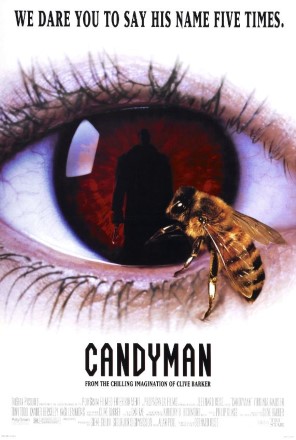
Worth noting: To achieve the desired level of realism, over 200,000 real honeybees were used during production, with Tony Todd wearing a protective mouth guard for the film’s most famous shot.
Where to Watch: VOD, Amazon🛒
Rating: 4/5 Stars
(A masterfully directed and intellectually stimulating horror classic that weaponises urban legend and social inequality into a uniquely haunting and visceral gothic nightmare.)
Welcome to Knockout Horror. Today we are reviewing Candyman from 1992.
Table of Contents
Candyman – Candyman – Candyman
Repeat his name five times in the mirror and he shall appear. This was the legend of the Candyman. Helen Lyle, a university student played by Virginia Madsen, is researching urban legends and learns of the tale of the Candyman. Over two dozen murders have been attributed to the Candyman, including a recent killing in a local project. Deciding to investigate, she heads to the projects of Cabrini Green. The only problem is, before she left she repeatedly uttered Candyman’s name in front of a mirror… She’s about to learn just how real the legend of Candyman is.
“Candyman took the very real subject of racism in America and brought it to horror fans in its most visceral form. The setting of Cabrini Green is a monster in and of itself.”
Candyman took the very real subject of racism in America and brought it to horror fans in its most visceral form. This is a movie that blends psychological horror with slasher tropes and even some subtle romance. It is frequently brutal, utterly compelling, and legitimately scary. What’s crazy is, Candyman never feels like it has to go out of its way to be scary. Much of that is down the location. Placing a supernatural villain in the projects rather than in middle white suburbia was an inspired decision. The setting of Cabrini Green is a monster in and of itself.

Bernard Rose and Virginia Madsen scouted locations on Cabrini Green and were left disturbed by the experience. Shooting on location required deals being made with local gang members to include them in the movie in exchange for protection. Hell, even one of the methods used to highlight the death of a character in the movie was something that happened in a Chicago project in real life. The impact of racism on a community and the cycle of poverty was as much of a villain as the Candyman himself.
It was genuinely scary and still is
The gritty location here made this feel like a supernatural tale with a degree of feasibility. The twists and turns of the apartment complexes on Cabrini Green hide many secrets. It’s not out of the realms of possibility to believe some of them are of the non-human variety. The antagonist himself was terrifying, as well. A towering man who speaks in a soft yet commanding voice. The iconic lines he utters only add to the buy-in. This was a creature warped by cruelty; calculated yet horrendously violent. It’s captivating stuff.
“The antagonist himself was terrifying, as well. A towering man who speaks in a soft yet commanding voice. The iconic lines he utters only add to the buy-in.”
Candyman was something of a ground-breaker in the horror genre when it came to its themes. A monster created directly by the racism of white people a generation or three before. It was brutally misunderstood on release. There was the suggestion that the movie perpetuates fears middle class white people have about black communities. The reality, however, is perhaps more how white people are scared to look at the issues racism had created for black communities.


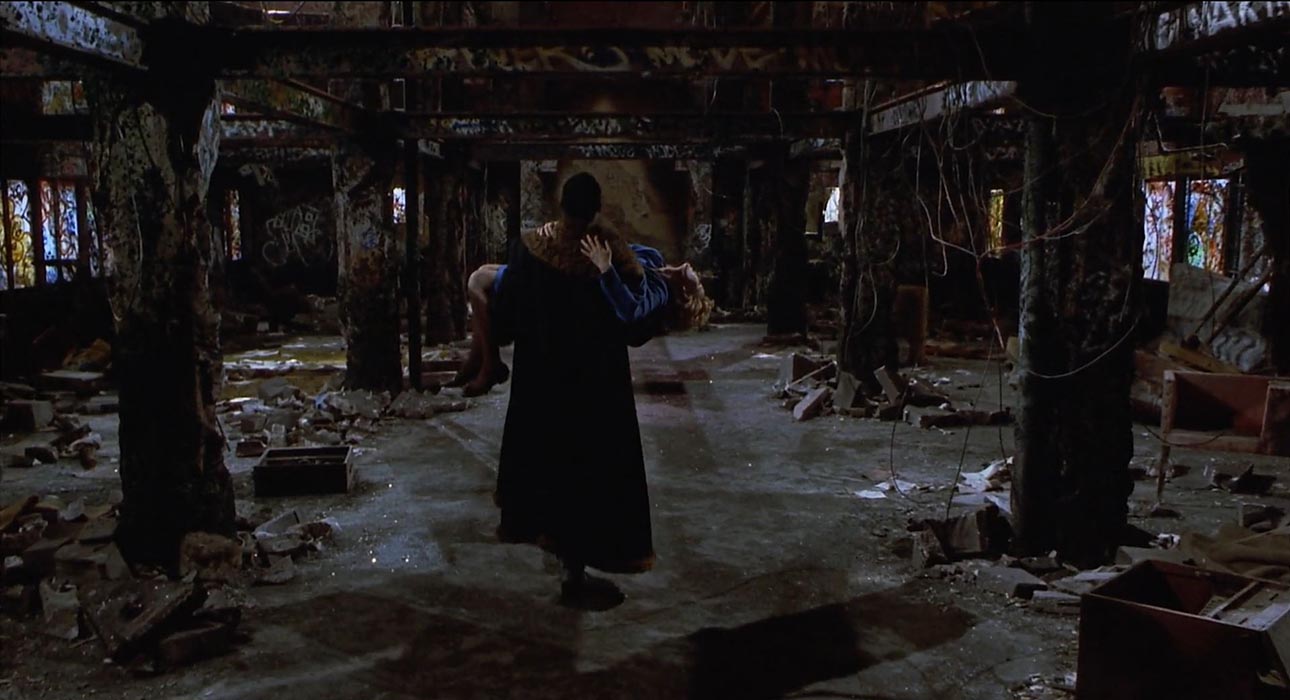
Candyman was a supernatural monster who was formerly a slave. Cabrini Green was a place that was destitute and home to massive amounts of violence. Rose held a mirror up to America and showed it what it had created and people weren’t happy about that. In an era where movies like Get Out are celebrated, it’s important to remember some of the movies that laid the groundwork for socially conscious horror. Candyman is one of them.
Candyman is still an unsettling film that will stay with you. The issues presented were very real then and they are still real now. Candyman‘s social commentary would be just as relevant in a modern setting.
A truly memorable performance
I am a huge fan of Candyman. With that in mind, I am obviously going to be pretty biased here. I genuinely believe that Tony Todd, as the Candyman, gives one of the most memorable, and fantastic performances in horror history. He is genuinely terrifying without ever really needing to resort to tried and tested horror tropes. He has a quiet, sinister, demeanour that stays with you long after the movie is done. It helps that Tony Todd is a huge guy standing 6′ 5″. He looks every bit the intimidating boogieman of legend.

Virginia Madsen is also excellent as Helen. She’s not your ordinary horror protagonist. She is actually very flawed. This only adds to the intrigue as she is slowly tormented. There’s a message here that Helen’s fate is of her own doing and Madsen conveys that quietly and effectively.
“Tony Todd, as the Candyman, gives one of the most memorable performances in horror history. He is genuinely terrifying without ever needing to resort to tried and tested tropes.”
Nothing in Candyman is played for laughs or with that typical cheesiness common to horror of this era. It is deadly serious and all the better for it. Bernard Rose wants viewers to realise that, regardless of this being a movie, much of the horror present is very real.
Crazy movie making techniques
Cinematography is great. Cabrini Green is a depressing place albeit full of life. The area is rife with boarded up windows, poor construction, and dilapidated buildings. The camera perfectly captures the everyday plight of the ordinary people attempting to survive against a backdrop of poverty and institutional racism. There are some interesting set designs including a creepy gothic church that really stand out. The obvious contrast between the richer areas of Chicago and the projects highlight the disparity between how the communities in the area lived.
Candyman evidently featured some real commitment to the cause of authentic filmmaking. Real bees were used for pretty much every scene featuring them. Virginia Madsen was, apparently, highly allergic to bee stings so this was likely terrifying for her. Tony Todd actually had to have bees placed in his mouth for one scene. He was stung over 20 times during production but, smartly, managed to negotiate a $1000 bonus for each sting. Not nearly enough if you ask me.
The bees weren’t the only unusual method employed during filming. For scenes where the Candyman talks to Helen, Virginia Madsen was actually hypnotised. This was to reflect the effect Candyman had on her. That shows a level of creativity, and something of a reckless disregard for your cast, that you don’t see much anymore. I believe the pay off is significant, however, as those scenes are fantastic and truly impactful.
The Good, The Bad & The Ugly
The Good
- Tony Todd: Delivers a truly iconic performance, creating a villain with immense gravitas, tragedy, and a genuinely bone-chilling physical presence.
- Atmospheric Score: Philip Glass provides one of the greatest horror soundtracks in history, lending the film an elegant and mournful gothic tone.
- Social Relevance: The film’s examination of racial trauma and urban decay is handled with a level of maturity that was decades ahead of its time.
The Bad
- Bleak Tone: The unrelenting misery of the setting and the tragic nature of the story can make this a very heavy and draining experience.
- Uncomfortable Themes: Some viewers may find the depiction of poverty and racial tensions in the projects difficult or exploitative.
- Slow Crawl: The film prioritises mood and mystery over fast-paced action, which may not appeal to fans of more energetic 90s slashers.
The Ugly: The Bee Mouth. A practical effect so visceral and dangerous that it has become an indelible and skin-crawling image in the minds of horror fans.
Should You Watch Candyman?
Yes, absolutely. It is a 4 star film that represents a high-water mark for 90s cinema. If you value horror with brains, a haunting atmosphere, and top-tier acting, Candyman is essential viewing. While its proximity to real-world issues makes it a tough watch, the technical brilliance and the legendary presence of Tony Todd make it a mandatory experience for anyone who appreciates the genre. It is an intelligent, technical, and profoundly disturbing masterpiece that rightfully earned its place in history.
You might also like:
- The Dead Thing (2025) review – Arthouse romance masquerading as horror
- Dark Match (2024) review – Chris Jericho’s satanic wrestling horror
- Lovely, Dark and Deep (2023) Review – A Tense Missing 411 Inspired Wilderness Horror
- I Know What You Did Last Summer (2025) review – A soul-less sequel
- Carrie (1976) Review – A Timeless Masterpiece Of Supernatural Revenge
Our Scoring Philosophy: A Fair Fight
Horror is a genre that thrives thanks to indie film makers and low budget creators. At Knockout Horror, we firmly believe that every movie that we review deserves a fair fight. That's why we grade on a curve. Our star ratings are all about context, judging a film on what it achieves with the resources it has.
A 4-star rating for a scrappy indie horror made for $10,000 is a testament to its ingenuity and raw power. A 4-star rating for a $100 million blockbuster means it delivered on its epic promises. We don't compare them side-by-side; we celebrate success in every weight class, from the back-alley brawler to the heavyweight champion. Please keep this in mind when considering star ratings.