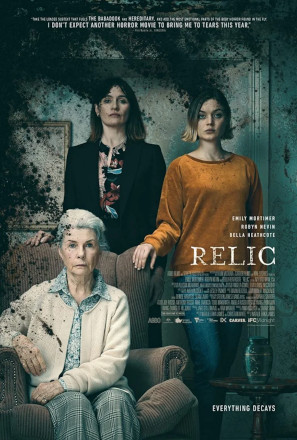
Relic (2020) Ending Explained – The Real Meaning of the Monster
Movie Details: Director: Natalie Erika James | Runtime: 1h 29m | Release Date: 2020 | Star Rating: 4/5 Stars
Welcome to Knockout Horror. Today, we are explaining the ending to the Aussie psychological horror Relic (2020). This film puts a monstrous spin on the very real trauma of witnessing a parent suffer from dementia. It is less about jump scares and more about the heartbreak of losing someone while they are still alive. If you haven’t seen it yet, read our spoiler-free review first.
⚠️ Warning: Major spoilers follow below.
The Ending in Brief
The TL;DR: Edna is not possessed by a demon; she is in the final stages of dementia. The “monster” is a physical manifestation of the disease consuming her. In the finale, Kay stops fighting and “peels” away Edna’s rotting skin to reveal a frail, blackened figure underneath. She carries this figure to bed, accepting her role as a carer. The final shot shows a black spot appearing on Kay’s back, implying the condition is hereditary and she is next.
Was Edna a monster? Metaphorically, yes. Her transformation represents how dementia changes a loved one into a stranger, making them unrecognisable and frightening to their family.
What is the Mould? The black mould spreading through the house represents the physical spread of the disease. Just as the house rots, Edna’s mind deteriorates.
What does the ending mean? It is about acceptance. Kay realizes she cannot “save” her mother, she can only care for what remains of her. The cycle of trauma continues with Sam witnessing the mark on Kay.
Table of Contents
Relic (2020) Ending Explained
Let’s strip away the skin of this movie and look at what is really going on underneath. No plot recap here, I’m sure you don’t want to read all that again. Relic is heavy on symbolism, so to understand the ending, we have to stop looking at it as a monster movie and start looking at it as a tragedy.
The Metaphor: Why Is The House Warping?
The shifting, impossible architecture of the house isn’t just scary; it’s a direct visual representation of Edna’s deteriorating mind. This is the most obvious explanation to address first.

- The Labyrinth: Just as Edna gets lost in her own memories, the house becomes a maze where rooms disappear and hallways lead nowhere. Sam getting trapped inside symbolises the confusion and isolation a dementia sufferer feels when their own mind betrays them.
- The Clutter: The piles of hoardings and post-it notes represent fragmented memories that no longer make sense to Edna.
- The Walls Closing In: The physical shrinking of the corridors mirrors the shrinking of the brain (atrophy) that occurs in late-stage dementia, trapping the person inside a diminishing world.
None of this is actually happening, it’s just a horror depiction of a very real and infinitely more scary condition. Sam and Kay are walking through this house as they are part of the condition, too. They experience Edna’s dementia as something terrifying in their own way.
Was Edna actually a monster?
Not in a literal sense. Writer/Director Natalie Erika James uses the monster as a vehicle to depict the horrors of dementia. To Kay and Sam, Edna becomes a monster because she acts violently, forgets who they are, and looks physically different (the bruising and decay).

The violence, the locking of Jamie in the closet, and the aggression are all symptomatic of late-stage dementia (specifically the “sundowning” phenomenon). Edna isn’t evil; she is confused, scared, and losing control of her faculties.
Medical Context: What is “Sundowning”?
Edna’s terrifying behavior in the film, where she becomes violent, confused, or wanders at night, is a troublingly accurate depiction of a real phenomenon known as Sundowning (or Sundown Syndrome).
Common in middle-to-late stage dementia, symptoms worsen significantly in the late afternoon and evening. Sufferers may experience:
- Increased Agitation: Pacing, yelling, or uncharacteristic aggression (like the scene where Edna attacks Kay).
- Hallucinations: Seeing people or things that aren’t there (the shadows Edna talks to).
- Capgras Delusion: The belief that a loved one has been replaced by an imposter (why Edna thinks Sam stole the ring or doesn’t recognise Kay).
The Skin Peeling Scene: Accepting the inevitable
The most shocking scene in the film occurs when Kay (Emily Mortimer) peels away the rotting flesh of her mother, Edna. This is not an act of violence, but an act of care. Throughout the film, Kay has been in denial about her mother’s condition, wanting to put her in a home or fix the unfixable.


When she peels the skin, she is literally stripping away the person Edna used to be. The black, frail figure underneath represents what dementia has left behind. By carrying this figure to bed and cuddling it, Kay is finally accepting the reality: her mother is gone, but she still needs to be loved and definitely needs to be cared for. It is a brutal metaphor for the “long goodbye” of terminal cognitive decline.
The Metaphor: The House is the Mind
The most brilliant trick Relic pulls is linking the house directly to Edna’s psychology. As Edna’s mind deteriorates, the house physically rots.
- The Mould: The black substance spreading on the walls represents the physical spread of dementia plaques in the brain.
- The Labyrinth: When Sam gets trapped in the impossible, shifting corridors, she is experiencing the confusion of a dementia patient. Edna’s mind is no longer a tidy home; it is a messy, terrifying maze where memories (represented by post-it notes and photos) are lost or buried.
What was the black spot on Kay’s back?
In the final seconds, Sam notices a small patch of black mould/rot on her mother Kay’s back. This confirms the film’s darkest theme: this condition is heredity. Just as Edna inherited this darkness from her father (the figure in the cabin), Kay has inherited it from Edna.

The cycle is continuing and Sam notices it instantly. She realises in that moment that one day, she will be the one peeling the skin off Kay, and eventually, she may find the spot on herself. It turns the ending from a moment of peace into a moment of existential dread.
Plot Detail: Who was the figure in the cabin?
The blackened corpse Kay sees in her dreams is her great-grandfather. Kay reveals that he suffered from dementia and was locked away in the cabin on the property to die alone, neglected by the family. This backstory explains Kay’s guilt; she is terrified of treating Edna the way her family treated the grandfather. The stained glass window from that cabin is now in the main house, symbolising that the “curse” has moved inside. Another clever visual metaphor to guide the viewer.
Frequently Asked Questions
Where was Edna at the start of the film?
Edna was wandering the streets for multiple days. This is a common phenomena with late-stage dementia. Sufferers often have no recollection or memory of where they were. This often results in extended searches involving the public and authorities.
Why did Edna bury the photo album?
Edna buried the photos because she felt her memories slipping away. In her confused state, she believed burying them was the only way to keep them “safe” from the thing (dementia) that was stealing them.
Why was Jamie locked in the closet?
Edna didn’t lock Jamie up out of malice. She was playing hide-and-seek, got distracted or confused, and simply forgot he was there. It is a tragic example of how dementia related memory loss can have dangerous consequences.
What was under the bed?
When Edna asks Kay to check under the bed, Kay sees a breathing shadow. This represents the disease lying in wait. The family tries to ignore it, but it is always there, growing in the dark until it consumes the person.
Is Relic similar to The Babadook?
Yes. Both are Australian horror films that use a monster as a metaphor for a psychological struggle. Where The Babadook explores grief and depression, Relic explores the trauma of aging and dementia.
Final Thoughts: The Horror of Heredity Decline
Relic is effective because it takes a monster we will all likely face, aging and decay, and gives it a physical form. The ending isn’t really a victory; it’s a submission to the cycle of life and death.
By ending on the image of the black spot on Kay, the film reminds us that trauma and illness are often passed down through generations. We care for our parents, watching them fade, all while knowing that we are slowly walking down the exact same path.
It’s quite frightening really and the theme resonates with me as I watched the very same thing with my own mum and dad who both died of cancer far too soon. It’s a bit on the nose at times but still effective. Thanks for reading.
Looking for a critique? For our verdict on the atmosphere, the slow burn, and a full rating, read our Relic (2020) Movie Review.
A Note on Ending Explanations
While we aim to provide comprehensive explanations based on the events on screen, film analysis is inherently subjective. The theories and conclusions presented in this "Ending Explained" feature are personal interpretations of the material and may differ from the director's original intent or your own understanding. That's the beauty of horror, right? Sometimes the scariest version is the one you build in your own head.
You might also like:
- Helloween (2025) review – Ronan Summers shines in this campy B-movie
- 32 Most Shocking & Disturbing Horror Movies: A Tiered Guide From Nasty to Unwatchable
- Silent Night (2021) review – A tonally disjointed apocalypse where nobody is likable
- The Conspiracy (2012) Review – A Chilling And Believable Deep Dive Into Paranoia
- I Know Exactly How You Die (2026) Review – Convoluted Meta-Horror Misses the Mark
Disclaimer: Images, posters, and video stills used in this horror ending explained article are the property of their respective copyright holders. They are included here for the purposes of commentary, criticism, and review under fair use. Knockout Horror makes no claim of ownership and encourages readers to support the official release of all films discussed.