
Calibre (2018) Ending Explained – A Life for a Life
Movie Details: Director: Matt Palmer | Runtime: 1h 41m | Release Date: 2018 | Star Rating: 4/5 Stars
Welcome to Knockout Horror. Today we are exploring the ending of the UK Horror Thriller Calibre. Calibre is a fantastic thriller available on Netflix, and while the ending is straightforward, the moral implications are pretty damn heavy. It goes without saying that this article will contain massive spoilers. If you haven’t watched the film yet, check out our Calibre review first. Alright, let’s go.
⚠️ Warning: Major spoilers follow below.
The Ending in Brief
The TL;DR: The cover-up fails. The villagers discover that Vaughn and Marcus killed a local boy and his father. Community leader Logan offers a brutal ultimatum: justice must be served for the father’s murder. Since Vaughn’s killing of the boy was an accident, he is offered a chance to live, but only if he executes Marcus. Vaughn kills his best friend to survive for his unborn child.
Why did Vaughn kill Marcus? It was the only way out. Marcus had murdered a community member in cold blood to save his own skin. The villagers demanded a “life for a life”. Vaughn chose his own family (his fiancée and unborn baby) over his reckless friend.
What happened to the bodies? The villagers disposed of Marcus’s body and his jeep. They agreed to tell the police that their relatives went missing, while instructing Vaughn to tell the authorities that Marcus left for the North. The community chose to bury the truth to avoid outside interference.
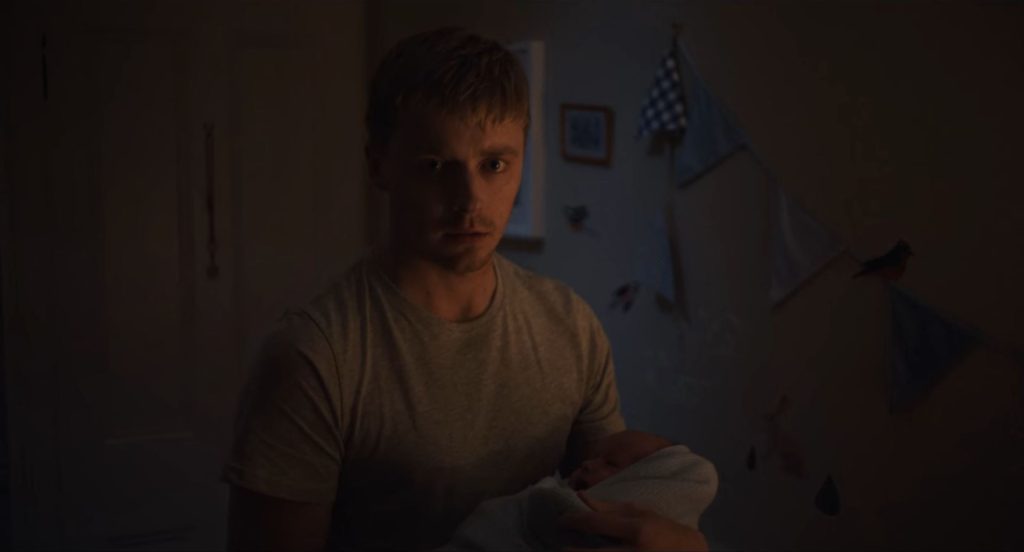
The Resolution: Vaughn returns home, traumatised but alive. The final shot shows him holding his newborn baby, staring into the distance, burdened by the heavy price he paid for his life.
Good to Know: The film’s ending reinforces the village’s code that “family comes first”. The villagers protect their own by hiding the crimes, and Vaughn ultimately adopts this same code by sacrificing his friend to ensure he can be a father to his child.
Table of Contents
Calibre Ending Explained
To understand the weight of the ending, we need to recap the spiral of bad decisions that led there but we are going to do it quickly. Marcus (Martin McCann) takes his friend Vaughn (Jack Lowden) to a remote Scottish village for a hunting trip. Vaughn is an expectant father, and this is meant to be a final weekend of freedom. Although close friends, the two share very different personalities. Marcus is reckless and impulsive and that’s where the problems start.
The Point of No Return
Hungover after a night of drinking and rather forgetful, Vaughn doesn’t bring his weapon along with him to the stalking trail. Marcus lets him use his second gun. Vaughn takes a shot at a deer but it bolts, leaving the bullet to accidentally hit and kill a young boy hidden behind it.

The boy’s father arrives, distraught and understandably aggressive. In a panic, Marcus shoots the father dead. Marcus reasons that they cannot go to the police because Vaughn was using the gun illegally, and they would both go to prison for years. He convinces Vaughn to bury the bodies and flee.
Unpicking The Logic: Why Didn’t They Call the Police?
The tragedy in Calibre is fueled by Marcus’s immediate, panicked risk assessment. In the UK, gun laws are incredibly strict. Vaughn was using Marcus’s rifle without a license, which is already a serious criminal offense for both the user and the provider.
Compounding this, Marcus knew they had cocaine in their systems and were hungover from heavy drinking the night before. In Marcus’s mind, calling the police wouldn’t result in a ruling of “tragic accident” – it would result in a guaranteed prison sentence for manslaughter and firearms offenses.
Marcus’s fatal flaw was his arrogance. He believed he could “manage” a double homicide better than he could manage the legal system. He traded a likely prison sentence for a gamble on getting away with murder, ultimately costing him his life.
The Trap Closes
The pair decide to hide the crime, head back to the village, collect their belongings and beat a hasty exist. Their escape is thwarted however, when Brian, a local, slashes their tires. This isn’t because of the murder (he doesn’t know yet), but because Marcus slept with his daughter, Kara, the night before and gave her cocaine.


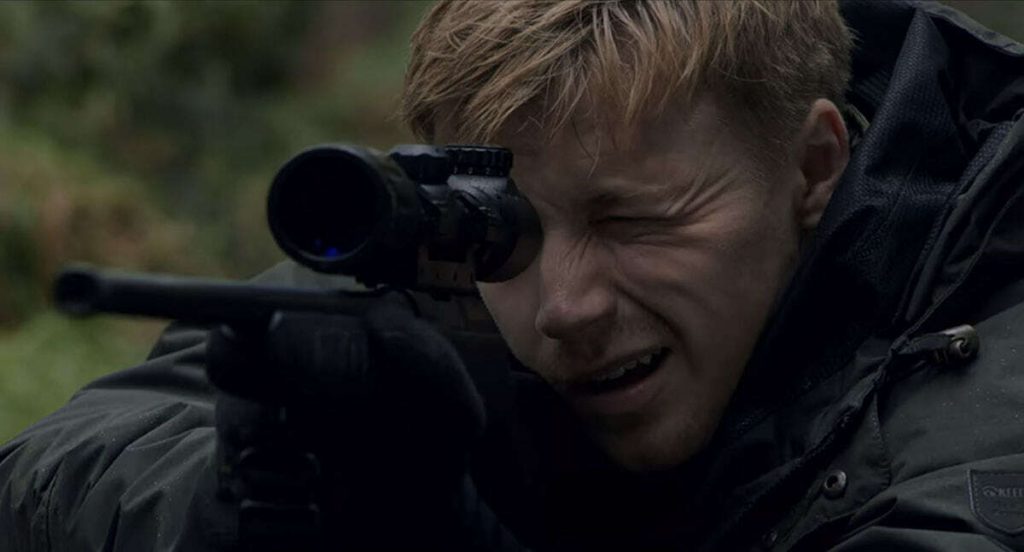
Trapped in the village while the car is fixed, a series of tense encounters leads to a seriously muddy atmosphere. Everything comes to a head when the pair are forced to join the search party for the missing father and son they just buried.
Inevitably, the bodies are found. A dog smells the grave, and the truth comes out. Marcus and Vaughn attempt to run, but they are out of their element. They are hunted down by the locals and brought back to the farm.
Dissecting The Trope: The Myth of Isolation
Marcus’s biggest mistake was assuming that the Scottish Highlands offered anonymity. Coming from the city, he believed that burying bodies in the “middle of nowhere” would buy them time. He failed to realise that to the locals, the forest isn’t “nowhere” – it’s their backyard.
In a community this small, routines are clockwork. The villagers knew exactly where the father and son were heading and exactly what time they should be back for dinner. When they didn’t return on schedule, the alarm was raised immediately. This is true of many small communities. I live in an isolated rural location but better believe the second we changed car everyone in the area knew it. News travels so fast.
This hyper-awareness is what doomed the pair. In a city, a disappearance might go unnoticed for days. In this village, an empty chair at the dinner table was immediate proof that a tragedy had occurred, mobilising the search party before Marcus and Vaughn even had a chance to fix their car.
Does Vaughn Shoot Marcus? The Ultimatum
Vaughn does shoot Marcus dead because he has no other option. If he doesn’t, he will be killed, too.
This is where Calibre shifts from a thriller to a tragedy. Logan (Tony Curran), the community leader, presents a brutal logic. If the police are called, the investigation will ruin the village. The media circus and scrutiny would destroy their way of life. Furthermore, justice must be served for the murder of the father.
Logan acknowledges that Vaughn killing the boy was a tragic accident. However, Marcus killing the father was a conscious act of murder. Therefore, Marcus must die. Logan gives Vaughn a choice: Kill Marcus, and you can go free. Refuse, and you both die.
Vaughn, broken and weeping, is forced to aim the shotgun at his best friend. Under extreme duress, he pulls the trigger, killing Marcus.
Horror Context: The Dying Community
Calibre grounds its horror in the very real economic decline of rural Scotland. The village is depicted as a place forgotten by progress, where traditional industries have vanished, leaving the community dependent on the money of “city slickers” like Marcus.
This creates a palpable tension. The locals need the tourism revenue to survive, but they resent the visitors who treat their home as a playground without respecting the land or the people. Marcus’s arrogance, flashing cash and buying drugs, symbolises this exploitation.
This socio-economic isolation explains the village’s fierce tribalism. Feeling abandoned by the government and the law, they have learned to rely solely on each other, making the decision to cover up the murders a desperate act of self-preservation rather than just malice.
The Cover-Up
The villagers are true to their word. They dispose of Marcus’s body and his jeep. They instruct Vaughn on exactly what to tell the police: Marcus left the village to head North, and Vaughn hasn’t seen him since.

The villagers will claim their own relatives simply disappeared, a mystery the Highlands will keep. Vaughn, knowing he has a child on the way who he needs to be there for, realises there is no other choice so goes along with the ruse.
What Does The Final Scene Mean?
Months later, we see Vaughn at home. He is safe, sleeping next to his fiancée. He walks into the nursery and picks up his newborn child. As he stares into the camera (or into the void), his expression is hollow. He is physically safe, but psychologically destroyed.
The ending emphasises that survival came at the cost of his soul. He prioritised his “blood” (his child) over his “water” (his friend), mirroring the values of the village that forced his hand. Though Marcus, in many ways, brought about his own fate through his impulsivity and aggression, Vaughn will always live with the trauma of what happened.
Thematic Spotlight: Tribalism and Rural Justice
The film paints a complex picture of rural isolation. The villagers are not mindless slashers; they are a tight-knit community abandoned by the rest of society. Their decision to handle the situation internally is born of a belief that the “outside world” (police, media, government) offers them nothing but trouble.
The film puts a spotlight on a dark moral relativism: In the village, protecting the community comes before the law. Vaughn survives only because he accepts this code, engaging in a primitive “blood for blood” exchange to protect his own future family.
Frequently Asked Questions
Why did the villagers let Vaughn go?
They recognised that Vaughn killing the boy was a genuine accident, whereas Marcus killed the father in cold blood. Logan also used Vaughn’s unborn child as leverage, knowing Vaughn would keep the secret to protect his family.
Who slashed the tires in Calibre?
Brian slashed the tires. This was unrelated to the murders initially. Brian was angry because Marcus had slept with his daughter, Kara, and gave her cocaine. This act of petty revenge ironically sealed Marcus’s fate by trapping them in the village.
Did Vaughn go to prison?
No. The ending implies the cover-up worked. Vaughn is back home with his family. However, the film suggests the psychological prison of guilt is the real punishment he must live with.
Was Marcus the villain?
In many ways, yes. While he didn’t intend for the boy to die, his arrogance, drug use, and toxic masculinity escalated every situation. He bullied Vaughn into the trip, supplied the illegal gun, and made the decision to murder the father rather than face the consequences. He was just a bit of a prick all round, really.
Final Thoughts
Calibre is a masterclass in tension and I absolutely loved it. It avoids supernatural elements to focus on the horror of human decision-making. The ending works because it feels inevitable; there was no clean way out of the mess Marcus created; he made his own bed. It’s a bleak, haunting conclusion that sticks with you long after the credits roll.
Thanks for reading. If you enjoyed this article, check out more of our Horror Movie Reviews. We update regularly with honest, unpretentious takes on the genre.
A Note on Ending Explanations
While we aim to provide comprehensive explanations based on the events on screen, film analysis is inherently subjective. The theories and conclusions presented in this "Ending Explained" feature are personal interpretations of the material and may differ from the director's original intent or your own understanding. That's the beauty of horror, right? Sometimes the scariest version is the one you build in your own head.
You might also like:
- Apartment 1BR (2019) Review – A Tense and Unsettling Study in Community
- The Conjuring: Last Rites (2025) review – A soulless end to the saga
- Twisted (2026) Review – Lauren LaVera & Djimon Hounsou Wasted
- Stalker (2022) Ending Explained – Rose’s Plan & The Phone Recording
- Discussing The Danielle Harris Reddit Drama
Disclaimer: Images, posters, and video stills used in this horror ending explained article are the property of their respective copyright holders. They are included here for the purposes of commentary, criticism, and review under fair use. Knockout Horror makes no claim of ownership and encourages readers to support the official release of all films discussed.