After Midnight (2019) Ending Explained – The Monster & The Metaphor
Movie Details: Directors: Jeremy Gardner, Christian Stella | Runtime: 1h 23m | Release Date: 2019 | Star Rating: 3.5/5 Stars
Welcome to Knockout Horror and to another Horror Movie Ending Explained. Today we are taking a look at the genre-bending horror romance, After Midnight. This is a pretty straightforward movie, but there are a few intriguing plot elements worth exploring deeper, specifically regarding the metaphor of the monster.
Naturally, this article contains spoilers. If you haven’t watched the movie yet, stop reading right now. Check out our review of After Midnight first; we enjoyed the movie a fair bit. Now, on with the explanation.
⚠️ Warning: Major spoilers follow below.
The Ending in Brief
The TL;DR: The monster is real. During Abby’s birthday party, the creature crashes through the window and attacks the group, proving Hank wasn’t hallucinating. Hank kills the monster using the antlers from a mounted buck head, an object Abby hated. In the aftermath, Hank proposes to Abby by revealing an engagement ring hidden inside a bottle of wine. She accepts, and they decide to face the future together.
Was the monster a metaphor? Yes, heavily so. The monster represents Hank’s fear of commitment and the “elephant in the room” regarding his stagnant relationship. It appears when Abby leaves and is killed only when Hank is finally ready to commit to her.
Why did Abby leave? She felt trapped. She sacrificed her love for city culture, art, and food to live in the rural wilderness with Hank. When Hank refused to marry her or move forward in life, she left to re-evaluate what she wanted.
The Resolution: Hank realises he has been selfish. By killing the monster with his prized hunting trophy (which he refused to take down for Abby), he symbolically sacrifices his old, stubborn identity to make room for their shared life.
Good to Know: The song Hank sings – “Stay (I Missed You)” by Lisa Loeb – was chosen because it was recognisable and affordable compared with other candidates they considered.
Table of Contents
After Midnight Ending Explained
No plot recap here, we don’t need to go through all that again. Let’s get to the explaining. To understand the ending of After Midnight, you have to look past the creature feature elements and view it as a relationship drama. The horror is secondary to the romance but the horror is most definitely real.
The Conflict: Stagnation vs. Growth
Hank (Jeremy Gardner) is a rural hunter who is obviously very comfortable in his ways. Abby (Brea Grant) is a city girl who loves wine, art, and culture. The central conflict isn’t the monster; it is the fact that Abby has compromised her entire identity to live in Hank’s rather dull world, while Hank has refused to compromise at all.

When Abby disappears, Hank spirals into a depression. He drinks heavily and becomes convinced a monster is attacking his house every night. His friends, including Abby’s brother Shane (Justin Benson), believe the monster is a hallucination caused by stress and alcohol. This sets up the central question: Is Hank crazy, or is the threat real?
Monsters as Metaphors
Horror cinema frequently uses monsters to physicalise internal emotional struggles – think The Babadook (grief) or It Follows (fear of intimacy).
In After Midnight, the creature serves as a manifestation of Hank’s fear of commitment. It only appears when Abby leaves, looming outside the door just like the conversation about marriage that Hank has been avoiding for years.
By ignoring the monster (the relationship issues), Hank allows it to grow stronger. He can only defeat it by literally facing it head-on and destroying the symbols of his bachelor lifestyle to make room for a shared future. It’s slightly on the nose but the metaphor definitely hits home.
Why Did Abby Leave?
Abby left because she was feeling trapped and unhappy in both her relationship and her living situation.
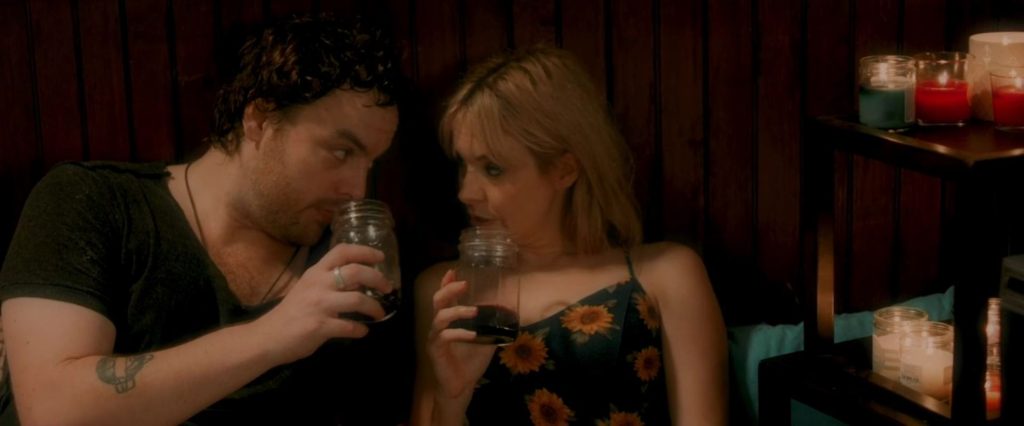
When Abby returns, the film shifts massively from a horror to a full blown domestic drama. She reveals she didn’t leave for another man; she left because she felt trapped. She wants marriage and shared experiences, but Hank is content with the status quo… He’s a bit of a dullard, to be honest. She spent her time away in Florida experiencing the things she missed – museums, sushi, and city life.
She challenges Hank: would he live in a cramped city apartment for her the way she has been living in a drafty old house for him? This conversation forces Hank to realise that his fear of change is driving away the only person he loves. To be perfectly honest, these two people seem way too different to actually spend their entire lives together without conflict, but whatever.
Why does Hank sing that song?
The climax of the film occurs at Abby’s birthday party. In a moment of extreme vulnerability (and horrible awkwardness), Hank sings Lisa Loeb’s “Stay (I Missed You)” to Abby on a karaoke machine. It is a gesture of trying to bridge the gap and reconnect on a base level.
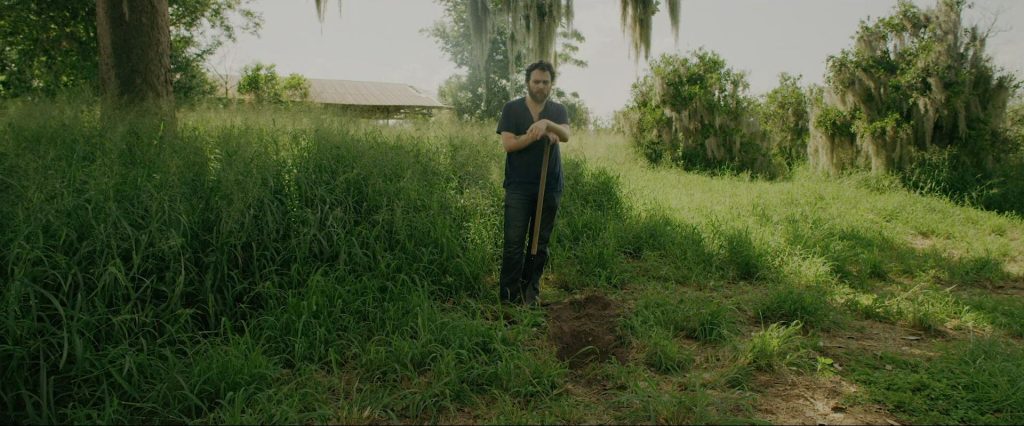
Using a song from a mixtape he made years ago, he is trying to remind her of when their love was fresh and not centred around anything other than pure affection. He’s also making something of a grand gesture about how he is willing to make himself uncomfortable to prove his love to her. Could they not have thought of another way to do it, though? This scene sucks!
Why “Stay” Fits Perfectly
The choice of Lisa Loeb’s “Stay (I Missed You)” isn’t just 90s nostalgia; the lyrics parallel Hank and Abby’s relationship issues almost line for line.
The opening line, “You say I only hear what I want to”s perfectly encapsulates Hank’s refusal to listen to Abby’s needs regarding marriage and city life. Later, the lyric “I don’t pay attention to the distance that you’re running” mirrors Hank’s total obliviousness to how far Abby was drifting away from him before she finally left.
By singing it, Hank is finally acknowledging the reality of their situation, using the very song he once used for an ex to finally fight for his current love. It’s still cringe, though.
Was the monster real and the symbolism of the kill?
Immediately after the song, the monster crashes through the window. This is the vindication Hank needs – the monster is physically real. It attacks the group, proving to Shane and Abby that Hank wasn’t losing his mind.

Hank kills the monster in a very specific way. He rips a mounted buck head off the wall – a trophy Abby hated and wanted him to remove – and uses the antlers to gore the creature to death.
This is heavy and extremely on the nose symbolism. By destroying the trophy to kill the monster, Hank is symbolically destroying his stubbornness. He is sacrificing the part of his life that was keeping them apart (his refusal to change his home environment) to save their relationship. He kills the “fear of commitment” (the monster) using the symbol of his “bachelor lifestyle” (the trophy).
The Justin Benson Connection
The sceptical police officer Shane is played by indie horror heavyweight Justin Benson, one half of the acclaimed directing duo Benson & Moorhead (The Endless, Spring, Marvel’s Moon Knight).
Benson and Gardner are close friends and frequent collaborators within the indie horror scene. Benson served as a producer on After Midnight, while Gardner previously had roles in Benson’s films Spring and The Endless.
It represents a fun crossover where one horror auteur (Gardner) directs another (Benson), allowing them to play off their real-life chemistry.
The Proposal
With the monster dead and covered in its blood, Hank picks up a bottle of “Peanut Noir” (a running joke in the film about his mispronunciation of Pinot Noir). He flips the bottle over to reveal an engagement ring sinking to the bottom.
He asks Abby if she wants to “drink another case of this shit” with him. It is a proposal and he is finally committing which Abby accepts. The film ends not with a scare, but with the couple united, having conquered both the physical threat and the emotional distance between them. Was that gooey enough for you?
Frequently Asked Questions
Was the monster in After Midnight real?
Yes. While it serves as a metaphor for relationship issues, the creature is physically real. During the climax, it breaks into the house and attacks everyone at the party, proving Hank was not hallucinating.
Why did Abby leave Hank?
Abby left because she felt unfulfilled. She had given up her love for the city, art, and culture to live a rustic life with Hank. Hank’s refusal to marry her or compromise on their living situation made her feel trapped and taken for granted.
What does the ending of After Midnight mean?
The ending signifies compromise. Hank kills the monster (his fears) using the taxidermy head (the old life Abby hated). By proposing, he signals he is ready to grow up and move forward with Abby, blending their worlds rather than forcing her to live in his.
What was the song Hank sang?
Hank sings “Stay (I Missed You)” by Lisa Loeb. The song was on a mixtape he made for a previous girlfriend, which Abby found. The lyrics reflect Hank’s realisation that he wasn’t listening to Abby’s needs.
Final Thoughts
After Midnight is a unique blend of mumblecore romance and creature feature. While the horror elements are sparse, the ending delivers a fairly satisfying punch of gore and emotion. It suggests that the scariest thing isn’t a monster in the woods; it’s the realisation that you might lose the person you love because you were too stubborn to change. The monster is still pretty scary, though… As is that awful karaoke scene.
Thanks for reading. If you enjoyed this article, why not stick around? I review horror movies, explain horror movie endings and make horror lists
A Note on Ending Explanations
While we aim to provide comprehensive explanations based on the events on screen, film analysis is inherently subjective. The theories and conclusions presented in this "Ending Explained" feature are personal interpretations of the material and may differ from the director's original intent or your own understanding. That's the beauty of horror, right? Sometimes the scariest version is the one you build in your own head.
You might also like:
- Smile (2022) Review – A Surprisingly Effective Study In Trauma And Psychosis
- Relic (2020) Ending Explained – The Real Meaning of the Monster
- Coraline (2009) Review – A Stunning and Sinister Stop-Motion Masterpiece
- One Cut of the Dead (2017) review – Meta-horror mastery from Japan
- The Wicker Man (1973) Review – The Definitive Folk-Horror Masterpiece
Support the Site Knockout Horror is a participant in the Amazon Services LLC Associates Program. Basically, if you click a link to rent or buy a movie, we may earn a tiny commission at no extra cost to you. As an Amazon Associate, I earn from qualifying purchases. This helps keep the lights on and the nightmares coming. Don't worry, we will never recommend a movie purely to generate clicks. If it's bad, we will tell you.
Disclaimer: Images, posters, and video stills used in this horror ending explained article are the property of their respective copyright holders. They are included here for the purposes of commentary, criticism, and review under fair use. Knockout Horror makes no claim of ownership and encourages readers to support the official release of all films discussed.