
The Swarm (2020) Ending Explained – Locusts, Blood & Sacrifice
Movie Details: Director: Just Philippot | Runtime: 1h 41m | Release Date: 2020 | Star Rating: 3/5 Stars
Welcome to Knockout Horror and to this The Swarm Ending Explained article. The Swarm (La Nuée) has a pretty self-explanatory ending, but that doesn’t mean we can’t clear it up even further for you. If you haven’t watched it yet, why not skip this article and check out our spoiler-free review of The Swarm? You can then come back and read this article for a nice sense of completion.
⚠️ Warning: Major spoilers follow below.
The Ending in Brief
The TL;DR: Virginie’s obsession with her locust farm spirals out of control when she discovers they reproduce faster when fed blood. The locusts eventually escape and kill the neighbour’s dog, the neighbour himself and Virginie’s love interest Karim. In the finale the swarm attacks Virginie and her daughter at a lake. Virginie cuts herself to attract the swarm then drowns them by diving into the water allowing her daughter to survive.
Why did Virginie feed them blood? She discovered accidentally that locusts fed on blood grew larger and reproduced faster. Desperate to save her failing farm and support her children she began feeding them her own blood and eventually the blood of animals.
Who died? Aside from various farm animals the locusts killed the family goat, the neighbour’s dog, the elderly neighbour and Karim.
The Resolution: The locusts are defeated by water. Virginie uses her own blood as bait to lure the swarm into the lake. Locusts cannot swim and their wings fail when wet causing the entire colony to drown.
Good to Know: The film operates as a metaphor for addiction. Virginie starts with small sacrifices of her own blood before moving to harder substances like animal blood and eventually sacrificing those around her to maintain the “high” of business success.
Table of Contents
The Swarm Ending Explained
No plot recap here, as always. Let’s get straight to the action and straight to explaining the ending. To understand the climax, we need to track Virginie’s (Suliane Brahim) descent into madness. A single mother struggling to keep her farm afloat after her husband’s suicide, she attempts to raise locusts for protein flour. The business is failing until she accidentally discovers that the locusts thrive on blood.
Thematic Spotlight: Horror in Sustainability
The Swarm taps into the very modern and real-world push for entomophagy which is the practice of eating insects as a sustainable protein source. In reality insect farming is often touted as the future of food because it requires significantly less water and land than traditional livestock like cattle or goats.
The film subverts this “green” solution by turning the tiny livestock into a predatory force. It highlights the inherent risks of monoculture farming where a single species is raised in massive numbers. If something goes wrong with the environment or the diet of the swarm the ecological consequences can be devastating.
By grounding the story in a real and struggling industry the film makes the horror feel more tangible. It is not just a monster movie but a look at how the pressures of modern agriculture and the “saving the planet” narrative can push a desperate farmer to dangerous extremes.
Why Does Virginie Need More Blood? The Escalation
Virginie starts small, letting the locusts feed on her arm. This is enough at first but the much healthier insects start getting it on on a much more frequent basis. As the swarm grows, her own blood isn’t enough to satiate them as they would suck her dry like a Capri Sun.

She starts buying animal blood to pacify them at first but supplies suddenly become hard to come by. She then kills her neighbour’s dog, and eventually sacrifices her son’s pet goat. Her physical and mental health deteriorates rapidly as all of this is happening, alienating her children, Laura and Gaston.
Dissecting The Trope: The Monstrous Mother
The Swarm uses the concept of the “Monstrous Mother” to drive its horror. Virginie is not just a mother to her children but also a surrogate mother to the locusts. She nurtures them, feeds them from her own body and protects them with a ferocity that eventually supersedes her human maternal instincts.


This perversion of motherhood is a common trope in horror but here it is linked specifically to economic survival. Virginie believes she is doing it all for her children but in reality she is sacrificing their safety for her obsession. The locusts become the favourite children who demand blood while her human children are neglected and endangered.
The ending sees a return to natural order. Virginie sacrifices her “adopted” children (the locusts) to save her biological daughter. It is a violent correction of the maternal instinct that had gone so horribly wrong.
What Happens to the Neighbour? The Breaking Point
The situation explodes when her suspicious elderly neighbour goes looking for his dog and enters the greenhouse. I hate how these movies always kill the damn dogs and cats. Why not think of some new ideas, damn it?

The locusts attack and kill him, consuming his blood in the process. Karim (Sofian Khammes), Virginie’s friend and potential love interest, discovers the body. Assuming Virginie killed the neighbour and horrified by what she has done, he decides to burn the greenhouse down to destroy the swarm.
How Does Karim Die? The Final Attack
Karim sets fire to the enclosure, but the swarm escapes. They attack and kill Karim immediately then pursue Virginie’s daughter, Laura, who flees to the nearby lake. Laura hides under an overturned boat, but the locusts are relentless, pushing the boat down to get to her.
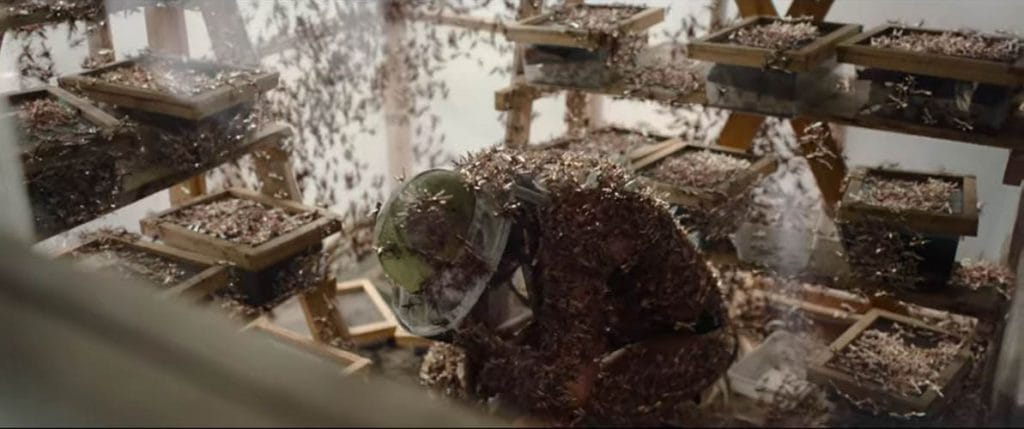
Virginie arrives and realises she has to put an end to this or her daughter will die. She slashes her arms and chest, covering herself in blood before screaming to attract the swarm’s attention. The blood-crazed locusts ignore Laura and attack Virginie. As they envelope her, she embraces the swarm and dives into the lake.
Dissecting The Trope:: The Swarm Mind
The Swarm relies on the biological concept of “phase polyphenism” which is the real process where solitary locusts transform into gregarious swarming monsters. In the film this transformation is triggered by the introduction of blood into their diet. This turns them from mere pests into a coordinated predatory unit.
The horror comes from their collective intelligence. A single locust is harmless but the swarm acts as a single organism with thousands of eyes and a shared hunger. This hive mind allows them to overpower much larger prey like dogs, goats and eventually humans by sheer weight of numbers and constant movement.
This trope is effective because it removes the possibility of reasoning with the antagonist. You cannot hide from a swarm that can smell blood through the mesh of a tent or the cracks in a door. The only solution is the one Virginie uses which is to exploit their collective instinct to follow the leader even if it leads them to a watery grave. Incidentally, having handled locusts due to keeping reptiles in the past, they are pretty harmless. I’ve never even been bitten by one… Can’t same the same about crickets, though… Yuk!
Virginie and Laura Survive: The Aftermath
The ending relies on a simple biological fact: locusts can’t swim. They can float but once they get wet they are pretty buggered.

When the swarm hits the water, they drown. Virginie nearly drowns as well but surfaces (or is pulled up by Laura), battered but alive. The final shot is ambiguous about her mental state, but the physical threat is gone.
Thematic Spotlight: Addiction and Sacrifice
The Swarm is less a creature feature and more a drama about addiction. Virginie is addicted to the success the blood brings her farm. Like a drug addict, she starts with small doses (her own blood), moves to harder substances (animal blood), and eventually hurts the people around her to maintain her supply.
The ending represents her hitting rock bottom. She has to physically destroy the source of her addiction (the locusts) and nearly destroy herself in the process to save her daughter.
Frequently Asked Questions
Did Virginie survive?
Yes. The final scene shows her embracing Laura in the water. She is severely injured and traumatised but she survived the drowning attempt.
Why didn’t the locusts eat Virginie earlier?
Virginie had built a symbiotic relationship with the swarm. She was their “mother” and provider. They fed on her without killing her because she controlled the feeding sessions. It was only in the finale when she offered herself as a total sacrifice that they swarmed her completely.
Was the neighbour’s death Virginie’s fault?
Legally and morally, yes. She was keeping dangerous genetically modified animals in an insecure environment. She also knew they had a taste for flesh after feeding them the dog making her liable for his death.
What is the meaning of the blood?
The blood represents the life force Virginie is draining from herself and her family to keep the business alive. It is a literal manifestation of the phrase “blood, sweat and tears”.
Final Thoughts
The Swarm is a bit of a frustrating movie. It has a great premise but gets bogged down in family drama and illogical character decisions. The ending is serviceable but feels a bit anticlimactic… Defeating a swarm of killer insects with a splash of water feels too easy. Still, for fans of eco-horror, it offers a unique spin on the genre.
Thank you very much for reading. Why not stick around? Check out some more Ending Explained articles. I also review horror movies and I also write horror lists.
A Note on Ending Explanations
While we aim to provide comprehensive explanations based on the events on screen, film analysis is inherently subjective. The theories and conclusions presented in this "Ending Explained" feature are personal interpretations of the material and may differ from the director's original intent or your own understanding. That's the beauty of horror, right? Sometimes the scariest version is the one you build in your own head.
You might also like:
- Deep Water (2026) Review – Shark Movie Isn’t a Disaster
- Ma (2019) Review – A Squandered Octavia Spencer Performance in a Dull Thriller
- I’m Haunted (2022) Review – A Derivative and Low-Effort Found Footage Slog
- It’s a Wonderful Knife (2023) review – A sweet and hammy festive slasher
- Vicious (2025) Review: A beautiful but empty Festive horror
Disclaimer: Images, posters, and video stills used in this horror ending explained article are the property of their respective copyright holders. They are included here for the purposes of commentary, criticism, and review under fair use. Knockout Horror makes no claim of ownership and encourages readers to support the official release of all films discussed.