

From Black (2023) Ending Explained – The Vessel & The Ritual
Movie Details: Director: Thomas Marchese | Runtime: 1h 40m | Release Date: 2023 | Star Rating: 2/5 Stars
Welcome to Knockout Horror. Today, we are tackling the Shudder original From Black. This is a huge article, so grab a coffee and strap yourself in, we’re unpicking a timeline that’s messier than a freshman’s dorm room.
Feeling like a derivative sibling to the far superior A Dark Song, From Black attempts to explore the intersection of the occult and the opioid crisis. We’re going to look at the ritual, the vessel mechanics, and a head-canon theory that makes the finale much more interesting than the film actually intended. Let’s get into it.
⚠️ Warning: Major spoilers follow below.
The Ending in Brief
The TL;DR: Cora successfully brings her son Noah back from the dead, but it’s not a “gift” – it’s a barter. After Abel’s original plan to use Cora as his replacement vessel fails (because she refused to drink the blood), Cora eventually makes a new deal with the demon. In the final scene, Noah returns to the house, but Cora is now the permanent vessel for the entity. She must find a new, “pure” person to pass the demon to before she can ever truly be with her son again.
What was the demon? The entity is an ancient Mesopotamian spirit that requires a human vessel. It offers to return lost loved ones in exchange for the host carrying its “blackness.”
Who died? Wyatt was murdered by the demon after Cora tried to use him as a sacrifice. The demon rejected him because he was “tainted” and “unclean”.
The Resolution: Noah is back (confirmed by the red shoe), but the cycle continues. Cora is free from the police station because her drug tests were clean and Wyatt’s body vanished, but she is now spiritually enslaved to the demon.
Good to Know: The film uses salt circles as a protective barrier, citing the purity of “Kosher salt” specifically to block the demon’s physical entry.
Table of Contents
From Black (2023) Ending Explained
As always, no plot recap, let’s get straight into the explaining. To understand From Black, we have to navigate a non-linear timeline that jumps between Cora (Anna Camp) in the present-day police station and the events leading up to the “blood-soaked house”.
Cora is a recovering addict who lost her son, Noah, seven years ago because she was too busy “singing with sweet lady H” to notice him wandering off to his death. Her sister, Allison (Jennifer Lafleur), is a cop who somehow gets assigned to her own sister’s cases – a clear violation of police ethics, but we’ll let it slide for the sake of drama.
The Mesopotamian Barter: How the Ritual Works
Abel (Will Patton), Cora’s therapy group leader, is the person who brings to the forefront the occult core of the film. He didn’t just lose his daughter; he brought her back. The ritual he uses is described as ancient Mesopotamian, revolving around the concept of a vessel. This isn’t a one-time magic trick, though; it’s a parasitic cycle that has lasted for millennia.

The rules are simple but pretty damn brutal: To bring someone back, you must host a demon. You carry the demon around (the vessel) until you can find another grieving person to take it off your hands. Easy, right?
Here’s the catch: the person currently holding the demon cannot see the loved one they brought back. They are simply existing in the same world, separated by the demon’s presence until said demon is passed on. Abel has been “vessel-sitting” for years, which is why he hasn’t actually seen his daughter in person yet.
He needs Cora to take the “blackness” so he can finally go home to his child but he doesn’t tell her this. He presents the situation as if it is a simple ritual with instant results.


The Occult Logic: Why Kosher Salt?
The film emphasises the use of Kosher salt to create a protective barrier that the demon cannot cross. In occult traditions, salt is a symbol of purity and preservation.
The “Pure” Requirement: Abel specifies Kosher salt because it lacks the additives found in common table salt (like iodine). In ritualistic magic, additives are seen as “impurities” that weaken the barrier’s spiritual frequency.
This mirrors the requirement for the “vessel” itself. The demon doesn’t want a “tainted” soul – which is exactly why Cora’s attempt to sacrifice her junkie ex-boyfriend, Wyatt, fails spectacularly later in the movie. Don’t ask me why it accepted junkie Cora, maybe all the grief purified her?
The Ritual’s “Instant Results” and Cora’s Guilt
Once Cora agrees to the ritual (cue the “vigorous rug-rolling” shot in the low-cut top), things move pretty fast. Unlike the weeks of grueling labor in A Dark Song, this ritual works like canned mac and cheese. Cora is floating and seeing visions within minutes like she downloaded an instant access “Summon Your Own Demon” app.
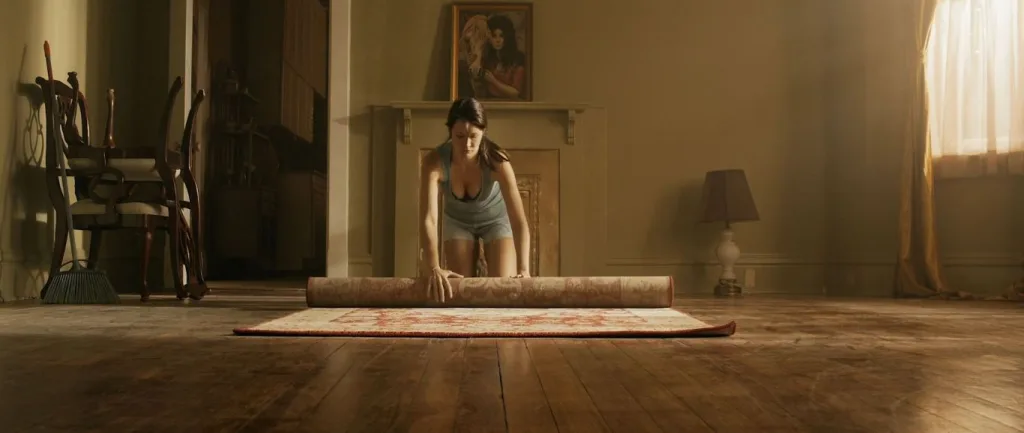
She is transported back to the day Noah was kidnapped, revealing that he was taken by a creepy man in a van and drowned in a bathtub. The demon uses these memories of grief to fuel the connection. We see all the usual occult like shenanigans but nothing of note before we make it to the final step and here’s the big reveal… Cora was being deceived.
The Ritual: Steps to Bartering with the Blackness
While the film keeps some of the ancient Mesopotamian specifics vague to maintain that “spooky mystery” vibe, the ritual Cora performs with Abel follows a very specific, high-stakes progression. Here are the key steps involved in bartering with the “Blackness”:
The Preparation: The ritual space must be protected using a circle of Kosher salt. This acts as a spiritual barrier to prevent the entity from physically manifesting outside the designated “vessel” area.
The Invitation: The participant must engage in rhythmic, ritualistic actions (like the “vigorous rug-rolling” or specific chants) to thin the veil and invite the entity’s presence.
The Vision Quest: Once the connection is established, the grieving person experiences intense, hallucinatory visions. These visions often force the participant to relive the trauma of their loss, which the demon uses as “fuel” for the bridge between worlds.
The Feast (The Day of Payment): To finalise the deal, the participant is required to consume “ritual meat” (represented in the film as goat meat). This symbolically represents the flesh, blood, and bone of the person they are trying to bring back.
The Vessel Transfer: The most critical step is the consumption of the “blood.” By drinking, the participant officially accepts the demon into their own body, becoming its new host (vessel). This act “pays” for the return of the loved one while simultaneously enslaving the host to the entity.
What Was The Deception?
The entire time, Abel was setting Cora up to become the new vessel so he could see his daughter.
The ritual reaches its “Day of Payment” in a sunny field where Cora is forced to eat goat meat (representing Noah’s flesh, blood, and bone). However, Cora realises that Abel actually set her up. He didn’t want to help her; he wanted to use her as his replacement vessel.
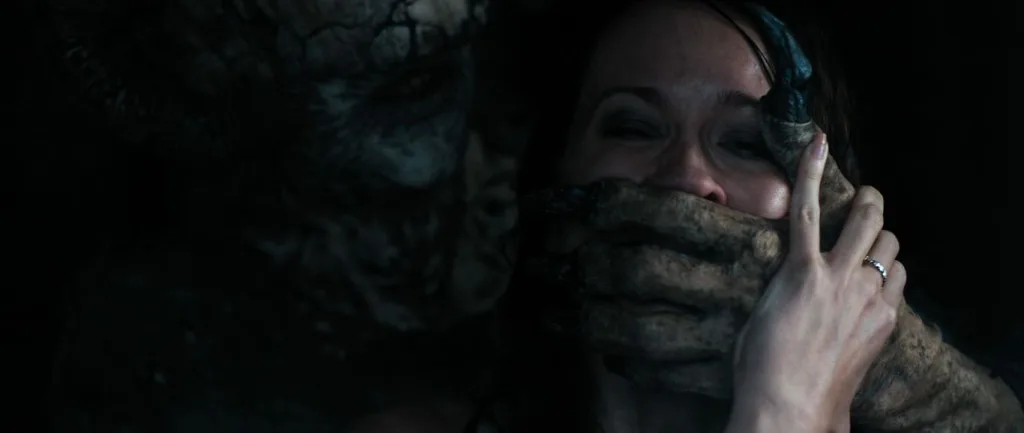
He planned to pass the demon on so he could see his child. This means that Cora would be stuck with the demon, unable to see Noah, and would have to do the exact same thing to someone else. Oh and with one caveat, the vessel must be someone pure.
Infuriated by the deception, Cora pours the blood on the ground and refuses to complete the transfer.
The Failed Sacrifice of Wyatt
Cora is transported back to the real world. The demon grabs her, pins her up against a wall, and tells her it wants what it is owed. If she doesn’t deliver it, it will take Noah away from her and subject him to an eternity of suffering.
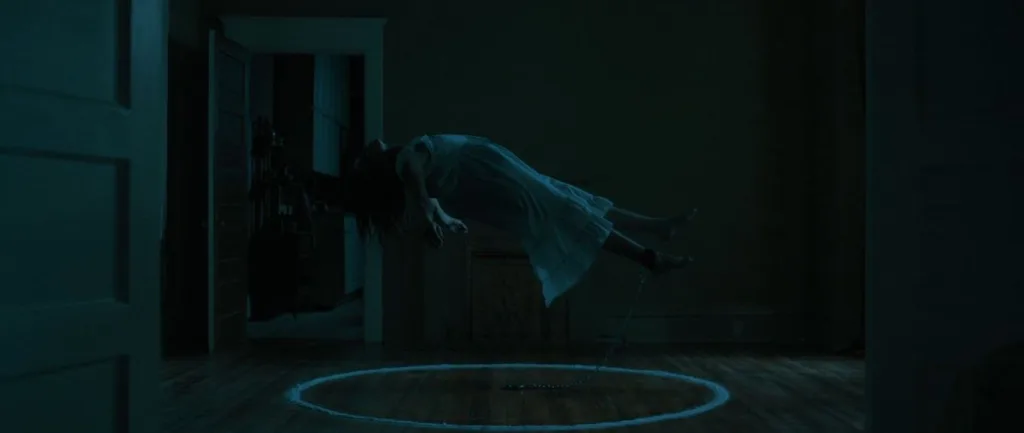
Cora agrees to provide a vessel and immediately tries to find a shortcut. She lures her ex-boyfriend Wyatt over, hoping the demon will take him instead. It’s a move straight out of the “Junkie Parent Survival Guide”. Unfortunately for Cora, the demon has standards. It grabs Wyatt, sniffs him like a piece of spoiled milk, and declares him “tainted and unclean”. Remember that whole “pure vessel” caveat we mentioned earlier?
Wyatt is an abusive redneck addict; he is the spiritual equivalent of a stale digestive biscuit when the demon wants a fresh-baked cookie. The demon kills Wyatt by using his head as a battering ram against Cora’s salt-protected door, but it refuses to accept his soul as payment for Noah.
Mesopotamian Demonology: The “Blackness”
The ritual in From Black draws on the concept of Pazuzu or Lamashtu – entities from Mesopotamian lore that were often blamed for the death of children and the suffering of mothers.
In this lore, demons aren’t just “evil”; they are elemental forces of chaos. The “blackness” Abel refers to is a literal spiritual infection.
By hosting the demon, the “vessel” acts as a bridge between the land of the living and the abyss. To get your child back, you aren’t resurrecting them from heaven; you are pulling them “from black” – the void where the entity resides. That’s where the title comes from.
Does Noah Die?
No, despite his horrifying murder at the hands of a creep, Noah is actually brought back to life.
In the present day at the police station, Cora realises she has no choice; the demon demands its payment. We see a dark pattern on the wall, indicating the entity is right there with her. In an unseen conversation, she makes her Faustian deal with the demon.

Allison, Cora’s cop sister, goes back to the house and finds Noah standing in the closet, wearing his single red shoe – a confirmation that he has been “bartered” back into existence. Here’s the big question, what deal did Cora make?
The “Most Likely” Ending: The Eternal Cycle
The most likely explanation is that Cora agreed to become the demon’s vessel. Just like Abel before her, she will now walk the earth carrying the “blackness”. She can’t be with Noah yet because that’s part of the deal. He is alive and well but she can’t see him.
She has to find another grieving, “pure” person to pass the demon to. She will likely have to start her own “therapy group” or hunt for a replacement, continuing the cycle that has lasted for millennia. She “saved” her son, but she has become the very thing she feared: a monster in a low cut top.
The Alternative Theory: The Allison Sacrifice
While the “Cycle” ending is the most probable, there is a much more interesting (and dark) theory. We know the vessel needs to be someone good, pure, and grieving. That describes Allison perfectly. Allison is a “righteous” person who has been obsessively grieving both her mother and her nephew Noah for years.
Cora might have agreed to let the demon take Allison as the new vessel. When Allison arrives at the house to find Noah, she is effectively walking into the same trap Wyatt did – except she is “clean” enough to be accepted.

Cora may have convinced herself this was an act of “mercy,” giving Allison the chance to see their mother again if she completes the ritual herself. It adds a layer of sibling betrayal that the movie desperately needed to feel high-stakes. It’s a lot more interesting, too.
Frequently Asked Questions
Is Noah really alive at the end of From Black?
Yes. The red shoe confirms that the boy found in the closet is indeed Noah, returned from the “black” through the demonic barter. However, he is essentially a product of an occult deal, leaving his true nature in question.
Why did the demon reject Wyatt?
The demon requires a “pure” or “righteous” vessel. Wyatt was an abusive addict and a “tainted” soul. In the movie’s occult logic, offering him to the demon was like offering a stale snack when the entity wanted a gourmet meal.
Did Abel get his daughter back?
Presumably, yes. Once Cora made her final deal with the demon at the police station, it would have completed Abel’s end of the ritual. He successfully passed the “vessel” status on, allowing him to finally see his daughter in Boston.
What is the “Blackness” in the movie?
The “Blackness” is the demonic essence that the vessel must carry. It represents a spiritual void or infection that acts as the price for bringing someone back from the dead.
Final Thoughts – A Dark Cycle of Grief
From Black ends on a note that suggests grief is a bit of a self-perpetuating monster. Cora “wins” in the sense that her son is breathing again, but she has lost her humanity to get there. It’s a silly ending for a movie with a 4.1 IMDb score, but it highlights the desperate lengths people will go to when they refuse to move on. Whether she’s carrying the demon herself or she sacrificed her sister, Cora is no longer the victim – she’s part of the ancient machine. Now wasn’t that movie a bit dull? Thanks for reading!
Looking for more? If you enjoyed this breakdown, check out our review of From Black or browse our Horror Movie Lists.
A Note on Ending Explanations
While we aim to provide comprehensive explanations based on the events on screen, film analysis is inherently subjective. The theories and conclusions presented in this "Ending Explained" feature are personal interpretations of the material and may differ from the director's original intent or your own understanding. That's the beauty of horror, right? Sometimes the scariest version is the one you build in your own head.
You might also like:
- Lake Mungo (2008) Review – A Haunting Masterclass in Grief and Mystery
- Last Straw (2024) review – A Grating Slasher With An Insufferable Protagonist
- The Welder (2021) Review – A Confused and Glacial Race-Themed Thriller
- Silent Night, Deadly Night (2025) review: A glossy but generic remake
- V/H/S/Halloween (2025) review – All tricks, very few treats
Disclaimer: Images, posters, and video stills used in this horror ending explained article are the property of their respective copyright holders. They are included here for the purposes of commentary, criticism, and review under fair use. Knockout Horror makes no claim of ownership and encourages readers to support the official release of all films discussed.