Apartment 1BR (2019) Ending Explained – The Community & The Twist
Movie Details: Director: David Marmor | Runtime: 1h 30m | Release Date: 2019 | Star Rating: 3.5/5 Stars
Welcome to Knockout Horror. I’ve just got done with our review of 1BR. The ending to this movie was fairly straightforward, but I thought I should put together a quick Ending Explained article for it anyway. I found it to be a pretty enjoyable film; it’s an easy watch, doesn’t drag its feet, and has an original plot, even if the ending leans a little on the predictable side. Let’s take a look.
⚠️ Warning: Major spoilers follow below.
The Ending in Brief
The TL;DR: Sarah breaks free from her conditioning when she is ordered to torture her friend Lisa. In a desperate struggle she kills the cult leaders, Jerry and Brian. She attempts to flee and is aided by her neighbour Lester. He shoots one of the attackers and then commits suicide to ensure Sarah can escape. Sarah makes it out of the complex only to discover that the cult owns the entire neighbourhood.
Who is watching them? Throughout the film characters reference a surveillance room and a higher power. The ending confirms that CDE Properties is a massive organisation. A centralised security hub likely monitors all the apartment blocks to ensure compliance and squash any rebellions.
What is the final twist? As Sarah runs down the street alarms begin to ring in neighbouring buildings. She sees the CDE logo on other gates and security cameras. The twist is that she has not just escaped a single haunted house; she is in a city where the cult is everywhere.
The Resolution: Sarah runs into the night. She is free from the apartment but is surrounded by enemies. The film ends on a note of paranoia as she realises the scale of the threat she is facing.
Good to Know: The CDE logo seen on the gates stands for Charles D. Ellerby. He is the founder of the cult and the author of the book “The Power of Community” which serves as the bible for the residents.
Table of Contents
1BR Ending Explained
No plot recap here, let’s get straight to business with the explanation. To understand the ending, we have to look at how Sarah (Nicole Brydon Bloom) was broken down. She moves into a complex that seems perfect, but after violating the “no pets” rule, she is tortured by the residents. This process (sleep deprivation, stress positions, and public humiliation) is textbook cult indoctrination but it leads to a place you might not expect.
Horror Context: Setting the Trap
Sarah arrives in Los Angeles looking for a fresh start and thinks she has found it at the Asilo Del Mar apartments. The rent is surprisingly cheap and the neighbours are incredibly welcoming. They throw a barbecue in her honour and seem like the perfect community.
There are some red flags from the start. Lester is a strange man with damaged glasses who stares at her. Sarah immediately pegs him as the one to watch out for. There are also strange banging noises in the pipes that keep her awake at night.
The tension builds when Sarah breaks the “no pets” rule. She sneaks a cat into her apartment and receives a threatening note under her door. This paranoia and sleep deprivation softens her up perfectly for the moment the cult finally strikes.
The Turning Point
Sarah initially succumbs to the brainwashing, finding comfort in the twisted “family” dynamic. After all, she was feeling pretty damn displaced after her big move. However, the cult brings in her old friend, Lisa, as a new, very unwilling, recruit. When Lisa rebels, the cult leaders, Jerry (Taylor Nichols) and Brian, order Sarah to torture Lisa to force compliance.
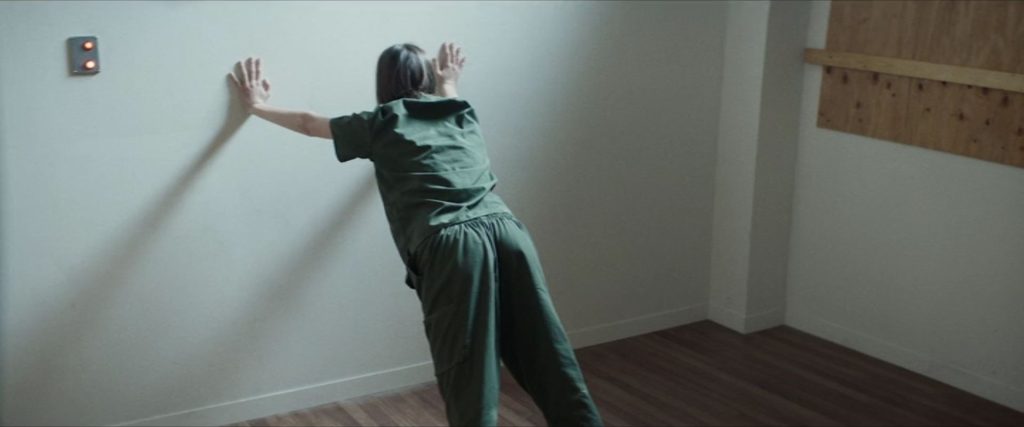
This snaps Sarah out of her trance. She refuses to hurt her friend. In the ensuing struggle, Sarah stabs Jerry in the neck with an ice pick. Tragically, Jerry shoots Lisa before dying. Enraged, Sarah kills Jerry and then Brian, retrieving the keys to the gate.
Thematic Spotlight: Cults and Corporate Control
1BR offers a chilling commentary on modern isolation and the predatory nature of cults. By setting the film in Los Angeles, a city known for transient populations and lonely dreamers, the film suggests that people are desperate for connection, making them easy prey for groups offering a “family”.
The use of the corporate logo (CDE) implies that this isn’t just a spiritual movement; it’s a business. The ending suggests a dystopian reality where cults operate like property management companies, industrialising the process of breaking human beings. It’s actually weirdly accurate, isn’t it?
Lester’s Sacrifice
As Sarah reaches the courtyard, the other residents corner her. She begs them to let her go, specifically appealing to Lester (Clayton Hoff), a fellow victim who has shown her kindness. The residents tackle Sarah, but Lester intervenes, shooting one of the attackers.

Sarah pleads with Lester to escape with her. Instead, Lester puts the gun to his chin and kills himself. This moment is pretty damn crucial: Lester knew he was too broken to survive in the outside world, but he used his final act of agency to ensure Sarah could be free.
Dissecting The Trope: The Misunderstood “Creep”
Horror cinema loves to play with our prejudices. The character of Lester is a classic example of the “Red Herring” trope. With his eyepatch and socially awkward demeanour he is initially presented as a potential threat. We assume he is the one Sarah needs to fear.
The film subverts this by revealing that the smiling and attractive neighbours are the true monsters. Lester is actually a victim who has been broken by the cult. His “creepy” behaviour is a symptom of his trauma rather than malice.
In the end he becomes Sarah’s only ally. This reversal challenges the audience to look past appearances. The person who looks like a villain is the only one capable of a heroic act of self-sacrifice.
The Final Twist
Sarah escapes the compound and runs onto the street. She pauses to catch her breath, only to notice something pretty terrifying. The apartment complex next door has a sign with the same logo – CDE Properties – as the one she just fled. There is also a security camera on the wall, identical to the one inside of her old apartment complex.

Suddenly, a siren blares from the neighboring building. Then another siren from further down the block. Then another. Sarah realises that The Community isn’t just one building; it’s an entire network. The cult has bought up real estate all over Los Angeles, turning the city into a hive of indoctrination centers. This isn’t an isolated case, at all. The entire city is corrupt.
Alternate Theory: The Domino Effect
An interesting (though less likely) interpretation of the final alarms is that Sarah inadvertently started a revolution. If the apartments are watching each other, perhaps residents in other buildings saw Sarah’s escape via surveillance feeds.
Seeing her fight back might have inspired others to rebel, causing alarms to trip across the city as multiple “Sarahs” decided to fight for their freedom simultaneously. While the “surveillance network” theory is more plausible, the idea of mass rebellion offers a glimmer of hope in a bleak ending. I think that’s going to be my personal head canon for this film.
Frequently Asked Questions
What does CDE stand for in 1BR?
CDE stands for Charles D. Ellerby. He is the founder of the cult and the author of the book “The Power of Community” which forms the basis of the rules and philosophy followed by the residents.
Why did Lester kill himself?
Lester had been broken by the cult for years and likely felt he could not function in normal society anymore. By killing himself he achieved the only freedom available to him while ensuring Sarah could escape without him becoming a burden.
Who was watching on the camera?
The film implies a centralised leadership or security team monitors all the CDE properties. When Sarah asks Brian “Who is watching?”, his fear suggests that even the leaders of individual buildings answer to a higher unseen power.
Does Sarah survive at the end?
Yes. Sarah physically escapes the apartment complex. However the ending leaves her situation precarious. She is alone in a city where her enemies are everywhere but she is armed with the knowledge of their existence and a newfound will to fight.
Final Thoughts
1BR is a solid thriller that punches above its weight. While the ending twist echoes The Invitation, it effectively reinforces the movie’s paranoia. The idea that your neighbors aren’t just nosy, but are part of a corporate-managed hive mind, is a truly frightening concept for anyone who has ever lived in an apartment complex.
Thank you very much for reading. Why not stick around? Check out some more Ending Explained articles. I also review horror movies and I also write horror lists.
A Note on Ending Explanations
While we aim to provide comprehensive explanations based on the events on screen, film analysis is inherently subjective. The theories and conclusions presented in this "Ending Explained" feature are personal interpretations of the material and may differ from the director's original intent or your own understanding. That's the beauty of horror, right? Sometimes the scariest version is the one you build in your own head.
You might also like:
- Exhibit A (2007) Ending Explained – Breaking Down The Grim Finale
- Shark Huntress (2021) Review – An Absurd and Incompetent Disaster
- Psycho (1960) Review – The Definitive Masterpiece Of Suspense
- Control Freak (2025) review – A dull, repetitive itch that never gets scratched
- Terror Eyes (2021) Review – A Cringey and Amateurish Found Footage Fumble
Support the Site Knockout Horror is a participant in the Amazon Services LLC Associates Program. Basically, if you click a link to rent or buy a movie, we may earn a tiny commission at no extra cost to you. As an Amazon Associate, I earn from qualifying purchases. This helps keep the lights on and the nightmares coming. Don't worry, we will never recommend a movie purely to generate clicks. If it's bad, we will tell you.
Disclaimer: Images, posters, and video stills used in this horror ending explained article are the property of their respective copyright holders. They are included here for the purposes of commentary, criticism, and review under fair use. Knockout Horror makes no claim of ownership and encourages readers to support the official release of all films discussed.