The Isle (2018) Ending Explained – Sirens & Spirits
Movie Details: Director: Matthew Butler-Hart | Runtime: 1h 36m | Release Date: 2018 | Star Rating: 2/5 Stars
Welcome to Knockout Horror. Today we are looking at The Isle. Strangely enough, I have noticed a lot of people searching for an explanation of this film’s ending. For me, it was one of my least liked horror movies in recent years, though it did provide some unintentional comedy. If you are interested in my full opinion, check out my review of The Isle. If you are just here for the explanation, read on. Needless to say, this article is heavy on spoilers.
⚠️ Warning: Major spoilers follow below.
The Ending in Brief
The TL;DR: The island is cursed by the vengeful spirit of a murdered girl named Lorna, who calls herself Persephone. She possesses the two surviving women, Lanthe and Korrigan, using them as Sirens to lure ships to their doom. In the finale, the women realise the only way to stop the slaughter is to destroy the vessels the spirit inhabits. They hold hands and jump off a cliff, sacrificing themselves to break the curse and allowing the last sailor, Oliver, to escape.
What was the monster? The antagonist is a ghostly entity born from the murder of Lorna. She manifests as “Persephone” (Queen of the Underworld) and possesses the living women to act as Sirens, using their song to crash ships on the rocks.
Why were they killing sailors? It was an act of blind revenge. Years prior, Lanthe’s brother William murdered Lorna when she rejected him. The older men on the island covered it up. Lorna’s spirit returned to punish all men, viewing them as evil, by luring them to the island to die.
The Resolution: Lanthe and Korrigan fight Persephone’s control long enough to realise that suicide is the only escape. By dying, they leave the spirit with no physical host. The mist clears, the song stops, and Oliver rows away to safety.
Good to Know: The older men, Fingal and Douglas, were complicit in the curse. By choosing to bury Lorna at sea to protect their sons rather than seeking justice, they essentially invited the haunting that eventually killed everyone on the island.
Table of Contents
The Isle Ending Explained
No plot recap here, let’s get straight to the explaining. I don’t want to relive that silliness anymore than you do. To understand the ending, we first need to look at the backstory revealed in the final act. The three shipwrecked sailors (Oliver, Ferris, and Bickley) are not the first to crash on this mysterious Scottish island. The islanders (Fingal, Douglas, Lanthe, and Korrigan) are actually harboring a dark secret rooted in some ancient folklore.
The Murder of Lorna
The root of the island’s secret lies in something that happened awhile before that we lean all about in a flashback. A young local woman named Lorna attended a dance and rejected the advances of William Innis (Lanthe’s brother). Embarrassed and angry, William followed her home and assaulted her.

Jacob (Korrigan’s brother) witnessed the assault but walked away instead of helping. In the struggle, William suffocated Lorna, killing her.
Instead of reporting the crime, the older men on the island, Fingal (James Cosmo) and Douglas, covered it up to protect their sons. They buried Lorna at sea and this act of injustice is what summoned the supernatural force. The scene where they find her body is so laughable. They barely look phased at all despite the horrifying nature of the scene. I hate when directors don’t actually direct their actors to emote.
Did You Know? Female Revenge in Horror
The “Woman Scorned” or “Rape-Revenge” trope is a staple of the horror genre, ranging from the gritty realism of I Spit on Your Grave to the supernatural retribution of The Grudge. These films often explore the transformation of a victim into a monster as a way to reclaim agency.
In The Isle, Lorna fits the archetype of the Monstrous Feminine. Her death was the result of male entitlement and violence (William’s assault) followed by patriarchal silence (Fingal and Douglas covering it up). Her return is not just about justice; it is about total annihilation.
However, the film complicates this by showing how revenge can become indiscriminate. Lorna doesn’t just kill her murderers; she enslaves other innocent women (Lanthe and Korrigan) to kill innocent men (the sailors), proving that unchecked trauma eventually turns the victim into the victimiser. It’s a strange conflation of sympathetic victim and merciless antagonist.
Persephone & The Sirens
Lorna returned as a vengeful spirit, identifying herself with Persephone, the Greek goddess of the underworld. She possessed the remaining young women on the island, Lanthe (Tori Butler-Hart) and Korrigan, turning them into Sirens.

Sirens are mythological creatures that lure sailors to their deaths with their song. Under Persephone’s control, Lanthe and Korrigan would go to the cliffs and sing, causing passing ships to crash on the rocks forcing the sailors onto the island where they had sex with them and then ate them, I guess. This explains why hundreds of sailors have died on the island’s shores over the years.
Folklore Focus: The Siren
Originating in Greek mythology, Sirens were dangerous creatures who lured nearby sailors with their enchanting music and singing to shipwreck on the rocky coast of their island. Most famously appearing in Homer’s The Odyssey, they were originally depicted as bird-women, though later folklore often conflated them with mermaids.
In The Isle, the film strips away the physical monster aspect but keeps the functional terror. Lanthe and Korrigan become human vessels for this mythology.
Controlled by the spirit of Lorna, they perform the exact function of the Siren: standing on the cliffs and singing a hypnotic song that disorients the crew of passing ships, forcing them to crash onto the rocks below so the spirit can claim their lives.
The Deaths of the Sailors
Throughout the film, the sailors are picked off one by one. Ferris is chased by a ghostly figure and dies. Bickley is murdered, seemingly by Lanthe (possessed by the spirit). This leaves only Oliver left, completely alone and isolated.

It is revealed that Lanthe and Korrigan previously tried to escape the island with Jacob, but Persephone possessed them and forced them to strangle Jacob to death. This trauma is why Korrigan is so unstable and blames Lanthe for the deaths.
Mythology Method: The Myth of Persephone
In Greek mythology, Persephone is the daughter of Zeus and Demeter. She was abducted by Hades and taken to the Underworld to become his queen. She embodies the duality of being both a spring maiden and the formidable Queen of the Dead.
In The Isle, the murdered girl Lorna adopts this persona. Like the mythological figure, Lorna was stolen from her life by a man (William) and cast into a dark grave (the sea). However, rather than remaining a victim, she returns as a ruler.
By calling herself Persephone, she takes on this exact same role, only in a much more restricted environment. Lorna asserts her dominance over the island’s dead. She is no longer the helpless girl who was murdered; she is the Queen of this specific underworld, controlling the living women and punishing the men who enter her domain.
The Final Sacrifice
In the climax, Oliver (Alex Hassell) attempts to escape in a small boat. He plugs his ears to block the siren song, but the plugs fail (or he removes them in a trance). He hears the song and prepares to jump into the sea to drown himself.
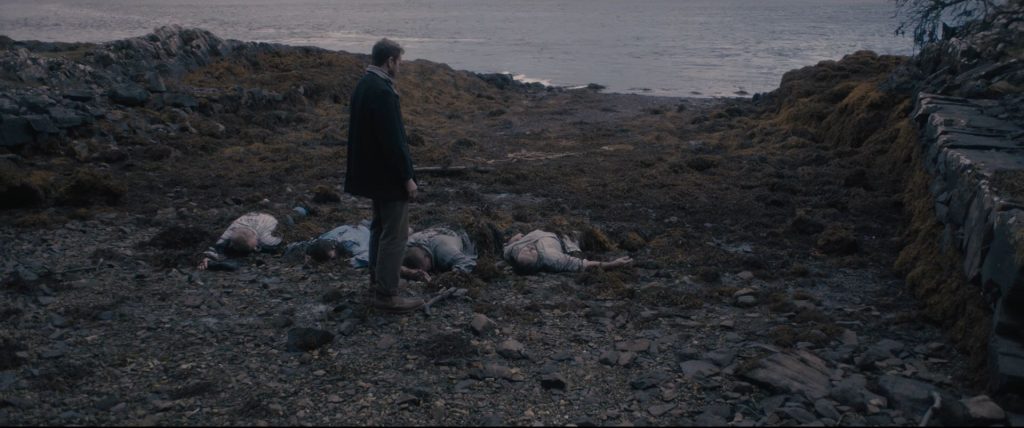
On the cliffs above, Lanthe and Korrigan fight Persephone’s control. They realise that as long as they are alive, the spirit will use them to kill innocent men. In a moment of clarity, they hold hands and jump off the cliff.
Their suicide destroys the physical vessels Persephone needs to operate; the spirit screams and vanishes. With the song broken, Oliver snaps out of his trance and rows away to safety, leaving the cursed island behind.
Did You Know? The Horror of Complicity
The true horror in The Isle isn’t just the ghost; it’s the conspiracy of silence that created her. When Fingal and Douglas choose to bury Lorna at sea rather than report her murder, they prioritise the reputation of their sons over justice for a victim.
This mirrors an actual reality often found in isolated, tight-knit patriarchal communities. Whether in small towns or closed social groups, there is a documented history of crimes against women being suppressed to protect “prominent young men” or maintain social cohesion.
The film critiques this “Old Boys’ Club” mentality. By showing that the fathers’ decision to silence a woman ultimately led to the destruction of their entire community, the story suggests that while human laws can be evaded by powerful men, the moral consequences of such complicity are inescapable. Unfortunately, there aren’t any bad-ass sirens to enact revenge in real life which is something of a shame, really. The world needs more sexy vengeful ghost ladies.
Frequently Asked Questions
Who killed Bickley in The Isle?
Bickley was murdered by Lanthe, though not of her own free will. She was possessed by the spirit of Lorna (Persephone) at the time. Korrigan blamed Lanthe because she knew that Lanthe was the vessel the spirit used to commit the violence.
Why did Lanthe and Korrigan kill themselves?
They realised that Persephone needed living vessels to act as Sirens. By jumping off the cliff, they destroyed the physical hosts the spirit relied on. This sacrifice broke the cycle of killing and stopped the siren song, saving Oliver.
What was the ghost in The Isle?
The entity haunting the island was the vengeful spirit of Lorna, a local girl murdered years earlier by Lanthe’s brother, William. She adopted the persona of Persephone, Queen of the Underworld, to exact revenge on all men.
Did Oliver survive at the end of The Isle?
Yes. Following the women’s suicide, the supernatural mist cleared and the siren song ceased. Oliver is shown rowing away from the island in the lifeboat, seemingly escaping the curse.
What happened to William Innis?
William, who murdered Lorna, was the first victim of her vengeful spirit. She killed him shortly after her return as Persephone. His death, along with Jacob’s, left only their fathers (Fingal and Douglas) alive on the island, forcing them to live with the consequences of the cover-up they orchestrated.
Final Thoughts
The Isle is a bit of a frustrating movie. It has a beautiful setting and a classic ghost story premise, but it is bogged down by slow pacing and some questionable acting. The ending, at least, offers a definitive conclusion to the mystery, even if the journey there is a bit of a slog.
Thanks for reading. If you enjoyed this article, why not stick around? I review horror movies and explain horror movie endings regularly.
A Note on Ending Explanations
While we aim to provide comprehensive explanations based on the events on screen, film analysis is inherently subjective. The theories and conclusions presented in this "Ending Explained" feature are personal interpretations of the material and may differ from the director's original intent or your own understanding. That's the beauty of horror, right? Sometimes the scariest version is the one you build in your own head.
You might also like:
- The Beldham (2024) review – A Visually Striking but Narratively Flawed Elevated Horror
- Evie (2023) Review – A Dreary And Disappointing British Horror
- In a Violent Nature (2024) Review – A Bold And Gory Slasher Reimagining
- Outpost (2023) review – Isolation horror that isn’t very isolated
- Exhibit A (2007) Ending Explained – Breaking Down The Grim Finale
Support the Site Knockout Horror is a participant in the Amazon Services LLC Associates Program. Basically, if you click a link to rent or buy a movie, we may earn a tiny commission at no extra cost to you. As an Amazon Associate, I earn from qualifying purchases. This helps keep the lights on and the nightmares coming. Don't worry, we will never recommend a movie purely to generate clicks. If it's bad, we will tell you.
Disclaimer: Images, posters, and video stills used in this horror ending explained article are the property of their respective copyright holders. They are included here for the purposes of commentary, criticism, and review under fair use. Knockout Horror makes no claim of ownership and encourages readers to support the official release of all films discussed.