Mandrake (2022) Ending Explained – Witchcraft & The Root
Movie Details: Director: Lynne Davison | Runtime: 1h 25m | Release Date: 2022 | Star Rating: 3/5 Stars
Welcome to Knockout Horror and our Ending Explained article for the Shudder original, Mandrake. Mandrake leaves much open to interpretation, requiring us to read between the lines. We are going to do exactly that so let’s get to it. If you haven’t watched the movie yet, give this article a miss for now. Check out our review of Mandrake first.
⚠️ Warning: Major spoilers follow below.
The Ending in Brief
The TL;DR: Mary Laidlaw is a witch who uses the legendary Mandrake root to heal herself and restore her fertility. She kidnaps her probation officer, Cathy, and forces her to dig up the deadly root. Mary succeeds in the ritual, kidnapping and murdering two children in the process, healing her own legs and Cathy’s infertility. However, Mary’s son Thomas is lynched by a mob before he can be cured of his life threatening diabetes. Mary escapes, and the film ends with Cathy realizing she is now psychically linked to the witch.
Why did Mary kill the kids? Mary needed innocent blood for the Mandrake ritual. She killed the two missing children to “feed” the root or empower the potion, which she then mixed with milk and the root’s sap.
What was Thomas doing? Thomas was the “Wandering Man” in disguise. He was helping his mother gather ingredients (children) and protect the Mandrake site. He desperately wanted the cure for his diabetes but died before he could get it.
The Final Vision: In the final scene, Cathy has a vision of Mary standing naked by a fire. This confirms Mary is still alive and implies that because Cathy drank the Mandrake sap, the two women are now permanently connected.
Good to Know: Mary force-feeding the sap to Cathy wasn’t just torture; it was a “gift”… By saying “I gave you back what was taken”, Mary confirms she restored Cathy’s ability to have children, creating a twisted bond of gratitude and horror between them.
Table of Contents
Mandrake Ending Explained
As always, we aren’t going to bore you with a plot recap. I am sure you just want quick answers and that’s exactly what I am going to give you. To understand the ending, we have to look at the lore the film establishes (somewhat loosely) regarding the titular plant.
What is a Mandrake?
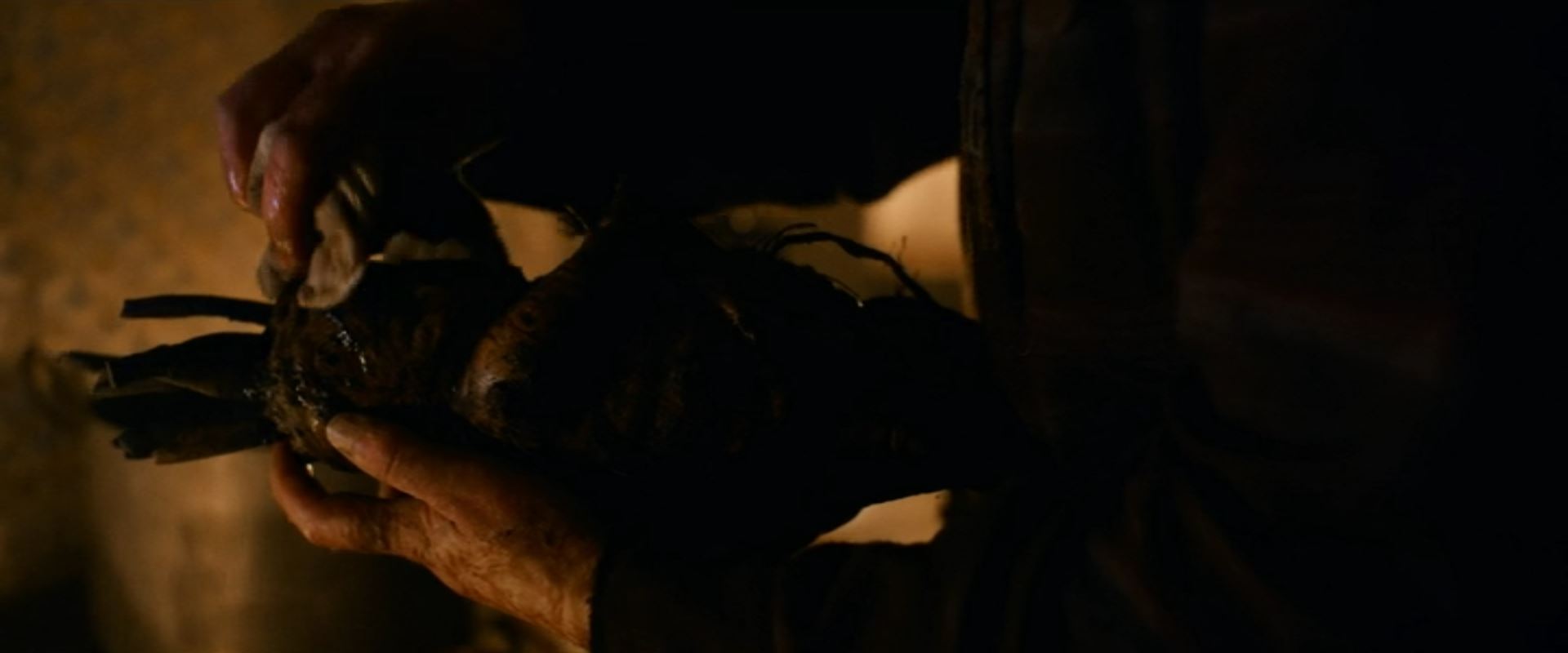
A mandrake (Mandragora) is a root historically associated with witchcraft and that’s exactly why it is so important in this film. It is a powerful hallucinogenic and is said to scream when dug up – a scream that kills anyone who hears it. In the film, Mary Laidlaw (Derbhle Crotty) seeks the root for its other legendary properties: healing and fertility.

She’s apparently a witch, after all, and she wants to do witch type things. The movie opens with a man, Shawn Duggan, dying while trying to dig up the root for Mary. This establishes that Mary needs someone strong enough to withstand the scream to get the root for her.
Folklore Focus: The Mandrake’s Scream
The Mandragora is one of the most famous plants in witchcraft folklore. Because its roots resemble a small human figure, it was believed to possess a spirit. The legend states that when the root is pulled from the earth, it emits a scream so piercing that it instantly kills anyone who hears it.
To avoid death, medieval lore suggested tying a starving dog to the plant and throwing a piece of meat just out of reach. The dog would pull the root out and die from the scream, sparing the witch. In the film, Mary subverts this by using humans instead of dogs.
She forces Cathy to dig it up because she needs a proxy to absorb the lethal risk. Mary survives the harvest only because Cathy acts as the “dog,” taking the brunt of the scream’s power – a test Mary believed Cathy could survive due to her inner strength and shared trauma of “barrenness.”
Why Does Mary Need the Mandrake?
Mary was imprisoned for killing her husband. She killed him with an axe in revenge for setting her on fire when he discovered she was having an affair. The fire left her legs badly scarred and damaged.



As a result of her imprisonment, she couldn’t raise her son who went into foster care. Now reunited after her release, her son, Thomas, suffers from a condition (likely severe diabetes, we see him using a finger prick test kit and jabbing himself) that requires constant blood sugar testing.
Mary wants the Mandrake to:
- Heal her scarred legs
- Cure Thomas.
She also seems obsessed with fertility, perhaps wanting to replace the years she lost in prison by having another child or simply restoring her womanhood.
Why Does Mary Kidnap Cathy?
Mary kidnaps Cathy because she believes that she has the strength to dig up the Mandrake root and survive the scream. Something that will prove to be true.

Cathy (Deirdre Mullins) is Mary’s probation officer. Cathy is struggling with her own trauma: she is estranged from her son Luke and is unable to have more children due to medical complications. Mary, claiming to be able to read people, senses this “barrenness” in Cathy.
Mary kidnaps Cathy because she believes Cathy possesses the strength (or perhaps the desperation) to survive the Mandrake’s scream. She forces Cathy to dig up the root and Cathy actually survives the ordeal, proving Mary right.
Did You Know? Why Cathy Survived
Mary didn’t choose Cathy at random. The film’s opening scene shows a strong man, Shawn Duggan, dying instantly while trying to harvest the root, proving that physical strength isn’t enough to survive the scream.
Mary claims to “see” people, and she recognised a specific darkness in Cathy: the trauma of infertility and the pain of being separated from her son. In Mary’s twisted worldview, this pain acted as a shield, hardening Cathy’s spirit.
Mary believed that only a woman who has known the specific grief of “losing” a child possesses the mental fortitude to withstand the Mandrake’s lethal cry. Cathy survived not because she was lucky, but because she was already broken in the same way Mary was.
The Ritual & What Happened to The Children
Mary has already kidnapped and killed two local children for use in her ritual but why? The film implies she needs the blood of two truly innocent and pure humans. Children were the obvious choice, here. We see her preparing a mixture that includes blood, milk, and the sap from the Mandrake root.
Mary consumes the mixture and her legs are instantly healed – she no longer needs her cane. She then force-feeds the mixture to Cathy. The next morning, Cathy’s leg injury is healed, and Mary implies that Cathy’s fertility has also been restored (“I gave you back what was taken”).
The Fate of Thomas
Thomas is lynched in the woods by the townspeople who are seeking justice for the murdered children.

Before Thomas can take his share of the cure, the jar is smashed during a struggle between Mary and Cathy. Desperate to perform the ritual again, Thomas (dressed as the “Wandering Man”) goes to kidnap another child – Cathy’s son, Luke.
Cathy intercepts Thomas and saves Luke before he can be taken. A mob of angry locals, seeking justice for the murdered children, catches Thomas and lynches him in the woods. Mary watches her son die, powerless to intervene.
Thematic Spotlight: The Theme of Monstrous Motherhood
At its core, Mandrake is a film about the terrifying lengths a mother will go to for her child. Mary Laidlaw is a villain, but her motivation is tragic: she is killing other children solely to cure her own son’s diabetes and suffering.
The film positions Mary as a dark mirror to Cathy. Both are mothers separated from their sons by the legal system, and both are defined by their fertility (or lack thereof). Mary recognises this shared trauma, which is why she chooses Cathy for the ritual.
The ending cements this duality. By drinking the potion, Cathy accepts a gift from the “monster”, implying that the primal force of motherhood operates beyond good and evil. Mary restores Cathy’s ability to be a mother, but the price was the blood of innocents, linking the two women forever.
The Final Scene Explained
In the end, Cathy is back with Luke. She visits Grace, her ex-husband’s new wife, who has just had a baby. While holding the baby, Cathy suddenly enters a trance-like state. She sees Mary standing naked before a fire in the woods.
This vision signifies that Mary is still alive and seemingly powerful. More importantly, it suggests a permanent psychic bond between Cathy and Mary. By consuming the Mandrake sap, Cathy has been initiated into Mary’s world. She is healed, she is fertile, but she is now connected to the witch forever.
Frequently Asked Questions
Was Mary actually a witch?
Yes. The film strongly implies Mary has supernatural abilities. She reads Cathy’s history without being told, bewitches Cathy’s boss Bill (causing him to kill Jason and then himself), and successfully performs a magic ritual that heals physical injuries instantly.
Who was the Wandering Man?
The “Wandering Man” seen in the woods was Thomas, Mary’s son, wearing a folk costume. He acted as Mary’s enforcer, protecting the Mandrake patch and kidnapping children for her rituals. This “wandering man” costume is also a nod to the man Mary had an affair with.
Did Cathy get her fertility back?
It is heavily implied that she did. Mary tells her, “I gave you back what was taken”, referring to Cathy’s ability to have children. The healing of Cathy’s leg wound serves as proof that the potion worked.
Why did the dad (Jason) die?
Jason was killed by his colleague Bill. Bill appeared to be under a spell cast by Mary; he acted in a trance, killing Jason to protect Mary’s escape, and then committed suicide on Mary’s command.
Final Thoughts
Mandrake is a messy film that requires a lot of legwork from the viewer. The lack of exposition makes it atmospheric but really damn confusing. With that being said, the core story – a mother willing to do anything (including murder) to heal herself and her son – is a dark, compelling twist on folk horror tropes.
Thanks for reading. If you enjoyed this article, why not stick around? I review horror movies and explain horror movie endings regularly.
A Note on Ending Explanations
While we aim to provide comprehensive explanations based on the events on screen, film analysis is inherently subjective. The theories and conclusions presented in this "Ending Explained" feature are personal interpretations of the material and may differ from the director's original intent or your own understanding. That's the beauty of horror, right? Sometimes the scariest version is the one you build in your own head.
You might also like:
- Heart Eyes (2025) review – Romantic-horror comedy done right
- 28 Days Later (2002) Review – Groundbreaking, Immensely Important, So Why The Middling Score?
- Unseen (2023) Ending Explained – Hotline Twist & Who Survives
- Remember Member (2022) Review – A Boring and Corny J-horror Slasher
- Thanksgiving (2023) review – Eli Roth delivers a blood-soaked holiday treat
Disclaimer: Images, posters, and video stills used in this horror ending explained article are the property of their respective copyright holders. They are included here for the purposes of commentary, criticism, and review under fair use. Knockout Horror makes no claim of ownership and encourages readers to support the official release of all films discussed.