Black Christmas (1974) Review – The Masterful Progenitor of the Slasher Genre
Black Christmas: Quick Verdict
The Verdict: A chillingly effective and historically significant masterpiece that stands as one of the most influential entries in horror history. Black Christmas eschews the gratuitous gore of its successors in favour of a slow-burning dread anchored by a sophisticated script and exceptional performances. Bob Clark’s use of first-person perspective for the killer “Billy” creates an intrusive sense of voyeurism that remains deeply unsettling today. Unlike the tropes that later defined the genre, the characters are written with genuine depth, particularly Olivia Hussey’s Jess. The film’s ability to find terror within the domestic space is handled with surgical precision. This 4.5 star classic is essential viewing not just as a “proto-slasher,” but because it remains a genuinely frightening and atmospheric thriller. It is a bleak, sharp, and unforgettable holiday nightmare that has never been topped by its remakes.
Details: Director: Bob Clark | Cast: Olivia Hussey, Margot Kidder, John Saxon, Marian Waldman | Runtime: 1h 38m | Release Date: 1974
Best for: Fans of atmospheric 70s horror, slasher historians, and those who prefer psychological tension over body counts.
Worth noting: Originally titled Stop Me, this film directly inspired John Carpenter’s Halloween after Bob Clark discussed potential sequel ideas with him.
Where to Watch: Shudder, Amazon🛒, Peacock
Rating: 4.5/5 Stars
(A pioneering slasher masterpiece that masterfully blends domestic dread with social commentary and remains one of the most terrifying holiday movies ever made.)
Welcome to Knockout Horror. Today we are reviewing Bob Clark’s Black Christmas from 1974.
Table of Contents
A festive horror classic
The story follows a house full of sorority sisters being stalked by an unknown assailant. After weeks of disturbing phone calls, things begin to get really serious after a murder occurs in the local area and one of the girls goes missing. Little do the women realise, the killer may be much closer than they think.
Written by Roy Moore, Black Christmas is a progenitor of the slasher genre and one of the most notable horror movies to take place, largely, inside the confines of one house. The sorority house that the movie is set in seems, initially, to be quite large. A big open plan living space, a large attic, many bedrooms and bathrooms. It seems spacious and accommodating. As the girls suddenly fall victim to an unknown killer however, the walls begin to close in. It suddenly feels much smaller and much less safe.
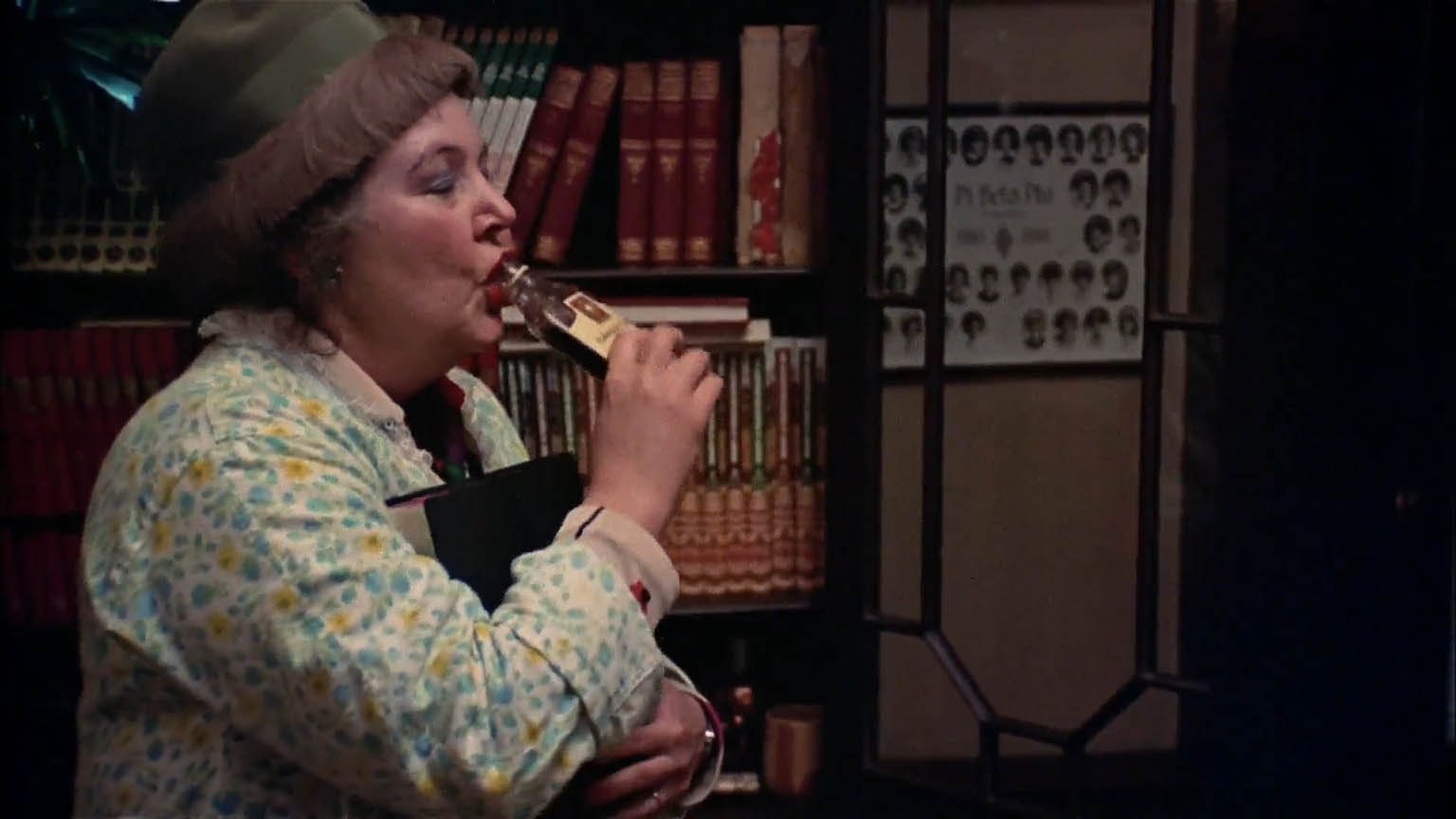
The fact that someone could be killing people in their home is terrifying. This is the place that people are supposed to feel the most safe. The women should be secure inside their home but they are not. This creates a palpable sense of tension. While the viewer is fully aware of what is happening, the women are totally oblivious. It is a fascinating dichotomy and works perfectly.
“Black Christmas is a progenitor of the slasher genre and one of the most notable horror movies to take place inside the confines of one house. As the girls fall victim to an unknown killer, the walls begin to close in.”
Black Christmas feels quite different to other slashers. It is tremendously self contained and, chronologically, very tight. Murders have taken place outside of the sorority house. The women are aware of this and groups of people are searching the streets. They are told to stay in and lock the doors and windows. Little do they know that they are trapping themselves in with the killer. It’s incredibly suspenseful stuff and tense throughout.
The original proto-slasher
Written with the urban legend of The Babysitter and The Man Upstairs in mind, Black Christmas was a slasher movie before slasher movies really existed. The entire genre owes a lot to the way Clark set the formula. The Texas Chainsaw Massacre preceded Black Christmas by a few months but it didn’t read like a standard slasher. While not being the first, Black Christmas was, perhaps, the most influential.

Indeed, it was this movie that inspired the themes found in Halloween four years later. Halloween was considered as the benchmark for Slasher horror which really solidifies this film as one of the genre’s most important progenitors. It is no surprise that the Golden Age of Slashers was only a short while later.
It did things different
The thing that makes Black Christmas stand out is how different it feels from a modern eye. It’s slow and brooding. It doesn’t indulge in violence and gore but still manages to be shocking. It almost plays out like a supernatural horror movie. Our antagonist moves around the house at will and is seemingly omnipresent. Nobody is safe and nowhere is safe. That leads to a constant sense of unease and tension. Whenever a character leaves the frame, they may never return.
It almost doesn’t feel like a slasher thanks to many of these traits. Modern slashers don’t play out like this. They are never this restrained. Clark was acutely aware that some of the fear should come from letting the viewer’s mind imagine how a character was murdered. It’s gloriously low key in that respect and feels unique even to this day. It also presented its cast of characters differently, as well.
“Halloween was considered as the benchmark for Slasher horror which really solidifies this film as one of the genre’s most important progenitors. It is no surprise the Golden Age followed shortly after.”
Featuring a complicated lead protagonist, this movie would buck the trends that would follow in genre films for decades after. It did not present us with a virginal young woman among a group of sexually active people. Jess is a complex character; she is pregnant but does not wish to keep the baby. She is calm and assured about her decision as well as being fiercely brave when it comes to protecting those she loves.
It offers up studies of feminism, abortion rights, and alcohol abuse. This was a movie that aspired to more than it may initially seem. The fact that subsequent slashers quickly devolved into tropes is disappointing. The genre left behind its socially aware trappings almost instantly.
Slow and tense
Black Christmas is not a movie for someone seeking brutal kills and lots of blood. Black Christmas aims to unsettle the viewer. It doesn’t relish in its murders and doesn’t feature much action or a fast pace. In this respect, it is something of an anti-slasher. Naturally, some of the scenes are quite disturbing. The visuals on display, in parts, are extremely macabre. One shot, in particular, was extremely shocking and controversial for the time.

Later slasher movies would adopt a different approach to Black Christmas. The desire to unsettle the viewer took a back seat to creative kills. The villains were now the most developed characters, almost designed with merchandise in mind. They wore masks, had iconic weaponry, and were instantly recognisable.
The killer crouching in the shadows was pushed to the side. This new group of bad guys confronted victims up close. Always visible, even when hidden in the shadows. They were larger than life and almost the entire focus of the movie. Black Christmas takes a completely different approach. This is a slow paced horror movie that wants to bake the viewer in suspense.
A divisive ending
The ending of Black Christmas is bound to split viewers’ opinions. It is one of those movies that could be described as leaving a bit of a question mark. While it is made fairly clear what happened, the lack of a satisfying resolution will likely put some people off. The film goes out of its way to throw in some red herrings.
The interesting thing here is that the red herrings are for the characters, not the viewer. We see the film from the killer’s perspective in many scenes. We know what is going on. The women in the house, however, do not. The police have a suspect and said suspect has something of a motive to harm Jess, at least. This plays into the ending of the film.
“Most of the kills take place off screen. It is a slasher, yes, but it is a slasher designed to make the viewer fear for the victims. Clark doesn’t indulge in the characters’ murders. It is never gratuitous.”
Black Christmas stays true to its desire to unnerve and unsettle, even in the end. This is never a movie aiming to entertain with guts and blood. Most of the kills take place off screen. It is a slasher, yes, but it is a slasher designed to make the viewer fear for the victims. Clark doesn’t indulge in the characters’ murders. It is never gratuitous. Expecting a gratuitous ending may have been wishful thinking. Still, that is just the type of movie this is. If you enjoy seeing lots of action and a lot of kills, Black Christmas may not be for you. For other horror fans, however, it is essential viewing.
Excellent acting
This was a fantastic cast at the time and there isn’t a single weak link in the movie. Our main protagonist, Jess, is played by Olivia Hussey. She does a great job as the glue that connects everything together, managing to display a dynamic range of emotions. Her part in the movie’s final stanza is particularly powerful.
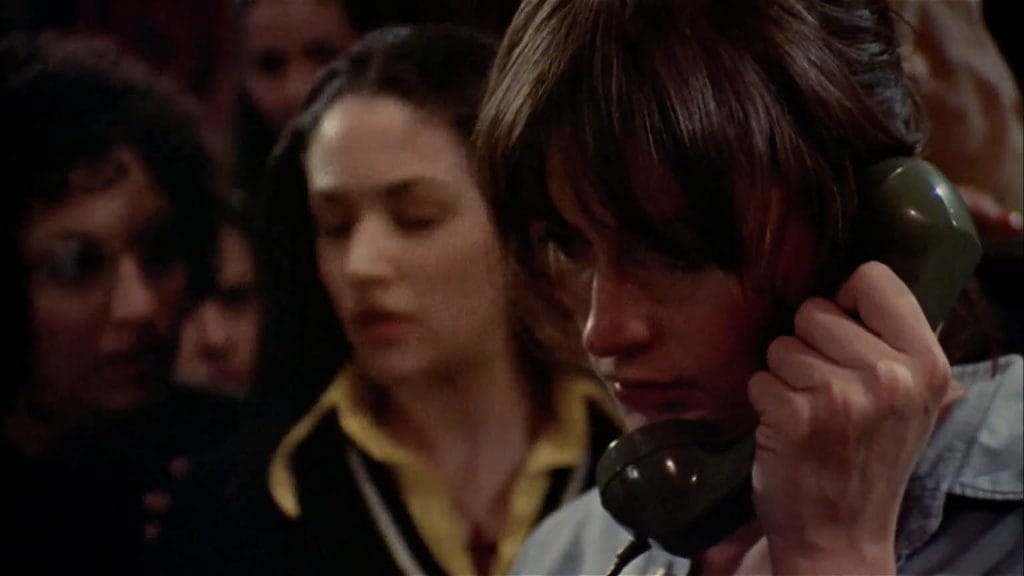
Special mention goes to her reaction to the classic Black Christmas revelation. Margot Kidder is brilliant as the sharp witted drunkard Barb. Her tipsy mocking of the policeman at the station is absolutely hilarious. Not to mention her side splitting line regarding the Moaner. It’s just The Tabernacle Mormon Choir making their annual obscene phone call. Horror gold!
Marian Waldman, as Mrs. Mac, might be the star of the show. Although quite a small part, her quiet disdain for the girls in the house is hilarious. Mrs. Mac is an alcoholic and has bottles sequestered in various parts of the house. Her moments stealthily retrieving these are always comical. We can’t forget her referring to Claude the cat as a “little prick”. It might be one of my favourite horror movie lines of all time.
Andrea Martin is great as the level headed Phyl. She also shares decent chemistry with Olivia Hussey. The late John Saxon, as Lt. Fuller, is excellent. His role is somewhat understated but really helps to add weight to later scenes. All in all, it is a great cast and they do a bang up job.
The Good, The Bad & The Ugly
The Good
- Sublime Atmosphere: The film builds a suffocating sense of dread by utilising the large house as a trap, making every shadow feel dangerous.
- Exceptional Cast: From Margot Kidder’s hilarious Barb to Olivia Hussey’s determined Jess, the performances are far superior to standard slasher fare.
- Innovative Direction: Bob Clark’s use of the “killer’s POV” and the disturbing audio of the phone calls changed the visual language of horror forever.
The Bad
- Glacial Pace: Those raised on modern, fast-paced slashers may find the deliberate, slow-burn investigative scenes a little testing for their patience.
- Divisive Resolution: The lack of a neat, “Hollywood” ending where the killer is unmasked and caught will likely frustrate some viewers seeking closure.
- Technical Age: While the film looks great, some of the 70s lighting and audio limitations are occasionally apparent to the modern eye.
The Ugly: The Attic Revelation. The recurring visual of the first victim in the attic is a macabre and lingering image that remains one of the most shocking in the genre.
Should You Watch Black Christmas?
Yes, absolutely. It is a 4.5 star film that is required viewing for any horror enthusiast. Whether you are interested in its historical importance as a proto-slasher or simply want a genuinely creepy movie for a cold winter night, Black Christmas delivers on all fronts. It is a sophisticated, scary, and expertly crafted piece of cinema that has stood the test of time better than almost any of its contemporaries.
You might also like:
- The Hand That Rocks The Cradle (2025) Ending Explained: Who Is Polly?
- Season’s Bleedings: 14 Goriest Christmas Horror Movies of All Time (Updated 2025)
- Dead Hot: Season of the Witch (2023) Review – A Cringe-Inducing Vanity Project
- Trick ‘r Treat (2007) Review – The Ultimate Cinematic Ode To Halloween
- Fun in the Sun – 15 Best Summer Horror Movies Ranked
Our Scoring Philosophy: A Fair Fight
Horror is a genre that thrives thanks to indie film makers and low budget creators. At Knockout Horror, we firmly believe that every movie that we review deserves a fair fight. That's why we grade on a curve. Our star ratings are all about context, judging a film on what it achieves with the resources it has.
A 4-star rating for a scrappy indie horror made for $10,000 is a testament to its ingenuity and raw power. A 4-star rating for a $100 million blockbuster means it delivered on its epic promises. We don't compare them side-by-side; we celebrate success in every weight class, from the back-alley brawler to the heavyweight champion. Please keep this in mind when considering star ratings.
Support the Site Knockout Horror is a participant in the Amazon Services LLC Associates Program. Basically, if you click a link to rent or buy a movie, we may earn a tiny commission at no extra cost to you. As an Amazon Associate, I earn from qualifying purchases. This helps keep the lights on and the nightmares coming. Don't worry, we will never recommend a movie purely to generate clicks. If it's bad, we will tell you.
Disclaimer: Images, posters, and video stills used in this review are the property of their respective copyright holders. They are included here for the purposes of commentary, criticism, and review under fair use. Knockout Horror makes no claim of ownership and encourages readers to support the official release of all films discussed.